The Woman Who Rose from a Shell
A goddess arrives on shore, fully grown, riding a scallop shell across a painted sea. No one had dared paint her like this in a thousand years.
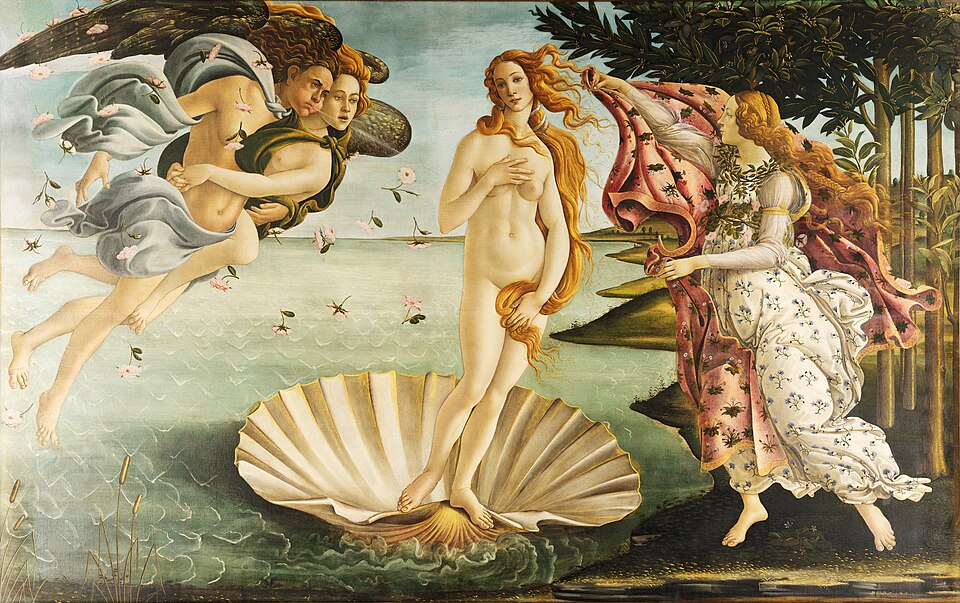
Sometime in the mid-1480s, in a Florence dazzled by wealth and classical revival, Sandro Botticelli set two pieces of canvas together, coated them with a blue-tinted gesso ground, and began the work that would become one of the most recognizable images in the world: The Birth of Venus. It hangs today in the Uffizi Gallery, inseparable in art history from Botticelli's other great mythological canvas, the Primavera, though the two were never conceived as a pair.
The scene it shows is not, technically, a birth at all. Venus has already emerged from the sea fully grown — a figure the Greeks called Venus Anadyomene, 'she who rises from the water.' What Botticelli paints is the moment after: her arrival on land, carried on an oversized scallop shell, its scale pure invention, echoing ancient depictions of the same myth.
At the left, the wind god Zephyrus blows her toward shore, his breath rendered as radiating lines from his mouth. He carries a second winged figure, blowing more gently — likely Aura, personification of a lighter breeze, though some scholars identify her as Chloris, a flower nymph. Roses, edged in gold, tumble through the air with them.
On the right, a woman who seems to hover just above the ground extends a flower-patterned cloak toward Venus, ready to cover her the instant she steps ashore. She is one of the Horae, minor goddesses of the seasons, her floral dress suggesting spring. Some see her as Flora, though the transformation Ovid describes elsewhere — Chloris becoming Flora — isn't clearly depicted here.
Such a large, prominent nude female figure had virtually no precedent in Western painting since antiquity, and this alone made the work startling. Venus's pose borrows the hand placement of the ancient Venus Pudica sculptures, yet her body — long-necked, softly curved, standing off-center — owes as much to Gothic rhythm as to classical form. Art historian Kenneth Clark observed that her differences from ancient sculpture were not physiological but rhythmic: her whole body follows the curve of a Gothic ivory, lacking the grounded stability antiquity prized.
More from Art

The Painting With No Foreground
A single robed figure stares out at an empty grey sea — and the emptiness itself became a scandal. When it was unveiled in Berlin in 1810, no one knew quite what to do with it.

The Painter Who Chased the Light
For a few purple minutes each evening, an American exile knelt in an English garden and raced the dying sun to paint two little girls lighting lanterns. It took him two years to finish.

When a President Became a God
Look straight up inside the U.S. Capitol dome and you will find George Washington enthroned among the clouds, surrounded by goddesses — the founding father transformed into myth.

Marble Brought Back to Life
A corpse asleep, a wing barely brushing her skin — and marble somehow learns to breathe. This is the moment Antonio Canova dared to carve.

The World Turned Upside Down
Look closely at a sixteenth-century Flemish village and you'll find a man biting a pillar, another carrying daylight in a basket, and a wife slipping a blue cloak over her husband's shoulders. Every gesture is a joke — if you know the language.

The Girl in the Glass Case
She stood two-thirds life size, dressed in a real tutu and human hair — and the critics who saw her in 1881 recoiled as if she were something obscene.