The Woman Who Wore Scandal Like a Dress
He asked to paint her, not the other way around — a bold gamble that turned into the most notorious portrait of the age. One dropped strap would nearly ruin them both.
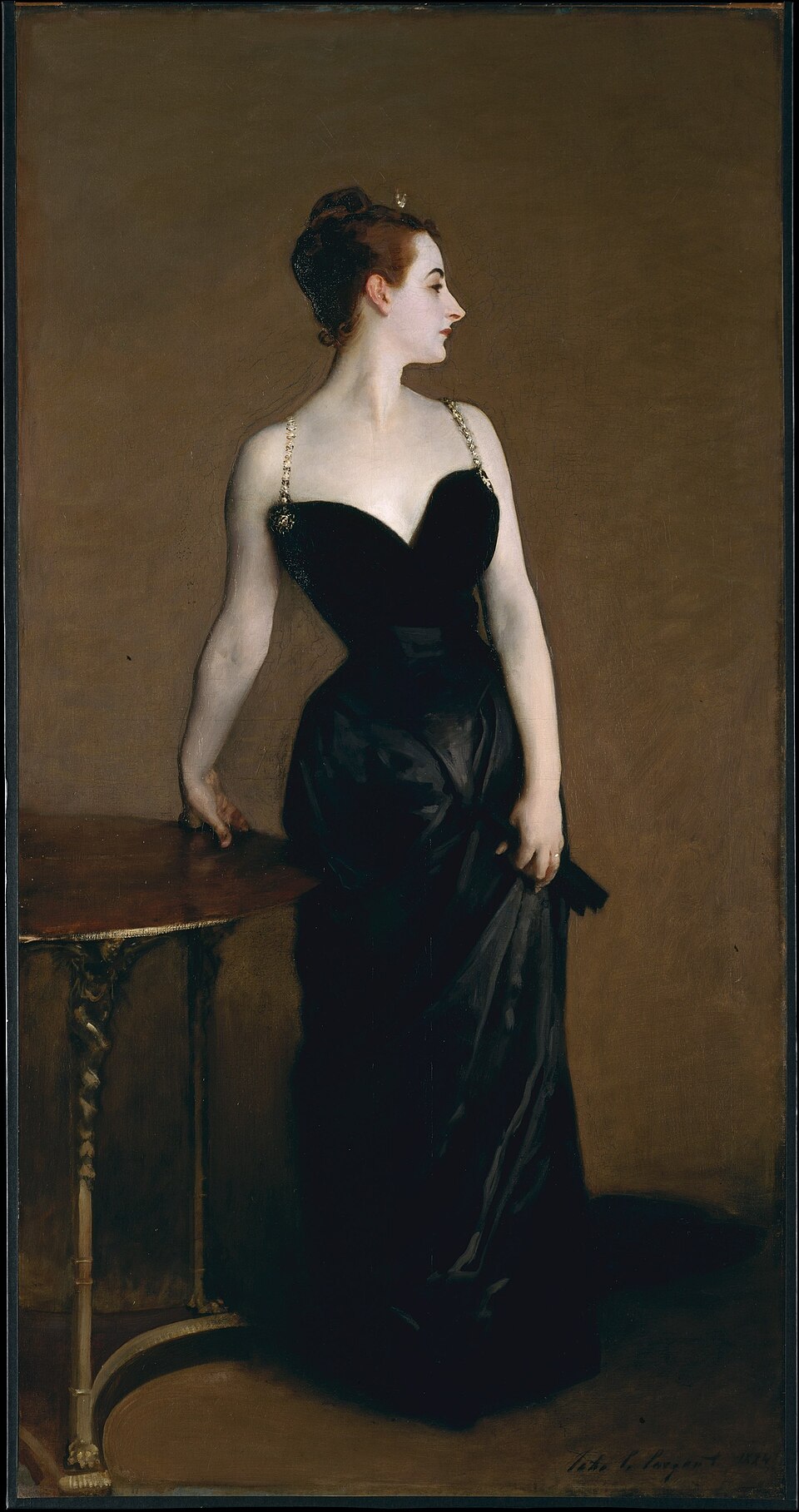
Virginie Amélie Avegno Gautreau was not born to Parisian aristocracy, but she conquered it anyway. An American Creole from New Orleans, she had emigrated to Paris and married Pierre Gautreau, a French banker twice her age. In the salons of the 1880s she became known as a 'professional beauty,' a woman whose face and figure were currency, whose lavender powder and pale skin made her the object of obsessive fascination. The painter Edward Simmons admitted he 'could not stop stalking her as one does a deer.'
John Singer Sargent was equally captivated. Unlike most portraits of the era, this one was not commissioned — Sargent pursued Gautreau himself, writing to a mutual friend that he had 'a great desire to paint her portrait' and hoped she was 'waiting for someone to propose this homage to her beauty.' Gautreau, who had turned down other painters, said yes in February 1883. Both were expatriates in French society, and their collaboration seems to have been driven by a shared hunger for status.
Progress was slow from the start. Through the winter of 1883, Gautreau was too absorbed in social engagements to sit still for the discipline a portrait required. At her suggestion, Sargent traveled to her family estate in Brittany in June, where he filled notebooks with roughly thirty preparatory drawings, watercolors, and oil studies, trying pose after pose. One surviving sketch, Madame Gautreau Drinking a Toast, captures her in profile against a dark background, loosely brushed and informal — a hint of what was to come.
Even in the countryside, Gautreau remained restless, distracted by her four-year-old daughter, her mother, houseguests, and a full staff. Sargent grumbled about 'the unpaintable beauty and hopeless laziness of Madame Gautreau.' Yet he pressed on, eventually arriving at a pose entirely different from his earlier studies: her body turned toward the viewer, her head twisted away in profile, her right arm extended behind her to rest on a low table. The strain in her neck and arm sharpened the elegance of her silhouette.
Sargent mixed a palette of lead white, rose madder, vermilion, viridian, and bone black to capture the strange paleness of her skin. He wasn't always satisfied — at one point he dashed a rose-toned wash over a gloomy background, deciding the change let her tall, slender figure show 'to much greater advantage.' Letters from that autumn trace his shifting mood, from delight in 'the sunshine of my beautiful model's countenance' to a kind of wistful fatigue as the summer at her estate, Les Chênes, came to an end.
More from Art

The Painting With No Foreground
A single robed figure stares out at an empty grey sea — and the emptiness itself became a scandal. When it was unveiled in Berlin in 1810, no one knew quite what to do with it.

The Painter Who Chased the Light
For a few purple minutes each evening, an American exile knelt in an English garden and raced the dying sun to paint two little girls lighting lanterns. It took him two years to finish.

When a President Became a God
Look straight up inside the U.S. Capitol dome and you will find George Washington enthroned among the clouds, surrounded by goddesses — the founding father transformed into myth.

Marble Brought Back to Life
A corpse asleep, a wing barely brushing her skin — and marble somehow learns to breathe. This is the moment Antonio Canova dared to carve.

The World Turned Upside Down
Look closely at a sixteenth-century Flemish village and you'll find a man biting a pillar, another carrying daylight in a basket, and a wife slipping a blue cloak over her husband's shoulders. Every gesture is a joke — if you know the language.

The Girl in the Glass Case
She stood two-thirds life size, dressed in a real tutu and human hair — and the critics who saw her in 1881 recoiled as if she were something obscene.