The Woman Who Would Not Look Up
One glove still on, a cup of coffee going cold, and a window that swallows the whole city into black glass — Edward Hopper built a masterpiece out of what a woman refuses to show us.
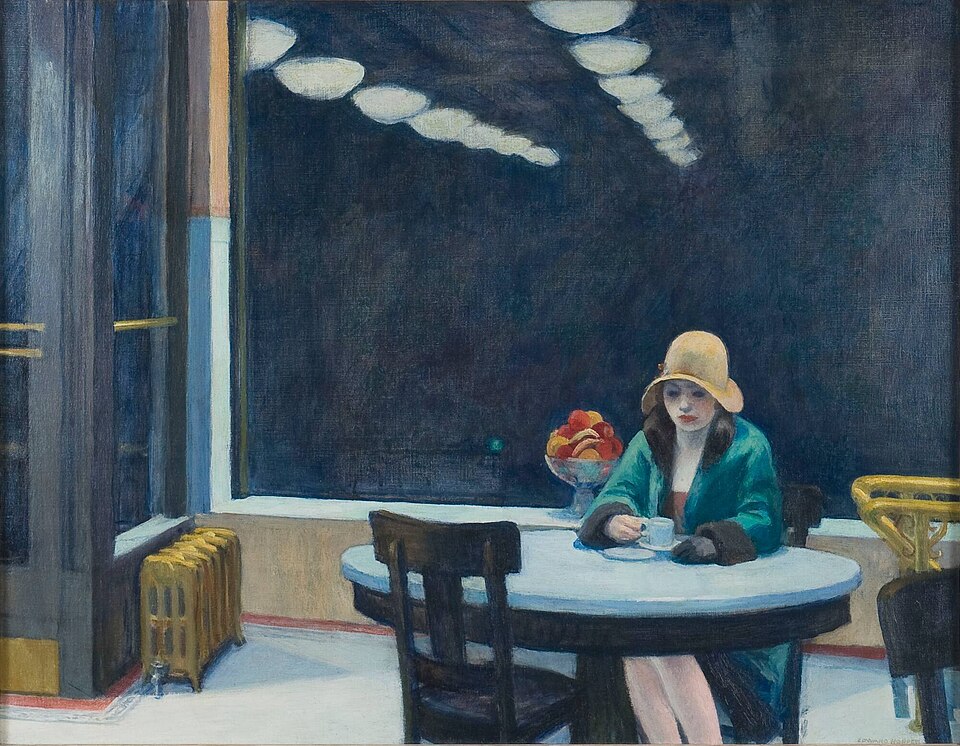
On Valentine's Day 1927, at the opening of Edward Hopper's second solo show at the Rehn Galleries in New York City, a new painting went on view: a woman alone at a marble table, staring down into a cup of coffee. By April it had been sold for $1,200 — worth over $22,000 today. It now hangs at the Des Moines Art Center in Iowa, still holding its silence nearly a century later.
The woman was modeled on Hopper's own wife, Jo, though he reshaped her for the canvas. Jo was 44 in 1927, full-figured and curvy; Hopper made the painted woman younger, and one critic later called her figure 'boyish' — flat-chested, slight. It is Jo's likeness, but not quite Jo.
Everything about the woman is deliberately unresolved. She is well dressed, her makeup careful — she could be heading to a job that demands appearances, or coming from one, or on her way to some social evening. She has removed only one glove, a detail that might mean distraction, haste, or simply that she has just come in from the cold. But a small empty plate on the table suggests otherwise: she has likely already eaten a snack here, and has been sitting for a while.
Her warm clothing places the season in late autumn or winter, but the hour remains impossible to pin down — winter days are short, so this could be dusk, a rendezvous point before an evening with a friend; or the dead of night, after a shift; or the gray edge of dawn before one begins. Whatever the hour, the restaurant is nearly empty, and the street outside shows no sign of life at all. This emptiness is what gave the painting its lasting association with urban loneliness. One critic wrote that 'the woman's eyes are downcast and her thoughts turned inward'; another said she gazes at her coffee cup 'as if it were the last thing in the world she could hold on to.' In 1995, Time magazine put Automat on its cover for a story about stress and depression across the 20th century. Critic Ivo Kranzfelder compared the subject matter of the painting — a young woman nursing a drink alone in a restaurant — to Édouard Manet's The Plum and Edgar Degas's L'Absinthe.
A chairback juts into the painting's lower right corner, implying that we, the viewers, are seated nearby — close enough to watch a stranger without her permission. Hopper made the woman's legs the brightest part of the canvas, a choice one critic says turns her into 'an object of desire' and the viewer into a 'voyeur.' It reads mildly today, but in 1927 the public display of a woman's legs was still a fairly new sight.
More from Art

The Painting With No Foreground
A single robed figure stares out at an empty grey sea — and the emptiness itself became a scandal. When it was unveiled in Berlin in 1810, no one knew quite what to do with it.

The Painter Who Chased the Light
For a few purple minutes each evening, an American exile knelt in an English garden and raced the dying sun to paint two little girls lighting lanterns. It took him two years to finish.

When a President Became a God
Look straight up inside the U.S. Capitol dome and you will find George Washington enthroned among the clouds, surrounded by goddesses — the founding father transformed into myth.

Marble Brought Back to Life
A corpse asleep, a wing barely brushing her skin — and marble somehow learns to breathe. This is the moment Antonio Canova dared to carve.

The World Turned Upside Down
Look closely at a sixteenth-century Flemish village and you'll find a man biting a pillar, another carrying daylight in a basket, and a wife slipping a blue cloak over her husband's shoulders. Every gesture is a joke — if you know the language.

The Girl in the Glass Case
She stood two-thirds life size, dressed in a real tutu and human hair — and the critics who saw her in 1881 recoiled as if she were something obscene.