The Woman with the Red Halo
A half-naked woman floats in darkness, ringed by a border of writhing sperm and a shrunken fetus — and art historians still argue over whether she is the Virgin Mary or a vampire.
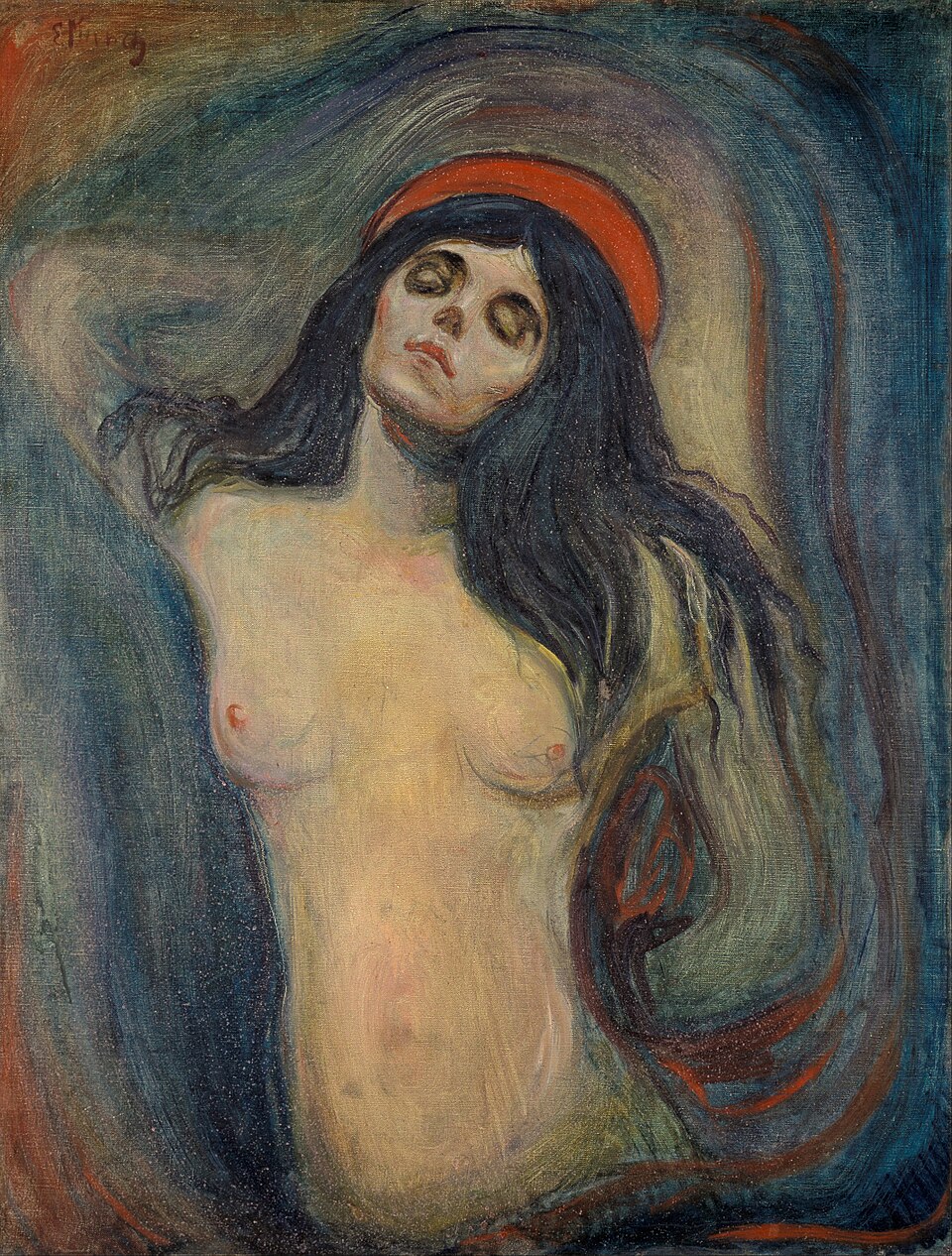
Between 1892 and 1895, Edvard Munch painted a bare-breasted woman in half-length, her eyes closed, her body twisting away from an unseen light even as her face turns toward it. He called the composition Madonna, though he also used the title Loving Woman, and Munch was no devout Christian nor known for religious subjects. The model was his friend Dagny Juel-Przybyszewska, and the painting may have been less an act of devotion than of worship — an emphasis on what he saw as her beauty and perfection as an ideal of womanhood.
The usual golden halo of the Virgin is gone, replaced by a red one, which art historian Sigrun Rafter of the Oslo National Gallery reads as a symbol of the duality of love and pain. She argues Munch meant to depict the woman in the act of intercourse, seen from the viewpoint of the man making love to her, with sanctity and sensuality fused into a single image. Even so, Rafter notes, the pose retains echoes of the Annunciation: the quiet, calm confidence, the closed eyes of modesty, the light falling from above.
Other critics have read her very differently. Werner Hofmann called the painting a strange devotional image glorifying decadent love, one that turns the cult of the strong woman into something monumental and demonic. Robert Melville saw 'ecstasy and pain in the act of love.' Feminist critic Carol Duncan described the figure as a femme fatale whose surrendering gestures — arm behind the head, arm behind the back as if bound — subtly check the overpowering force she otherwise represents. Critic Peter Day went further, calling her a potentially vampiric figure, her sensuality shot through with imagery of death and corruption, the male desire around her literally transfigured into the undulating sperm bordering the canvas.
That border is one of the composition's strangest features. The lithographic print version of Madonna carries a decorative frame of wriggling sperm, with a fetus-like figure curled in the bottom left corner. The 1893 painted version originally had a frame with similar decoration, but it was later removed and lost, surviving now only in the prints, of which several different versions exist.
Scientific study of the Munch Museum's version identified the specific pigments Munch used: chrome yellow, Prussian blue, yellow ochre, charcoal black, artificial ultramarine, and vermilion. The version now in the National Museum of Norway held its own secrets. Infrared reflectography carried out by conservator Thierry Ford and photographer Børre Høstland revealed an underdrawing beneath the surface, showing that Munch had originally posed the subject with her arms hanging down, like a conventional portrait, before reworking her into the twisting figure known today. The presence of this underdrawing suggests the National Museum's canvas may be the very first version Munch painted.
More from Art

The Painting With No Foreground
A single robed figure stares out at an empty grey sea — and the emptiness itself became a scandal. When it was unveiled in Berlin in 1810, no one knew quite what to do with it.

The Painter Who Chased the Light
For a few purple minutes each evening, an American exile knelt in an English garden and raced the dying sun to paint two little girls lighting lanterns. It took him two years to finish.

When a President Became a God
Look straight up inside the U.S. Capitol dome and you will find George Washington enthroned among the clouds, surrounded by goddesses — the founding father transformed into myth.

Marble Brought Back to Life
A corpse asleep, a wing barely brushing her skin — and marble somehow learns to breathe. This is the moment Antonio Canova dared to carve.

The World Turned Upside Down
Look closely at a sixteenth-century Flemish village and you'll find a man biting a pillar, another carrying daylight in a basket, and a wife slipping a blue cloak over her husband's shoulders. Every gesture is a joke — if you know the language.

The Girl in the Glass Case
She stood two-thirds life size, dressed in a real tutu and human hair — and the critics who saw her in 1881 recoiled as if she were something obscene.