The Wooden Face Twice as Old as the Pyramids
Buried in a Siberian peat bog for eleven and a half millennia, a carved larch pole outlived stone, bronze, and every empire that followed it — and nobody quite agrees on what its faces mean.
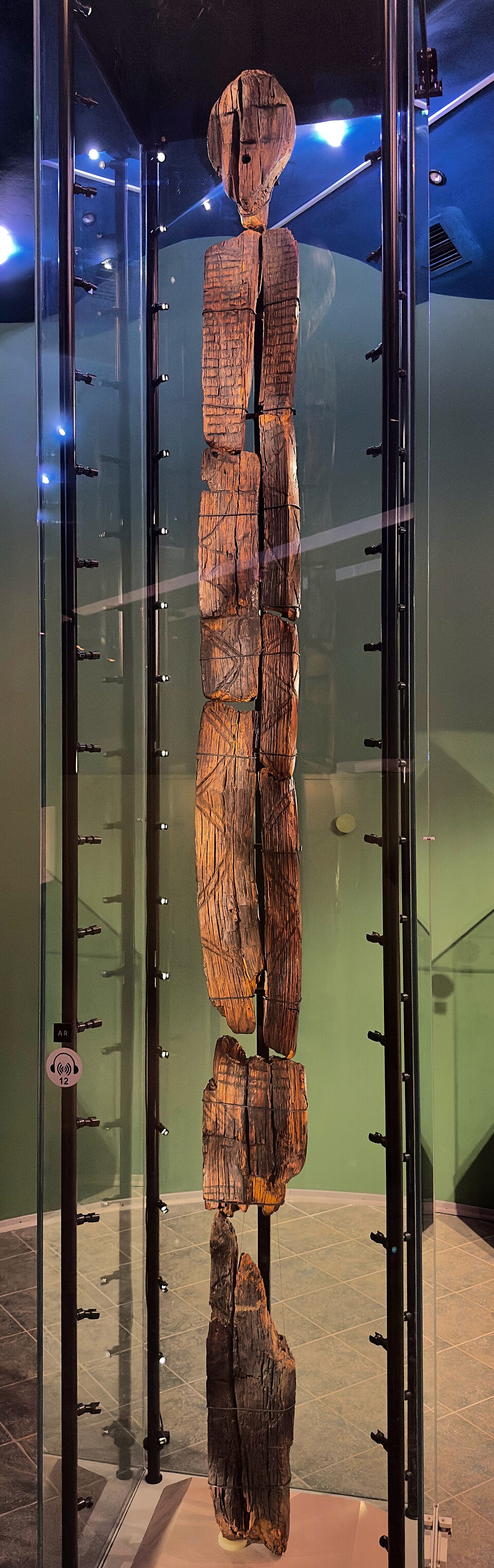
On January 24, 1890, workers digging through the Shigir peat bog on the eastern slope of the Middle Urals, near the village of Kalata, roughly 100 kilometers from Yekaterinburg, pulled up something no one expected: fragments of carved wood buried four meters deep. The area had already yielded prehistoric finds forty years earlier, when an open-cast gold mine turned up ancient objects, but nothing prepared researchers for what emerged this time.
The wood had come apart into ten pieces. Professor D. I. Lobanov reassembled the main fragments into a sculpture standing 2.8 meters tall. In 1914, archaeologist Vladimir Tolmachev revisited the puzzle, incorporating leftover fragments that Lobanov had not used, and proposed that the original figure once stood 5.3 meters high. Some of those extra pieces have since been lost, so today only Tolmachev's drawings preserve their record.
For decades the true age of the object was contested. Initial radiocarbon testing by G. I. Zajtseva at the Institute of the History for the Material Culture in Saint Petersburg, later confirmed by Moscow's Geological Institute, put the sculpture at around 9,500 years old. In the 1990s many scholars doubted this figure, assuming hunter-gatherers of that era simply lacked the skill to make and decorate something so large. A subsequent German analysis pushed the age even further back, to roughly 11,500 years — making it the oldest known wooden sculpture in the world. A decorated antler found nearby, dated to the same period, lent support to that estimate.
In 2021, researchers from the University of Göttingen and the Institute of Archaeology of the Russian Academy of Sciences published new AMS dating results in Quaternary International, placing the idol near the start of the Holocene, about 10,000 years ago. Whatever the precise number, it remains the oldest known monumental wooden sculpture on Earth, its geometric zigzags and simple lines consistent with Late Glacial and Early Mesolithic art found across Eurasia.
The sculpture itself was carved from larch, a tree that, counting its annual rings, had lived at least 159 years before it was felled. Stone tools cut the markings into its flat, rectangular body. At the top sits a head with eyes, a nose, and a mouth; horizontal lines across the chest may represent ribs, while chevron patterns cover much of the rest, and several additional faces appear at intervals down its length, giving the whole piece the look of a totem pole.
More from Archaeology

The Bronze Disc That Rewrote the Sky
Two looters with a metal detector dug up something illegal, invisible in value, and older than Stonehenge's final stones — a map of the heavens buried for over three thousand years.

The Faceless Women of the Ice Age
Long before writing, before cities, before the wheel, someone carved a woman's body into stone and ivory — and left no name, no face, no explanation.

The Pebble That Might Be Human
A palm-sized stone found on a Moroccan riverbank may be humanity's oldest attempt to see itself — or simply a trick of erosion.

The Crown That Vanished: Deshret and the Red Land
A crown worn by kings for three thousand years has never once been found in a tomb — not one. So where did it go?

The Face That Traveled Between Empires
A farm worker's shovel struck stone in 1897 and unearthed a face so striking it would be sold to France, seized as war booty, and finally traded back for a Velázquez.

The Boy in the Dark Tunnel
A schoolboy fell into black water inside an ancient tunnel and surfaced with his fingers brushing letters no one had noticed for 2,600 years.