The Yellow House and the Flowers That Wouldn't Die
He painted them wilting, blazing, and reborn in yellow — a bouquet meant to lure a friend into staying. It nearly worked, and it outlasted everyone involved.
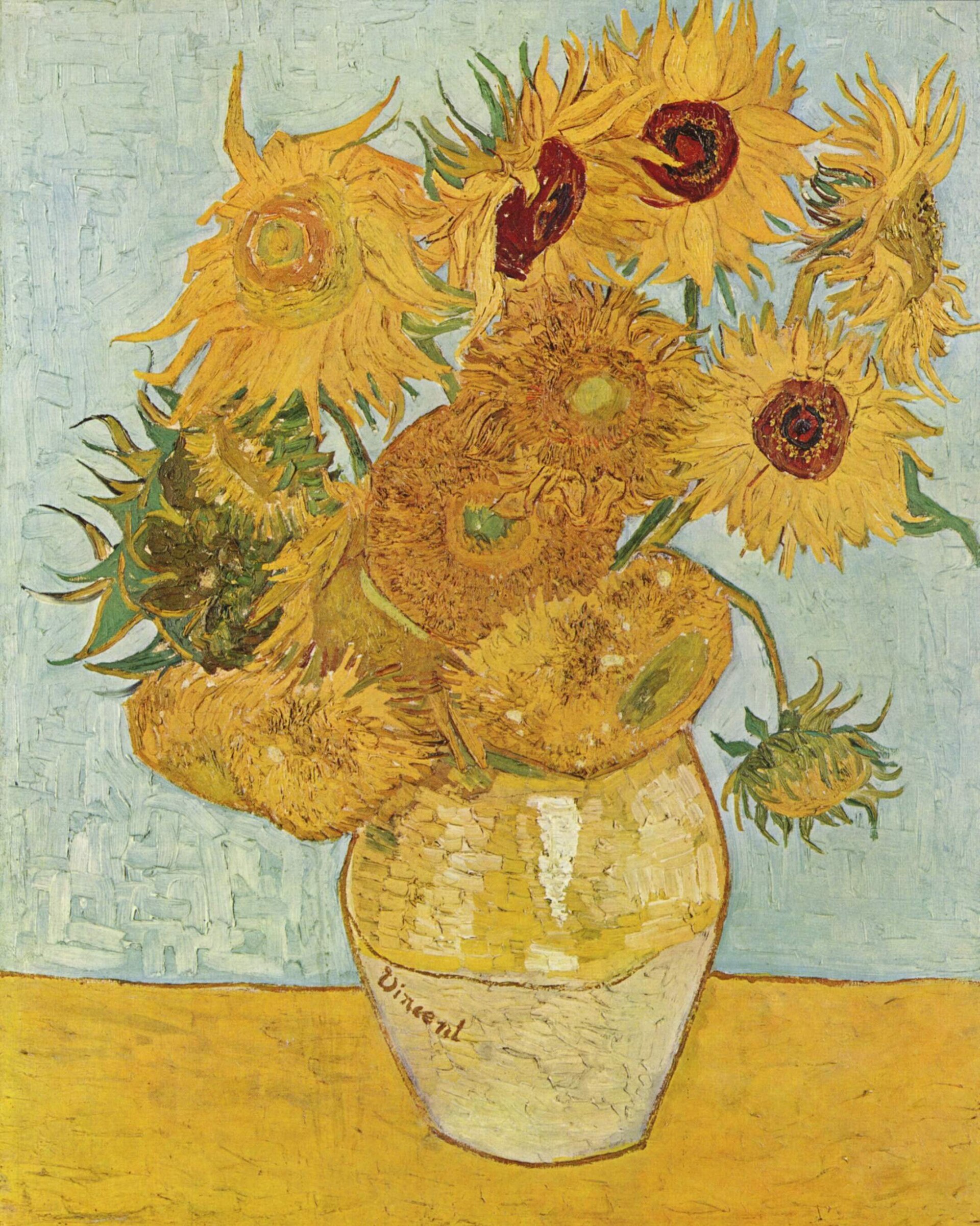
Little is known of what Vincent van Gogh did during the two years he lived quietly with his brother Theo in Paris, from 1886 to 1888. It was only in the spring of 1889 that the world learned he had painted sunflowers at all — a small series made in 1887, showing the flowers lying on the ground, cut and spent. Paul Gauguin, who had briefly lived and worked alongside Vincent, acquired two of these Paris canvases.
That spring, Gauguin tried to claim one of Vincent's newer Arles sunflower paintings in exchange for some studies he had left behind. Vincent refused, indignant, writing to Theo that Gauguin had 'absolutely no right' to make such a request — he already had two Paris sunflowers, and that should be enough. The exchange never happened as Gauguin wished; Vincent kept what he considered his.
The real transformation came in Arles in August 1888. In a letter to Theo dated 21 or 22 August 1888, Vincent described painting 'with the gusto of a Marseillais eating bouillabaisse' when it came to large sunflowers. He was working on three canvases at once, driven by a specific hope: that he and Gauguin might soon share a studio, and he wanted 'nothing but large sunflowers' to decorate it — a painted welcome for a friend he badly wanted to keep close.
The versions from that August don't perfectly match Vincent's own descriptions of them. Canvas sizes differ from what he claimed, and the flower counts creep upward — fifteen or sixteen blooms where he'd said a dozen or fourteen. Some of these changes were made wet-in-wet, genuine revisions rather than later tampering, and they carried through when Vincent repainted repetitions of the fourth version in January 1889.
Those January repetitions no longer exist quite as he left them. The Amsterdam version gained a wooden strip at the top, likely added by Vincent himself. The Tokyo version was later enlarged on all sides with extra canvas strips, probably by its first owner, Émile Schuffenecker. In the 2000s, doubts briefly surfaced about that painting's authenticity — some wondered if Schuffenecker or even Gauguin had a hand in it — but most experts still consider it genuine Van Gogh.
More from Art

The Painting With No Foreground
A single robed figure stares out at an empty grey sea — and the emptiness itself became a scandal. When it was unveiled in Berlin in 1810, no one knew quite what to do with it.

The Painter Who Chased the Light
For a few purple minutes each evening, an American exile knelt in an English garden and raced the dying sun to paint two little girls lighting lanterns. It took him two years to finish.

When a President Became a God
Look straight up inside the U.S. Capitol dome and you will find George Washington enthroned among the clouds, surrounded by goddesses — the founding father transformed into myth.

Marble Brought Back to Life
A corpse asleep, a wing barely brushing her skin — and marble somehow learns to breathe. This is the moment Antonio Canova dared to carve.

The World Turned Upside Down
Look closely at a sixteenth-century Flemish village and you'll find a man biting a pillar, another carrying daylight in a basket, and a wife slipping a blue cloak over her husband's shoulders. Every gesture is a joke — if you know the language.

The Girl in the Glass Case
She stood two-thirds life size, dressed in a real tutu and human hair — and the critics who saw her in 1881 recoiled as if she were something obscene.