The Younger Sitter: Inside the Mystery of the Isleworth Mona Lisa
A woman with the same enigmatic gaze as the Louvre's masterpiece — but decades younger. Is she Leonardo's first draft, or someone else's careful echo?
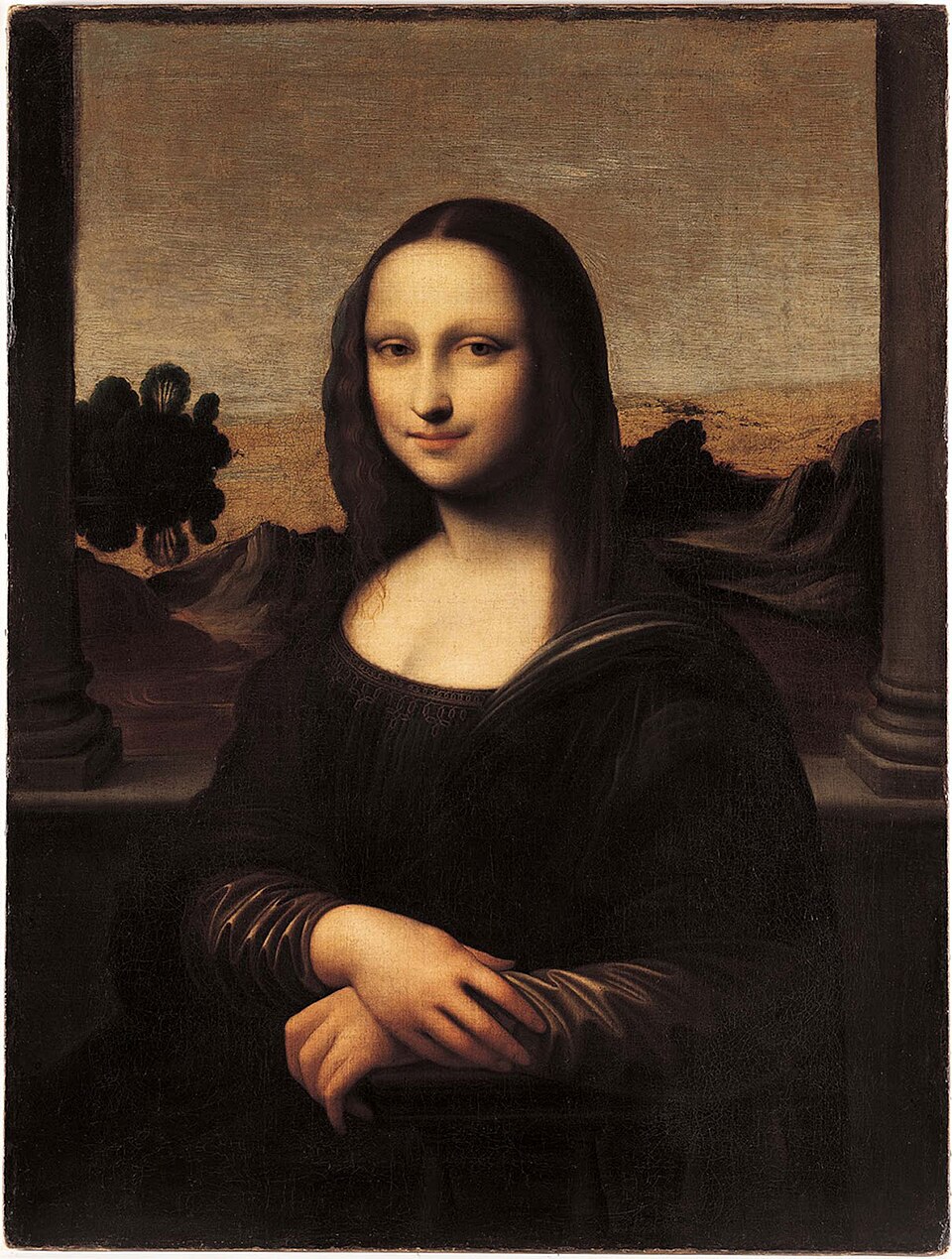
In 1913, an English connoisseur named Hugh Blaker acquired an oil painting that had, by most accounts, been hanging quietly in Montacute House for over a century. It depicted a dark-haired woman seated at an angle against a distant landscape — unmistakably the same subject as Leonardo da Vinci's Mona Lisa in the Louvre. But something was different. The woman looked younger, flanked by columns absent from the Paris original, and rendered not on wood panel but on canvas. Blaker's studio happened to be in Isleworth, West London, and so the painting acquired its lasting nickname: the Isleworth Mona Lisa.
The canvas itself tells a quiet story of craftsmanship. Woven from hand-spun linen in a simple tabby pattern, with about eighteen threads per square centimeter in the warp and sixteen in the weft, it bears the slight irregularities of centuries-old textile work — the warp pulled tighter than the weft, a subtle deformation typical of the era. At 84.5 by 64.5 centimeters, it is modestly larger than its Louvre counterpart, and its muted, golden tonality struck early reviewers as consistent with other works attributed to Leonardo.
The first wave of public scrutiny arrived in 1914, when art critic Paul George Konody weighed in. He was frustrated by sloppy early reporting that had, in his view, curdled reasonable skepticism into 'hostile incredulity.' Yet even Konody, cutting through the noise, concluded that the painting was 'very largely worked up by the master himself,' and found its features 'far more pleasing and beautiful than in the Louvre version.' He observed simply that the head was 'inclined at a different angle' than in the Paris panel.
Other early observers pressed further into the painting's particulars. One unnamed reviewer noted that the head was tilted more forward and that the hair parting fell precisely at the center, whereas in the Louvre picture, he wrote, it began at the middle of the forehead and ran back at an 'impossible and incorrect angle.' Another described the Isleworth figure's higher forehead, slightly wider face, and eyes set further apart than those in the Louvre panel. In the early 1920s, the Italian scholar Adolfo Venturi reportedly praised 'the beauty of the eye drawing' and considered the eyes and the line of the mouth to be Leonardo's own principal contribution. A number of Italian experts in that decade echoed Konody's assessment, at a moment when the canvas was being more widely examined by connoisseurs.
Science eventually entered the debate. Physicist John F. Asmus, who had pioneered laser-restoration techniques for Renaissance art and had previously examined the Louvre Mona Lisa itself, ran a computer image-processing study in 1988. His conclusion: the brushstrokes forming the face in the Isleworth painting were made by the same hand responsible for the Louvre face. He noted that the head appeared tilted forward with a shorter-seeming neck, at a steeper angle than the Paris version, and repeated his findings in a follow-up study in 2016. An independent 2015 academic article, working from stylistic grounds alone, reached a similar attribution to Leonardo.
More from Art

The Painting With No Foreground
A single robed figure stares out at an empty grey sea — and the emptiness itself became a scandal. When it was unveiled in Berlin in 1810, no one knew quite what to do with it.

The Painter Who Chased the Light
For a few purple minutes each evening, an American exile knelt in an English garden and raced the dying sun to paint two little girls lighting lanterns. It took him two years to finish.

When a President Became a God
Look straight up inside the U.S. Capitol dome and you will find George Washington enthroned among the clouds, surrounded by goddesses — the founding father transformed into myth.

Marble Brought Back to Life
A corpse asleep, a wing barely brushing her skin — and marble somehow learns to breathe. This is the moment Antonio Canova dared to carve.

The World Turned Upside Down
Look closely at a sixteenth-century Flemish village and you'll find a man biting a pillar, another carrying daylight in a basket, and a wife slipping a blue cloak over her husband's shoulders. Every gesture is a joke — if you know the language.

The Girl in the Glass Case
She stood two-thirds life size, dressed in a real tutu and human hair — and the critics who saw her in 1881 recoiled as if she were something obscene.