The Zero Point: How a Black Square Broke Painting
For a week he could not sleep, eat, or drink — because he had just painted nothing at all, and called it the future.
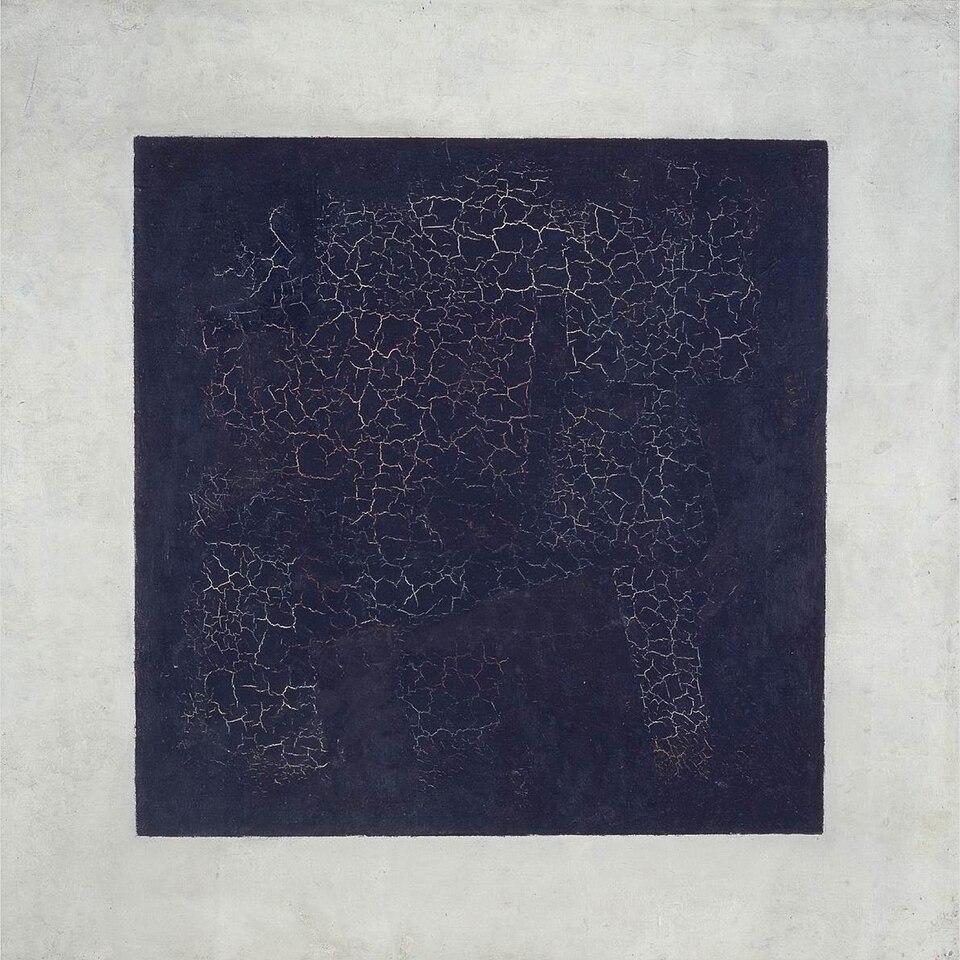
In December 1913, on the stage of the Luna Park Theatre in Saint Petersburg, a black square flickered into being eight times over. It appeared on a curtain, on backdrops, on the coats and hats of pallbearers carrying away the dead sun in a Cubo-Futurist opera called Victory over the Sun. The opera, written by the poet Velimir Khlebnikov and scored by Mikhail Matyushin, was a farce that mocked religious dogma and Tsarist order, ending the world in darkness. Kazimir Malevich, the self-taught Ukrainian-born painter designing its sets and costumes, sensed something enormous in that recurring shape.
He begged Matyushin, in letters, not to let the black square go when a 1915 restaging was planned. The square, he wrote, was 'the embryo of all possibilities,' a form that would 'acquire a terrible strength' as it developed. It was, he insisted, going to matter to painting itself.
By 1915 Malevich had made good on that promise. Using thick, broad strokes of black oil paint, he covered a 79.5 by 79.5 centimeter linen canvas, framing it with rough strokes of white and grey. He called the result the birth of Suprematism, a movement he described in his manifesto as 'a desperate struggle to free art from the ballast of the objective world.' He wanted paintings anyone could feel, with the emotional force of religious icons — but built from pure form alone.
He was so certain of the breakthrough that he later confessed he could not sleep, eat, or drink for an entire week afterward. When the painting debuted at The Last Futurist Exhibition 0,10 in Petrograd, it was hung not on a wall at eye level but high in the corner of the room, in the exact spot reserved in Russian homes for icons — a deliberate collision between the new art and the old sacred order.
Malevich called it the 'zero point of painting,' a phrase that stuck. He would go on to paint variations — White on White, Black Circle (c. 1924), Black Cross — but this first square remained the hinge on which his whole career turned.
More from Art

The Painting With No Foreground
A single robed figure stares out at an empty grey sea — and the emptiness itself became a scandal. When it was unveiled in Berlin in 1810, no one knew quite what to do with it.

The Painter Who Chased the Light
For a few purple minutes each evening, an American exile knelt in an English garden and raced the dying sun to paint two little girls lighting lanterns. It took him two years to finish.

When a President Became a God
Look straight up inside the U.S. Capitol dome and you will find George Washington enthroned among the clouds, surrounded by goddesses — the founding father transformed into myth.

Marble Brought Back to Life
A corpse asleep, a wing barely brushing her skin — and marble somehow learns to breathe. This is the moment Antonio Canova dared to carve.

The World Turned Upside Down
Look closely at a sixteenth-century Flemish village and you'll find a man biting a pillar, another carrying daylight in a basket, and a wife slipping a blue cloak over her husband's shoulders. Every gesture is a joke — if you know the language.

The Girl in the Glass Case
She stood two-thirds life size, dressed in a real tutu and human hair — and the critics who saw her in 1881 recoiled as if she were something obscene.