Thirty-Two Cans That Broke the Rules
In a cramped Manhattan apartment, a former commercial illustrator sat tracing soup labels by hand — and in doing so, quietly rewired what art was allowed to be.
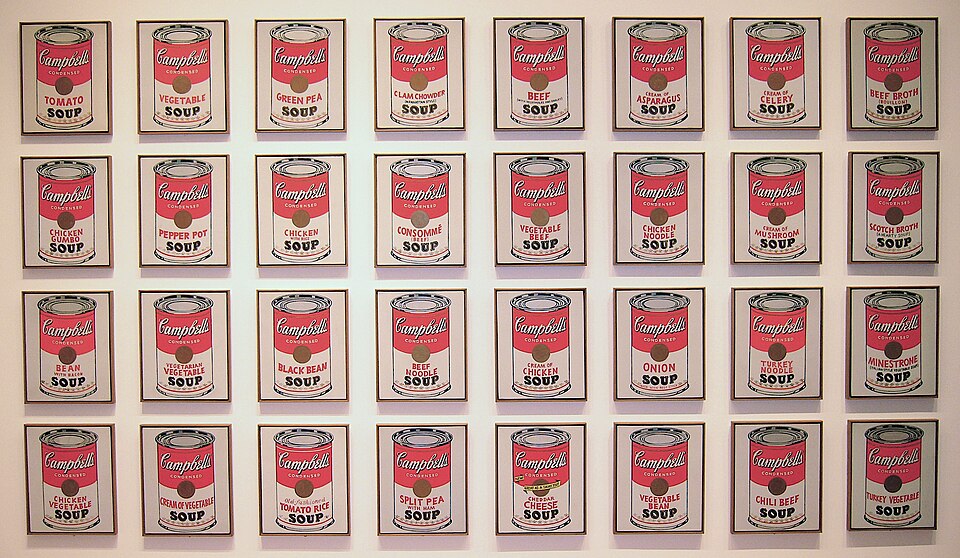
In late 1961, at his home studio at 1342 Lexington Avenue in New York, Andy Warhol began painting soup cans. Not abstract swirls, not gestural drips, but the precise, mundane packaging of Campbell's soup — the kind found in any American pantry. Over the following months he would paint roughly fifty such canvases, eventually settling on a definitive set of thirty-two, one for each variety of Campbell's soup then sold, each rendered in a uniform 20-by-16-inch format.
Warhol arrived at this subject after years of quiet, steady success as a commercial illustrator. He had moved to New York in 1949 after studying at the Carnegie Institute of Technology in Pittsburgh, and his first published drawing appeared in Glamour that same year. Throughout the 1950s he built a career translating everyday products into images — a skill that, decades later, would blur the line between advertising and fine art rather than separate them.
By 1960 Warhol was painting canvases based on comic strips, hoping to establish himself within the emerging Pop art movement. But he lagged behind peers in securing gallery representation, and was rejected by the Leo Castelli Gallery for working too close to Roy Lichtenstein's comic-based style. Determined to find something distinctly his own, Warhol turned toward the imagery of consumer packaging — soup cans, dollar bills, Coca-Cola bottles. As he put it in 1961, he needed something with real impact, personal enough that it wouldn't look like he was copying Lichtenstein or James Rosenquist.
The thirty-two soup can paintings were not, contrary to later assumption, silkscreens. They were hand-painted and traced, with a rubber stamp used to apply the gold fleur-de-lis detail near the bottom of each can, and commercial-grade acrylic paint standing in for traditional oils. They were among the last works Warhol painted largely by hand, completed just as he began learning silkscreen printing in late 1961 from Floriano Vecchi of Tiber Press, refining his handling of pigments and squeegee pressure through repeated visits — a technique he would soon adopt for nearly everything that followed.
Word of the project spread through Warhol's small circle before it ever reached a gallery wall. Critic David Bourdon saw examples in Warhol's studio by March 1962. Time magazine took note too, describing him in a May 11, 1962 feature as an artist 'currently occupied with a series of portraits of Campbell's soup cans in living colour.' That same month, art dealer Irving Blum visited the studio and found Warhol at work on his sixteenth soup can painting. Surprised that Warhol still had no gallery representation, Blum offered him an exhibition on the spot.
More from Art

The Painting With No Foreground
A single robed figure stares out at an empty grey sea — and the emptiness itself became a scandal. When it was unveiled in Berlin in 1810, no one knew quite what to do with it.

The Painter Who Chased the Light
For a few purple minutes each evening, an American exile knelt in an English garden and raced the dying sun to paint two little girls lighting lanterns. It took him two years to finish.

When a President Became a God
Look straight up inside the U.S. Capitol dome and you will find George Washington enthroned among the clouds, surrounded by goddesses — the founding father transformed into myth.

Marble Brought Back to Life
A corpse asleep, a wing barely brushing her skin — and marble somehow learns to breathe. This is the moment Antonio Canova dared to carve.

The World Turned Upside Down
Look closely at a sixteenth-century Flemish village and you'll find a man biting a pillar, another carrying daylight in a basket, and a wife slipping a blue cloak over her husband's shoulders. Every gesture is a joke — if you know the language.

The Girl in the Glass Case
She stood two-thirds life size, dressed in a real tutu and human hair — and the critics who saw her in 1881 recoiled as if she were something obscene.