Three Stooped Women Who Frightened Paris
A canvas of peasant women picking up leftover wheat sent shudders through the French upper classes—who saw in it not poverty, but revolution.
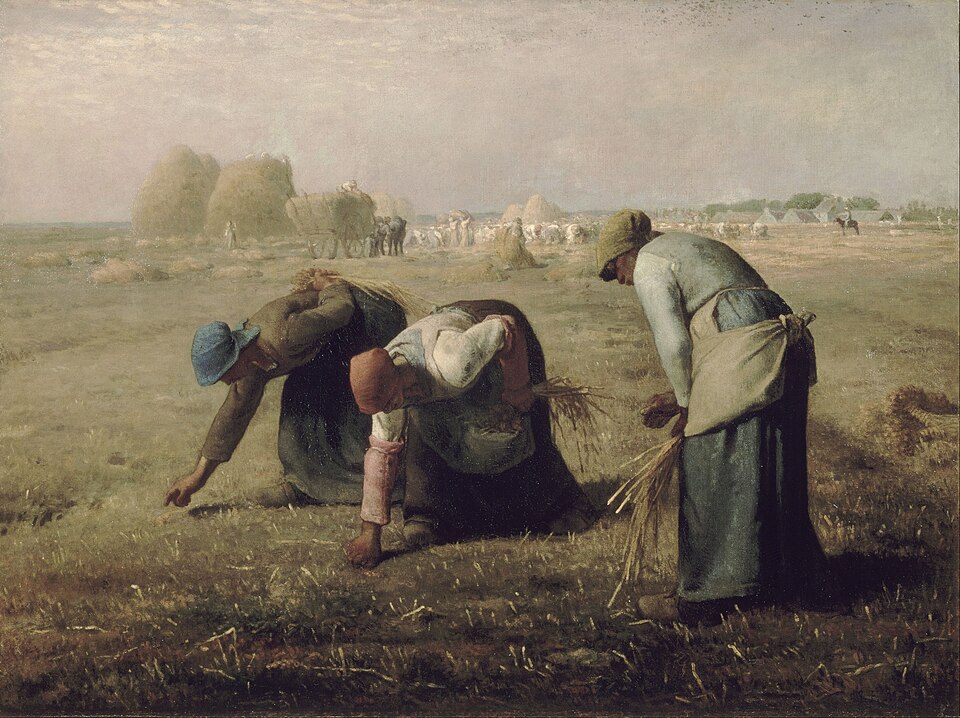
In 1857, at the Paris Salon, Jean-François Millet unveiled a painting that seemed, on its surface, almost too humble to matter: three women bent low over a harvested field, gathering the stray stalks of wheat left behind after the real reapers had gone. He called it The Gleaners. It was oil on canvas, 33 by 44 inches, and it depicted nothing more dramatic than the oldest, poorest labor in the countryside—the right of the landless to scavenge what the harvest had spilled.
And yet the reaction was fierce. Critics and the comfortable classes of Paris did not see quiet rural dignity; they saw menace. One critic invoked 'the scaffolds of 1793,' summoning the guillotines of the Revolution. France had only recently lived through the upheaval of 1848, and the sight of laboring women rendered with such monumental seriousness—on a canvas sized for religious or mythological subjects, not scenes of toil—unsettled viewers who linked the working masses with the rising specter of socialism.
Part of the discomfort was mathematical: the poor vastly outnumbered the rich, and a painting that dignified their labor, rather than diminishing it, felt to some like an implicit threat. One critic sneered that the three gleaners posed as 'the Three Fates of Poverty,' their ugliness and grossness 'unrelieved.' Gleaning itself was not a new subject in art—biblical Ruth had long been painted stooping in fields—but Millet stripped away all trace of scriptural compassion. In the background of his canvas, a rich harvest glows in sunlight; in the foreground, three women labor in grinding poverty. The irony was deliberate, and it stung.
Millet, meanwhile, was in no position to bask in controversy—he needed money. He had asked 4,000 francs for the painting but, after tough negotiation with an English buyer named Binder, settled for 3,000. Millet was so embarrassed by the low price that he tried to keep it secret. He would not live to see the painting's fortunes reverse.
He died in 1875, largely unrewarded for a work that had brought him mostly notoriety. But public taste shifted. By 1889, The Gleaners—by then owned by banker Ferdinand Bischoffsheim—sold at auction for a staggering 300,000 francs, a hundredfold increase from its original sale. The buyer's identity was kept quiet at first, fueling rumors that an American collector had swept it away. Less than a week later, the truth emerged: the purchaser was Jeanne-Alexandrine Louise Pommery, the Champagne magnate, whose acquisition also quieted whispers that she was in financial trouble after leaving her grapes on the vine longer than her rivals that season.
More from Art

The Painting With No Foreground
A single robed figure stares out at an empty grey sea — and the emptiness itself became a scandal. When it was unveiled in Berlin in 1810, no one knew quite what to do with it.

The Painter Who Chased the Light
For a few purple minutes each evening, an American exile knelt in an English garden and raced the dying sun to paint two little girls lighting lanterns. It took him two years to finish.

When a President Became a God
Look straight up inside the U.S. Capitol dome and you will find George Washington enthroned among the clouds, surrounded by goddesses — the founding father transformed into myth.

Marble Brought Back to Life
A corpse asleep, a wing barely brushing her skin — and marble somehow learns to breathe. This is the moment Antonio Canova dared to carve.

The World Turned Upside Down
Look closely at a sixteenth-century Flemish village and you'll find a man biting a pillar, another carrying daylight in a basket, and a wife slipping a blue cloak over her husband's shoulders. Every gesture is a joke — if you know the language.

The Girl in the Glass Case
She stood two-thirds life size, dressed in a real tutu and human hair — and the critics who saw her in 1881 recoiled as if she were something obscene.