Topkapı: The Palace That Ruled by Silence
For nearly four centuries a single walled complex on a hilltop above the Bosphorus decided the fate of an empire — and the price of entering its inner courtyards was, quite literally, silence.
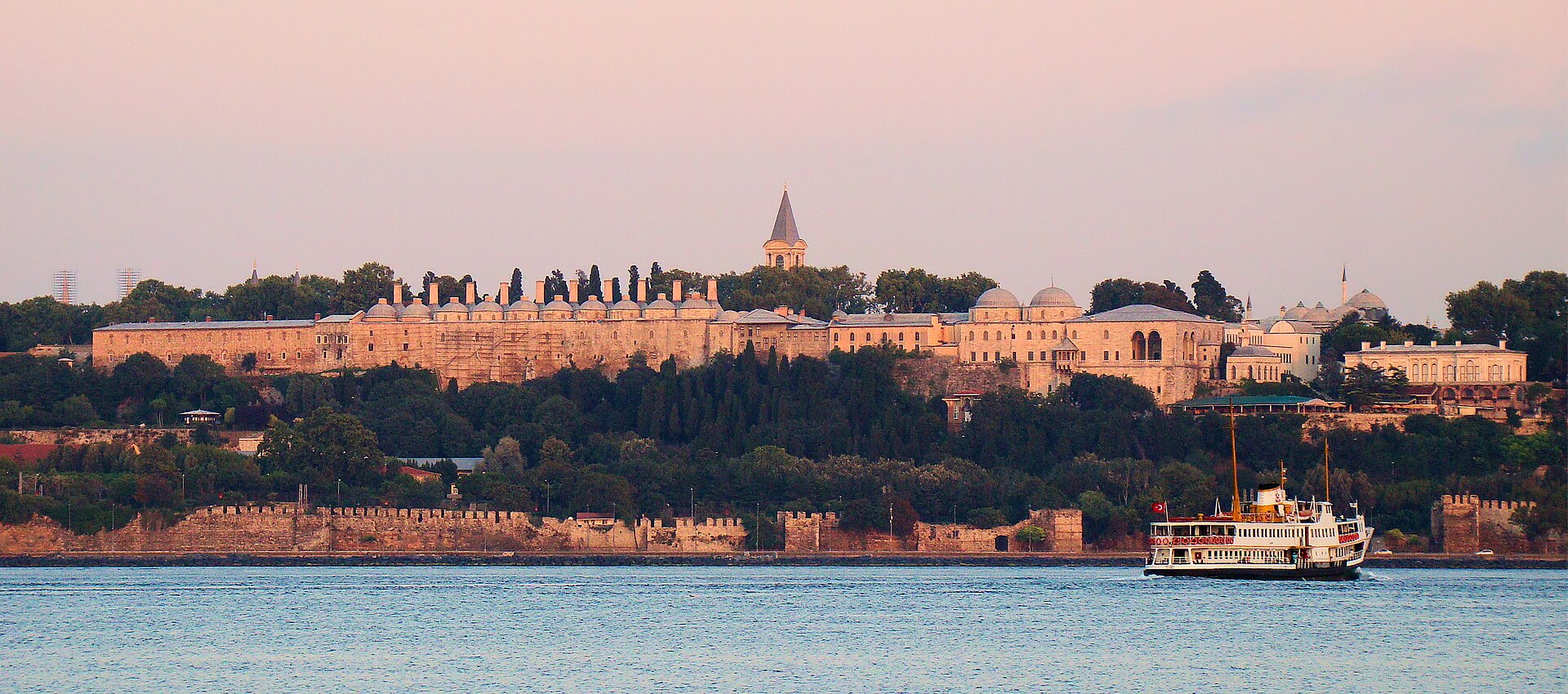
According to the Ottoman record, Fatih Sultan Mehmed had a new palace built on the Seraglio Point in 1478, the promontory where the Golden Horn meets the Bosphorus and the Sea of Marmara, twenty-five years after his conquest of Constantinople. The site had once held the acropolis of ancient Byzantion, and Mehmed's builders reused some of the old Byzantine walls as they raised what was first called the New Palace — Saray-ı Cedîd — to distinguish it from the Old Palace at Beyazıt Square. According to the contemporary historian Critobulus of Imbros, the sultan summoned 'the very best workmen from everywhere' because he intended a residence that could rival the greatest palaces of the past.
Mehmed's own layout would govern the palace for centuries: his private quarters at the highest point of the promontory, a chain of courtyards and pavilions cascading down toward the water, the whole enclosed by high walls. European visitors found it strange by their own standards — 'irregular, asymmetric, non-axial,' one wrote — but the Ottomans called it the Palace of Felicity, and its very unevenness reflected a deliberate philosophy. In 1477 and 1481, Mehmed codified this philosophy in the Kanunname, a set of laws governing court rank, hierarchy, and protocol, at whose heart lay the principle of imperial seclusion. Grilled windows, secret passageways, and an enforced silence within the inner courtyards all served to keep the sultan and his household apart from the world outside.
The palace grew dramatically under Suleiman the Magnificent between 1520 and 1560, as the empire's expanding power demanded a residence to match it. A further transformation came after a catastrophic fire destroyed the Old Palace in 1541: Suleiman's wife, Hurrem Sultan, moved the Imperial Harem permanently into Topkapı, reshaping the balance of the complex. Later renovations followed disasters of their own — an earthquake in 1509 and a great fire in 1665 both forced significant rebuilding.
By the 18th century the palace had acquired the name it carries today. An earlier seaside residence called Topkapusu Sâhil Sarâyı — meaning 'Cannon Gate' — burned down during the reign of Mahmud I, and its name migrated to the main palace, which had until then been known simply as the Imperial New Palace.
For roughly 380 years, Topkapı stood as the administrative heart of the Ottoman Empire and the official residence of its sultans — at its height home to nearly 4,000 people. Grand Viziers convened in the Imperial Council building; the Sultan's family lived within the Harem; state business, religious ceremony, and dynastic life all unfolded within its four courtyards. But after the 17th century its importance slowly waned, as sultans preferred newer residences along the Bosphorus shoreline. In 1856, Sultan Abdülmecid I made the shift official, moving the court to the newly completed Dolmabahçe Palace. Topkapı did not vanish from public life, though — it retained the imperial treasury, the library, and the mint, and its Hırka-i Saadet chamber, holding the Sacred Relics, continued to receive the sultan and his family every Ramadan.
More from Architecture

Stonehenge: The Stones That Refuse to Explain Themselves
For more than 4,500 years, a ring of leaning giants has watched the sun rise and set on the same two days each year — and no one alive can say for certain why.

The Dome That Refused to Fall
Two thousand years ago, Roman engineers poured a dome so vast that no one has dared build a bigger one from unreinforced concrete since. It still stands, open to the sky.

A Minaret Rising Over Kingsland Road
On a busy London street better known for shops and buses, the tallest minaret in Britain quietly reaches into the sky. Its story began not in Sinan's sixteenth-century Istanbul, but in 1990s Hackney.

The Bridge That Was Killed Twice
For 427 years it arched over the Neretva like a stone rainbow. Then, in a matter of days in 1993, it simply ceased to exist.

Hoover Dam: The Concrete That Tamed a River
In the scorched depths of Black Canyon, thousands of men built the largest concrete structure the world had ever seen — and finished it two years early, at a cost of over a hundred lives.

Neuschwanstein: The Castle Built for a Ghost
A king who despised his own palace built the most famous fairy-tale castle on earth — and died before he ever truly lived in it.