Two Figures, One Sliver of Moon
Two men stand on a mountain path at dusk, staring up at a thin crescent moon under a sky that hints at an eclipse — and for two centuries, no one has been entirely sure who they are, or why Samuel Beckett once called this scene the birthplace of Waiting for Godot.
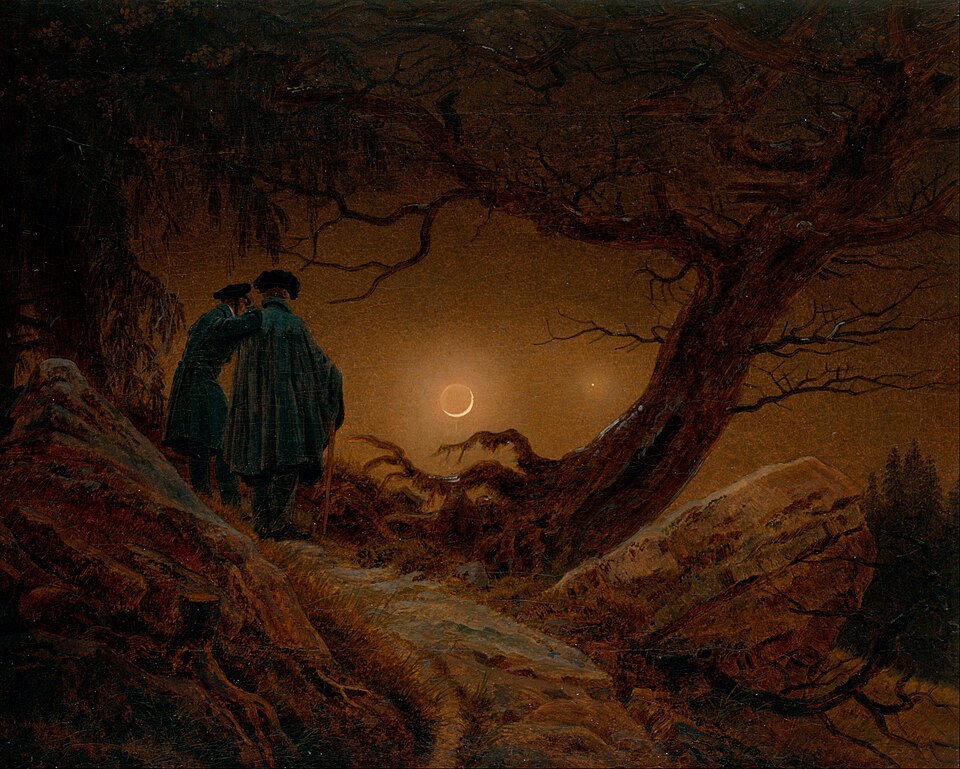
In the fading light of a German forest, two men climb a narrow mountain path. One, in a grey-green cape and the black beret of the altdeutsche Tracht, leans on a walking stick. The other, slimmer, dressed in a grey-green frock-coat with a white collar showing beneath a Burschenschaft cap, its ribbon tied under his chin, leans on his companion's shoulder. Both look up at the same thing: a sickle of waxing moon, its darkened side faintly lit by earthshine, and the evening star beside it. The sky itself suggests something more dramatic is unfolding above them — a solar eclipse appears to be occurring, adding a strange, charged stillness to the scene. This is the composition Caspar David Friedrich painted at least three times between around 1819 and 1830, and it has become one of the defining images of German Romanticism.
The painting now in Dresden's Galerie Neue Meister, dated 1819–20, is generally considered the original. A later variant, from around 1824, replaces the two men with a man and a woman, her arm resting on his shoulder as they too gaze skyward; that version hangs in Berlin's Alte Nationalgalerie. A third version, dated to around 1830 (the Metropolitan Museum of Art gives a range of 1825–1830), is now in New York. Other copies exist as well — Johan Christian Dahl, who owned the presumed first version, said Friedrich made an unknown number of copies, and that others copied the image too, making the exact history of these works difficult to untangle.
Every version shares a stark visual logic: a dark, almost monochrome foreground of brown and grey set against a pale, luminous sky, with no middle ground to soften the transition. An uprooted, moss-grown oak stretches its branches toward a spruce on the opposite side, held from falling only by a boulder wedged beneath it. A tree stump and a fallen branch lie in the immediate foreground. Behind the figures, the land drops away, and the dark tips of pine trees hint at a forest below. The effect is one of contrast — earthly, tangible space set against an irrational, sublime infinity, a theme Romantic painters returned to again and again.
Art historians have pointed out that the Dresden composition follows the golden section with unusual precision, in the relationships between the central vertical axis, the axis running to the evening star, and the axis passing through the older man's eye. German art historian Werner Busch has argued that this careful geometry is not incidental but signals a transcendent message embedded in the men's shared experience of nature.
Who are these two men? The identifications offered over the years don't agree. Friedrich's friend Wilhelm Wegener suggested the figure on the right is Friedrich himself, and the younger man on the left his pupil August Heinrich (1794–1822), who was 25 in 1819. Dahl agreed the younger man was Heinrich but thought the older man was Christian Wilhelm Bommer, brother of Friedrich's wife Caroline — though Bommer was only 18 that year, undermining the theory. Twentieth-century historians offered still other guesses: Max Semrau placed Friedrich and his friend Benjamin Friedrich Gotthelf Kummer on a cliff on the island of Rügen, while Max Sauerlandt set the same two men in the Harz Mountains.
More from Art

The Painting With No Foreground
A single robed figure stares out at an empty grey sea — and the emptiness itself became a scandal. When it was unveiled in Berlin in 1810, no one knew quite what to do with it.

The Painter Who Chased the Light
For a few purple minutes each evening, an American exile knelt in an English garden and raced the dying sun to paint two little girls lighting lanterns. It took him two years to finish.

When a President Became a God
Look straight up inside the U.S. Capitol dome and you will find George Washington enthroned among the clouds, surrounded by goddesses — the founding father transformed into myth.

Marble Brought Back to Life
A corpse asleep, a wing barely brushing her skin — and marble somehow learns to breathe. This is the moment Antonio Canova dared to carve.

The World Turned Upside Down
Look closely at a sixteenth-century Flemish village and you'll find a man biting a pillar, another carrying daylight in a basket, and a wife slipping a blue cloak over her husband's shoulders. Every gesture is a joke — if you know the language.

The Girl in the Glass Case
She stood two-thirds life size, dressed in a real tutu and human hair — and the critics who saw her in 1881 recoiled as if she were something obscene.