Valhalla: The Hall Where Warriors Never Truly Die
Imagine a battlefield frozen in eternity — broken shields for a roof, wolves at the doors, and the dead rising each morning only to fight and die again by nightfall. This was the Viking paradise.
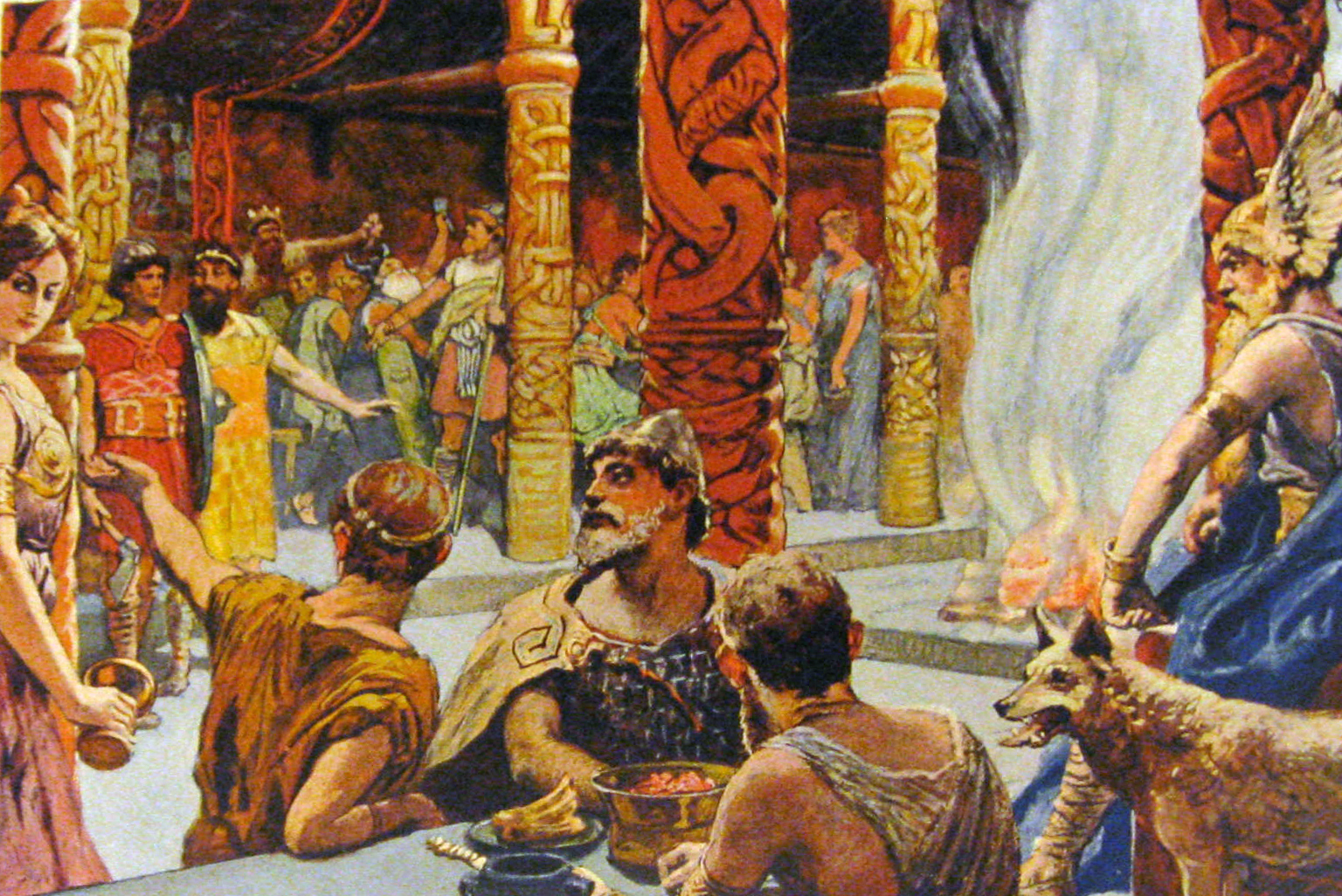
In the cosmology of the Norse peoples, death was not a single destination but a fork in a road with five possible paths. A soul might travel to Fólkvangr, ruled by the goddess Freyja, or descend to Hel, presided over by Loki's daughter of the same name. Others might drift to the watery realm of the goddess Rán, or simply remain within the burial mound where the dead were said to go on living in their own quiet way. But the fifth realm was different from all the rest — it was a hall built for glory, and its name was Valhalla.
Valhalla, from the Old Norse Valhǫll, literally means 'Hall of the Slain.' Philologists note something curious in its roots: the second element, hǫll, may originally have meant 'rock' or 'mountain' rather than 'hall,' suggesting that Valhalla was first imagined not as a golden building but as a rocky abode of the dead, an underworld carved into stone. Only later did it become the shining hall so vividly described in medieval sources.
According to the Prose Edda and the Poetic Edda — compiled in the 13th century from older oral traditions — Valhalla stood in the realm of Glaðsheimr within Asgard, and was ruled by Odin himself. Seen from a distance, it appeared to rise peacefully, gleaming and golden. But its architecture told a darker story: its rafters were spear-shafts, its roof was thatched with shields, and coats of mail were strewn across its benches instead of cloth. A wolf hung before its western doors, and an eagle hovered above the roof — omens and guardians drawn from the battlefield itself.
According to the Norse sources themselves, Valhalla was said to have 540 doors, and at Ragnarök, 800 einherjar — the slain warriors gathered there — would march out from each door into the nine realms to fight alongside Odin against the jötnar, the giants. Of all those killed in battle, only half were believed to go to Valhalla; the other half went instead to Freyja's Fólkvangr.
The warriors who reached Valhalla were called einherjar, and their existence there was anything but restful. Odin, in the guise of Grímnir, is described choosing the slain each day. The einherjar fought one another endlessly, died over and over, and rose again — a perpetual reenactment of the battlefield, populated by women who fed them and served them drink. These women were also said to be the ones who had chosen which men would die in the first place: the valkyries.
More from Mythology

The Doctor Who Sang a Nation Into Being
A country doctor rode into the forests of Karelia armed with nothing but a notebook — and rode out with the soul of a nation.

The Boat That Carried the Sun
Every sunset, the ancient Egyptians believed, the sun climbed into a boat and sailed straight into the realm of the dead — only to fight a monstrous serpent before dawn could return.

The Wild Man of the Snows
At 21,000 feet, a colonel found tracks in the snow that he blamed on a wolf — but his guides knew better, and gave the world a name that would echo for a century.

The Knight Who Went Mad for Love: Orlando Furioso
A hero so devoted to duty he was Charlemagne's greatest paladin loses his mind—not to a sword wound, but to heartbreak. To cure him, a friend must ride a flying horse to the Moon.

The Book That Turned the World Into Myth
A poet condemned to exile spent his final years in Rome finishing a poem that would outlive empires—a poem about nothing standing still, not gods, not lovers, not even the shape of a man.

Paradise Lost: Milton's Rebel Angel
A blind poet, dictating verses in the dark, dared to explain the ways of God to men — and in doing so, made Hell's ruler unforgettable.