Whaam!: The Comic Panel That Conquered the Museum Wall
A single word, painted in giant letters across an exploding plane, would help decide what counts as art. It came not from a poet, but from a war comic nobody thought twice about.
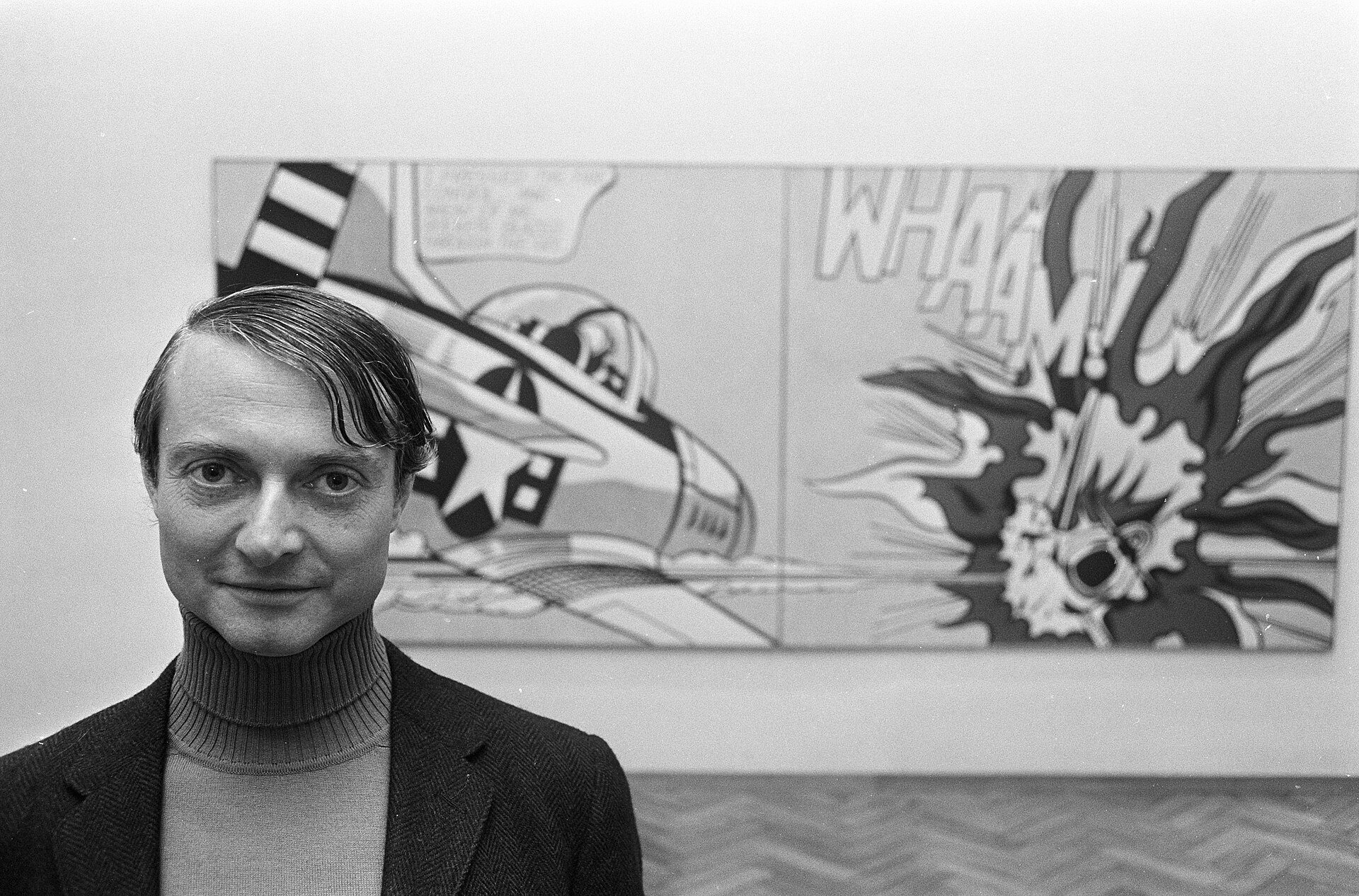
In 1963, at the Leo Castelli Gallery in New York City, visitors encountered a canvas unlike anything the art world had sanctioned before: two vast panels, one showing a fighter jet firing a rocket, the other showing that rocket detonating a second plane in a burst of flame, the word 'WHAAM!' blazing across it in comic-book lettering. The painting was the work of Roy Lichtenstein, and it would become one of the defining images of pop art.
Lichtenstein had come to this moment by an unlikely route. In 1943 he left his studies in painting and drawing at Ohio State University to serve in the U.S. Army, where he remained until January 1946. He entered training programs for languages, engineering, and piloting, all of which were canceled before they began, and he ultimately served in noncombat roles as an orderly, draftsman, and artist. At Camp Shelby, one of his duties was enlarging Bill Mauldin's Stars and Stripes cartoons. He was sent to Europe with an engineer battalion but never saw active combat.
After the war, Lichtenstein settled into an abstract-expressionist style laced with parody, and around 1958 began hiding cartoon figures like Mickey Mouse and Bugs Bunny inside his abstract compositions. He was part of a new generation of artists moving toward a cooler, more objective aesthetic, one that would crystallize into movements like pop art and minimalism. These artists appropriated imagery from commercial art and mainstream culture, unsettling old ideas about originality. As curator Bernice Rose observed, Lichtenstein was drawn to 'challenging the notion of originality as it prevailed at that time.'
His early comic-based paintings, such as Look Mickey, drew on beloved animated characters. But by 1963 he had turned to weightier material: romance and war. Comic books at the time carried almost no cultural prestige; a 1954 Senate investigation into juvenile delinquency had examined alleged links between comics and crime, and by decade's end they were widely dismissed as, in the words of scholar Mark Thistlethwaite, material of 'the lowest commercial and intellectual kind.' Lichtenstein himself had not been a comics enthusiast as a boy, but he was drawn to the challenge of building serious art from a source so far from the traditional 'artistic image.' He admitted he was 'very excited about, and very interested in, the highly emotional content yet detached impersonal handling of love, hate, war, etc., in these cartoon images.'
Whaam! grew directly from that fascination. Lichtenstein adapted a panel drawn by Irv Novick for the 'Star Jockey' story in All-American Men of War No. 89 (February 1962), part of a DC Comics dream sequence in which the fictional pilot Johnny Flying Cloud imagines himself shooting down jets. Lichtenstein swapped out both aircraft for different models, likely borrowing the attacking plane from Jerry Grandenetti's art in the next issue and the target plane from a Russ Heath drawing elsewhere in issue No. 89. He also dropped the original speech bubble, in which the pilot cried, 'The enemy has become a flaming star!' — letting the painted word 'WHAAM!' carry all the drama instead.
More from Art

The Painting With No Foreground
A single robed figure stares out at an empty grey sea — and the emptiness itself became a scandal. When it was unveiled in Berlin in 1810, no one knew quite what to do with it.

The Painter Who Chased the Light
For a few purple minutes each evening, an American exile knelt in an English garden and raced the dying sun to paint two little girls lighting lanterns. It took him two years to finish.

When a President Became a God
Look straight up inside the U.S. Capitol dome and you will find George Washington enthroned among the clouds, surrounded by goddesses — the founding father transformed into myth.

Marble Brought Back to Life
A corpse asleep, a wing barely brushing her skin — and marble somehow learns to breathe. This is the moment Antonio Canova dared to carve.

The World Turned Upside Down
Look closely at a sixteenth-century Flemish village and you'll find a man biting a pillar, another carrying daylight in a basket, and a wife slipping a blue cloak over her husband's shoulders. Every gesture is a joke — if you know the language.

The Girl in the Glass Case
She stood two-thirds life size, dressed in a real tutu and human hair — and the critics who saw her in 1881 recoiled as if she were something obscene.