Wheatfield with Crows: Van Gogh's Uncertain Farewell
A road that leads nowhere, a sky torn open by black wings — for decades the world believed this was the last thing Vincent van Gogh ever painted. The truth is stranger and quieter than the legend.
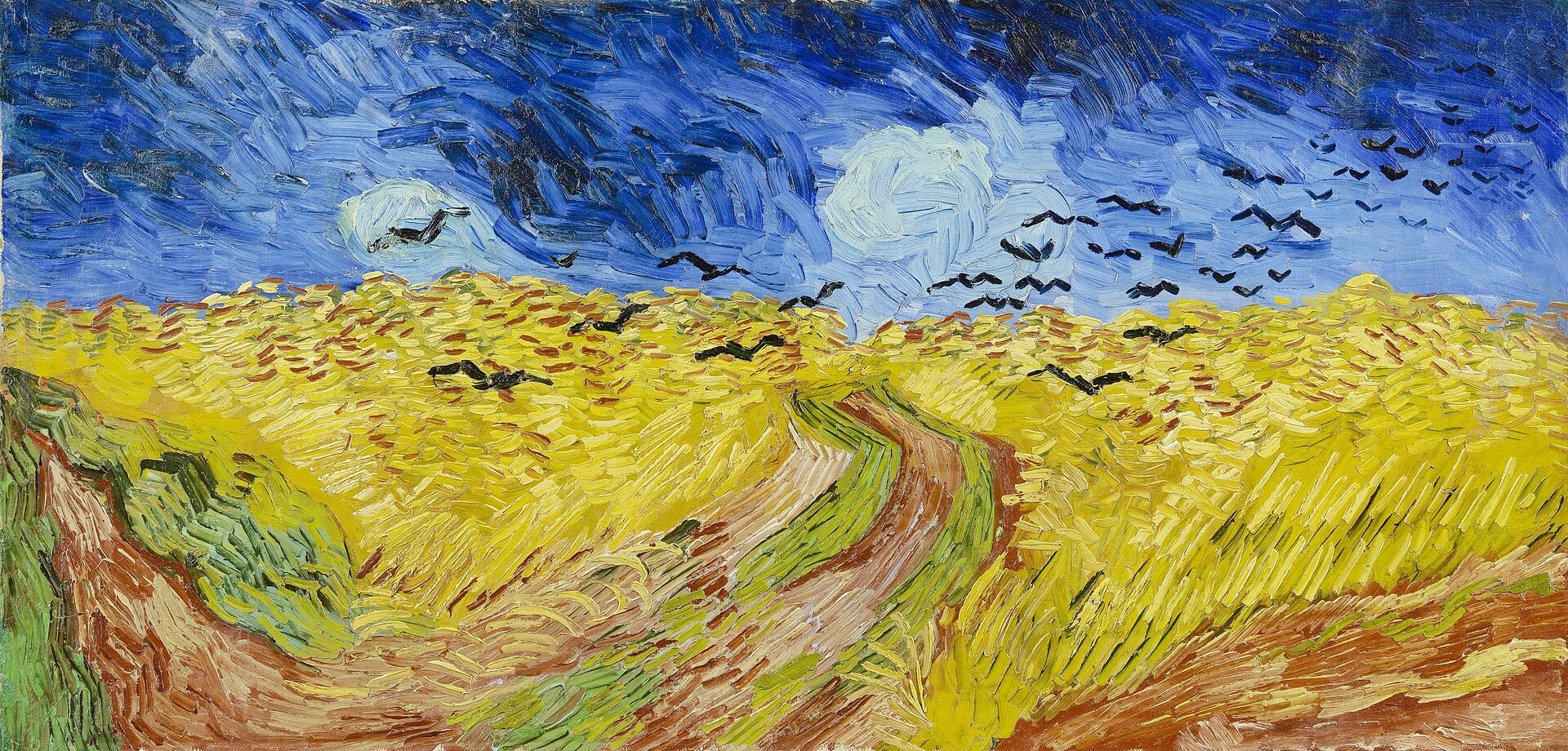
In July 1890, in the final weeks of his life, Vincent van Gogh set up his easel before a wheatfield near Auvers-sur-Oise and painted a scene that would become one of the most haunting images in Western art: a turbulent sky crowded with crows above a windswept field, cut through by a path that simply stops. The wheat fills two-thirds of the canvas, restless under a darkening heaven, and the crows scatter in no discernible direction — an unease built into the very composition.
For generations, audiences have been told that this was Van Gogh's last painting, an image made moments before he shot himself. That belief was cemented in the popular imagination by Vincente Minnelli's 1956 biopic Lust for Life, which staged Van Gogh completing the canvas right before his suicide. It is a powerful scene, but not a true one. Van Gogh's actual final painting, evidence suggests, was Tree Roots, and his letters indicate Wheatfield with Crows was likely finished around 10 July, before other works such as Auvers Town Hall (14 July) and Daubigny's Garden.
The painting belongs to a small, distinctive group of works: elongated double-square canvases that Van Gogh used exclusively during June and July 1890, the last weeks of his life. Around 10 July, he wrote to his brother Theo and Theo's wife Jo Bonger that he had painted three large canvases since seeing them in Paris on 6 July. Two were vast stretches of wheatfields beneath turbulent skies — believed to be Wheatfield under Clouded Sky and Wheatfield with Crows — and the third was Daubigny's Garden.
In that same letter, Van Gogh admitted he had deliberately tried to express sadness, and later spoke of 'extreme loneliness.' Yet he also insisted the paintings conveyed something he considered healthy and fortifying about the countryside, and he planned to bring them to Paris as soon as he could. It is a striking contradiction — despair and vitality held in the same breath — that resists any simple reading of the work as a suicide note in paint.
Scholars Ingo Walther and Rainer Metzger have pushed back hard against the myth, noting there is nothing in Van Gogh's own words to support a straightforward tale of artistic despair, nor any evidence that this canvas sat on his easel when he died. They point instead to an earlier letter, from June 1880 — a full decade before the painting was made — in which Van Gogh compared himself to a caged bird, suggesting the crows carried a deeply personal symbolism tied to his sense of confinement, rather than a literal announcement of death.
More from Art

The Painting With No Foreground
A single robed figure stares out at an empty grey sea — and the emptiness itself became a scandal. When it was unveiled in Berlin in 1810, no one knew quite what to do with it.

The Painter Who Chased the Light
For a few purple minutes each evening, an American exile knelt in an English garden and raced the dying sun to paint two little girls lighting lanterns. It took him two years to finish.

When a President Became a God
Look straight up inside the U.S. Capitol dome and you will find George Washington enthroned among the clouds, surrounded by goddesses — the founding father transformed into myth.

Marble Brought Back to Life
A corpse asleep, a wing barely brushing her skin — and marble somehow learns to breathe. This is the moment Antonio Canova dared to carve.

The World Turned Upside Down
Look closely at a sixteenth-century Flemish village and you'll find a man biting a pillar, another carrying daylight in a basket, and a wife slipping a blue cloak over her husband's shoulders. Every gesture is a joke — if you know the language.

The Girl in the Glass Case
She stood two-thirds life size, dressed in a real tutu and human hair — and the critics who saw her in 1881 recoiled as if she were something obscene.