When on High: The Clay Tablets That Rewrote Creation
Buried for over two thousand years beneath the ruins of an Assyrian palace, seven broken tablets held a story of gods, chaos, and a slain goddess that would shake Victorian certainties about the Bible itself.
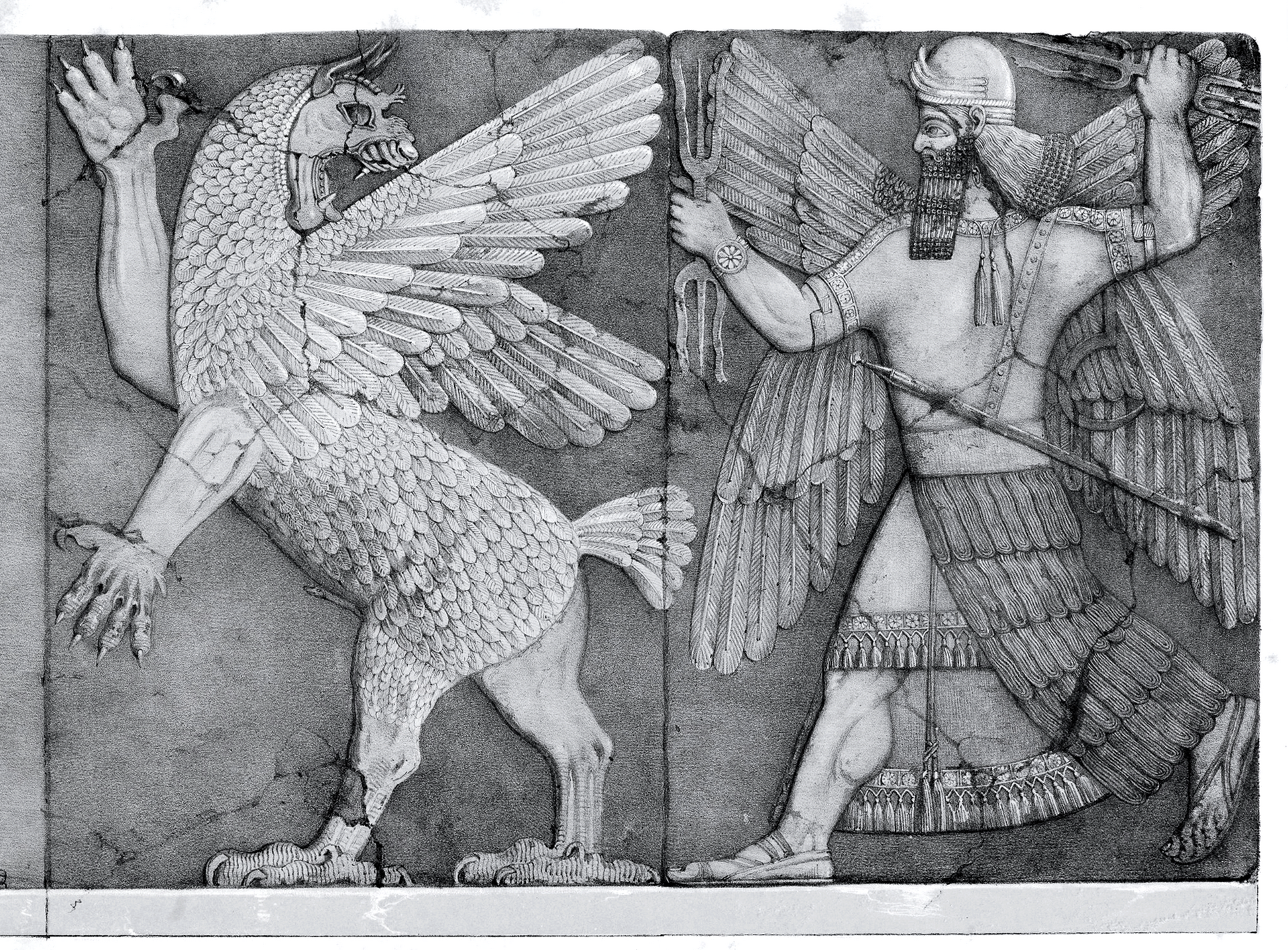
In 1849, the English archaeologist Austen Henry Layard was digging through the ruined Library of Ashurbanipal at Nineveh, near modern Mosul, Iraq, when he uncovered fragments of clay tablets covered in cuneiform script. He could not have known it then, but among the roughly 20,000 fragments eventually recovered from the site lay the only complete surviving account of ancient Near Eastern cosmology: the Enūma Eliš, Babylon's creation myth, named for its opening words meaning 'When on High.'
It would take decades before the world understood what had been found. In 1876, English Assyriologist George Smith produced the first published version of the myth. Smith had already made headlines the year before, in 1875, when he began publishing in the Daily Telegraph his discoveries of a Babylonian flood myth strikingly similar to the biblical deluge, along with fragments of creation stories and tales of a war between good and evil gods. His revelations were so sensational that a newspaper-funded expedition sent him back to Assyria to find more.
Before the tablets ever emerged from the earth, echoes of this myth had survived through Berossus, a third-century BCE Babylonian priest of Bel, whose writings were preserved secondhand through Alexander Polyhistor and later Eusebius. Berossus described a primeval darkness and water, strange hybrid beings with wings and animal heads, and a female figure named Omoroca, or Thalatth, who was slain by the god Bel and split in two to form Heaven and Earth. He also told of Oannes, a fish-man who rose from the sea to teach humanity writing, law, mathematics, and agriculture.
The actual tablets, recorded in Akkadian, span roughly a thousand lines across seven clay tablets, each holding between 115 and 170 lines of Sumero-Akkadian script. Nearly the entire text survives intact; only most of Tablet V remains lost. Across these seven tablets unfolds the story of the world's creation, a battle among the gods that leads to an offering made to the god Marduk, the fashioning of humankind to serve the Mesopotamian deities, and a closing hymn of praise to Marduk himself. Some later Assyrian versions swapped in the god Ashur in Marduk's place. The myth may have been recited aloud during the Akitu festival, Babylon's New Year celebration.
Marduk's rise to supremacy in the story was no accident of theology. As Babylon gained political dominance among the cities of Mesopotamia, its patron god Marduk grew correspondingly important among Akkadian deities, and the creation epic was reworked to place him at its center. Scholars generally trace this elevation to the Second Dynasty of Isin, spurred by King Nebuchadnezzar I's return of Marduk's statue from Elam, though a late Kassite date has also been proposed. The myth thus doubled as a tool of ideological support for Babylonian kingship.
More from Mythology

The Doctor Who Sang a Nation Into Being
A country doctor rode into the forests of Karelia armed with nothing but a notebook — and rode out with the soul of a nation.

The Boat That Carried the Sun
Every sunset, the ancient Egyptians believed, the sun climbed into a boat and sailed straight into the realm of the dead — only to fight a monstrous serpent before dawn could return.

The Wild Man of the Snows
At 21,000 feet, a colonel found tracks in the snow that he blamed on a wolf — but his guides knew better, and gave the world a name that would echo for a century.

The Knight Who Went Mad for Love: Orlando Furioso
A hero so devoted to duty he was Charlemagne's greatest paladin loses his mind—not to a sword wound, but to heartbreak. To cure him, a friend must ride a flying horse to the Moon.

The Book That Turned the World Into Myth
A poet condemned to exile spent his final years in Rome finishing a poem that would outlive empires—a poem about nothing standing still, not gods, not lovers, not even the shape of a man.

Paradise Lost: Milton's Rebel Angel
A blind poet, dictating verses in the dark, dared to explain the ways of God to men — and in doing so, made Hell's ruler unforgettable.