When Saints Came Down to Bury a Nobleman
In 1586, a Toledo priest asked a Greek painter to prove that a fourteenth-century miracle had really happened. What he got instead was one of the greatest paintings in Western art.
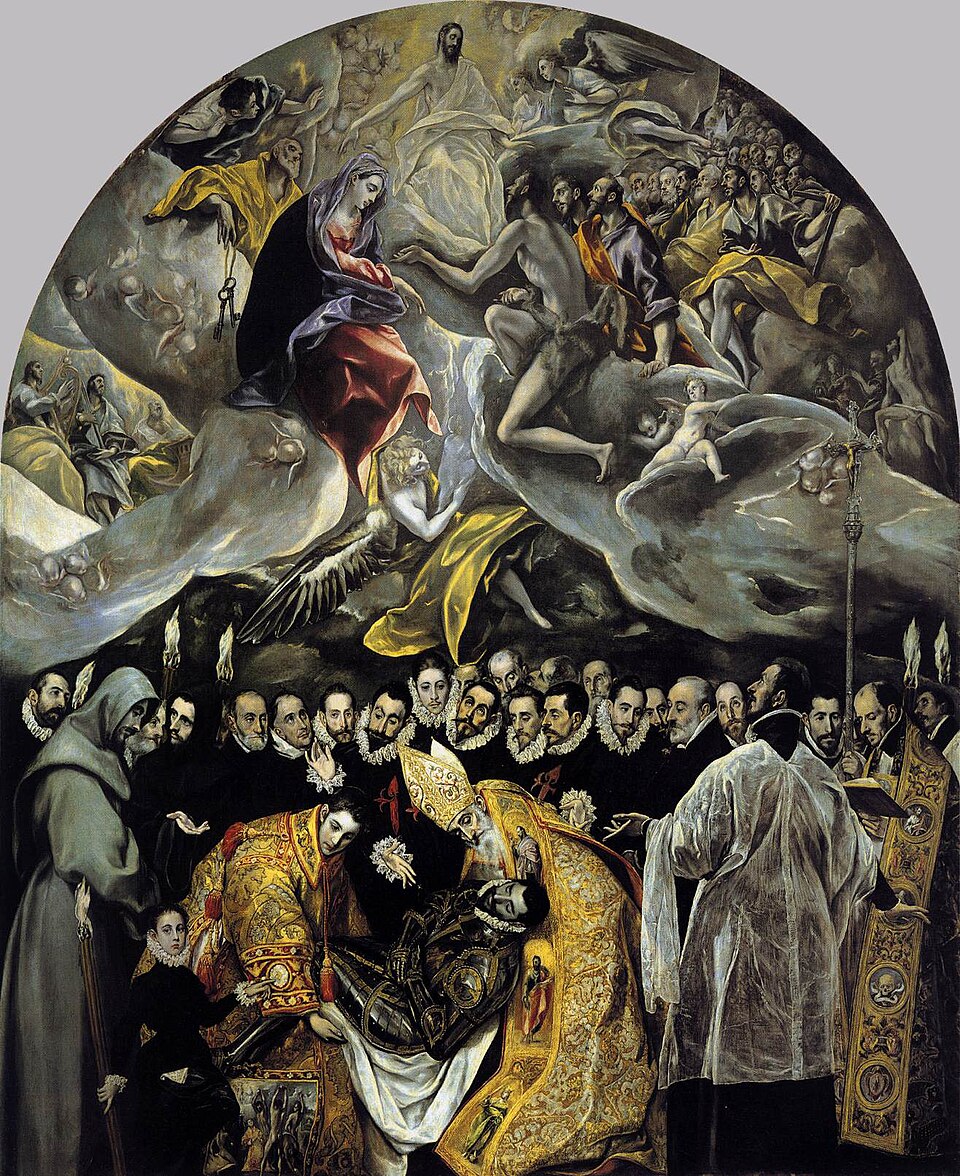
In 1323, Don Gonzalo Ruiz de Toledo, mayor of the town of Orgaz and a descendant of the Byzantine Palaiologos family, died. He had been a pious and generous man, leaving money to enlarge and adorn the church of Santo Tomé in Toledo, where he asked to be buried. Legend held that at his funeral, Saint Stephen and Saint Augustine descended from heaven and buried him with their own hands, before the astonished eyes of everyone present. This event, occurring more than two and a half centuries earlier, became the subject of one of El Greco's most celebrated paintings.
The commission came from Andrés Núñez, the parish priest of Santo Tomé, who had been refurbishing the Count's burial chapel and wanted a painting to crown the project. On 18 March 1586, Núñez and El Greco signed a contract that spelled out exactly what the painting should show, required the artist to pay for his own materials, and set a deadline of Christmas 1587. Greco worked at a punishing pace and finished the piece between late 1587 and the spring of 1588.
Money became a point of friction. The contract specified that the painting's value would be settled by expert appraisal, and a long dispute followed between the painter and the priests over what that value should be. El Greco was initially unwilling to compromise, but eventually accepted the lower of the estimates offered, settling for 13,200 reales.
Even before the argument over payment was resolved, the painting had become a sensation. By 1588 people were already flocking to Santo Tomé to see it. Much of that excitement had nothing to do with saints or miracles: the contract had stipulated, following local custom, that the eminent and noble men of Toledo should be shown attending the burial, as was customary when a nobleman was laid to rest. El Greco filled the lower half of the canvas with recognizable portraits of the clergy, jurists, poets, and scholars of his own era — and, among them, a portrait of himself, his hand raised in the gesture of a pantocrator, along with a portrait of his own son.
Writing in 1612, the chronicler Francisco de Pisa noted that the people of Toledo never tired of the painting, precisely because it contained realistic portraits of so many notable men of their own times. The work functioned, in effect, as a gallery of contemporary Toledan society layered onto a medieval legend — a fusion that gave the fourteenth-century miracle a very sixteenth-century face.
More from Art

The Painting With No Foreground
A single robed figure stares out at an empty grey sea — and the emptiness itself became a scandal. When it was unveiled in Berlin in 1810, no one knew quite what to do with it.

The Painter Who Chased the Light
For a few purple minutes each evening, an American exile knelt in an English garden and raced the dying sun to paint two little girls lighting lanterns. It took him two years to finish.

When a President Became a God
Look straight up inside the U.S. Capitol dome and you will find George Washington enthroned among the clouds, surrounded by goddesses — the founding father transformed into myth.

Marble Brought Back to Life
A corpse asleep, a wing barely brushing her skin — and marble somehow learns to breathe. This is the moment Antonio Canova dared to carve.

The World Turned Upside Down
Look closely at a sixteenth-century Flemish village and you'll find a man biting a pillar, another carrying daylight in a basket, and a wife slipping a blue cloak over her husband's shoulders. Every gesture is a joke — if you know the language.

The Girl in the Glass Case
She stood two-thirds life size, dressed in a real tutu and human hair — and the critics who saw her in 1881 recoiled as if she were something obscene.