A Golden Postcard Bound for the Stars
Two spacecraft carry humanity's only physical message to the cosmos — a gold-plated drawing of a naked man and woman, encoded with the secrets of hydrogen and pulsars. Three weeks. That's all Carl Sagan had to explain our species to whoever might find it.
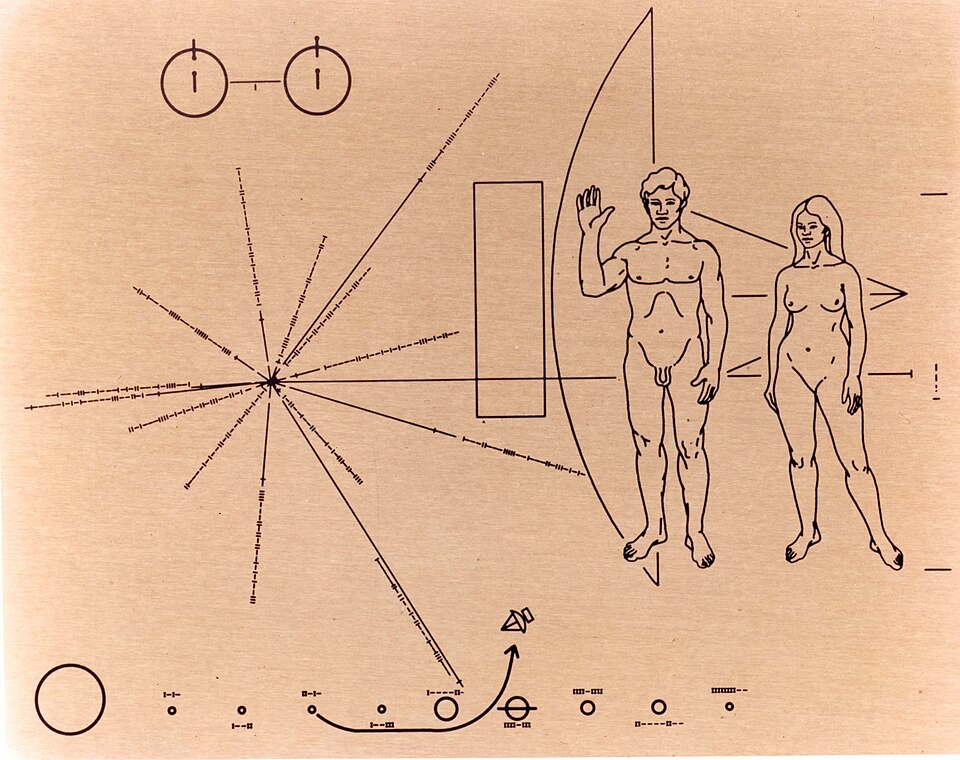
In 1972, as engineers at the Jet Propulsion Laboratory prepared Pioneer 10 for launch, a curious question arose: what if this machine, the first ever to escape the Solar System, was found by someone — or something — out there? Eric Burgess, visiting Pasadena during the Mariner 9 mission, raised the idea and brought it to Carl Sagan, who had already lectured on communicating with extraterrestrial intelligence at a conference in Crimea. NASA agreed. Sagan had three weeks.
Working with astronomer Frank Drake, Sagan designed a plaque meant to speak across the gulf of species and stars without words. His wife at the time, artist Linda Salzman Sagan, rendered the artwork, with additional contributions from Jon Lomberg. The final plaques — gold-anodized aluminium, 9 by 6 inches, a mere 120 grams — were manufactured at Precision Engravers in San Carlos, California.
The first plaque launched with Pioneer 10 on March 2, 1972; the second followed aboard Pioneer 11 on April 5, 1973. Both were mounted on the antenna support struts, shielded there from the slow sandblasting of interstellar dust that would otherwise erode the etchings over eons.
At the top left, a simple diagram shows the hyperfine transition of neutral hydrogen — the most abundant element in the universe — flipping at a frequency of 1420.405 MHz, a period of 0.704 nanoseconds. A small binary '1' beneath it sets a universal ruler: 21 centimeters, 0.7 nanoseconds, units used throughout the rest of the plaque.
To the right stand the nude figures of a man and a woman before a silhouette of the spacecraft itself. Between the brackets marking the woman's height is the binary numeral 8, which in hydrogen-wavelength units means 8 × 21 cm = 1.68 meters — her height, used to set the scale of the humans against the craft. The man's hand is raised, not in greeting exactly, but to show a movable limb and an opposable thumb. Sagan had originally wanted the two figures holding hands, until he realized an alien viewer might read them as a single, two-headed organism. The drawings drew on Leonardo da Vinci and Greek sculpture. The woman's genitals were left unmarked but for the mons pubis — a compromise, it's said, born of Sagan's fear that NASA would reject anything more explicit. Robert S. Kraemer's memoirs suggest the original design did include a line indicating her vulva, erased before approval by NASA's chief scientist John Naugle.
More from Archaeology

The Bronze Disc That Rewrote the Sky
Two looters with a metal detector dug up something illegal, invisible in value, and older than Stonehenge's final stones — a map of the heavens buried for over three thousand years.

The Faceless Women of the Ice Age
Long before writing, before cities, before the wheel, someone carved a woman's body into stone and ivory — and left no name, no face, no explanation.

The Pebble That Might Be Human
A palm-sized stone found on a Moroccan riverbank may be humanity's oldest attempt to see itself — or simply a trick of erosion.

The Crown That Vanished: Deshret and the Red Land
A crown worn by kings for three thousand years has never once been found in a tomb — not one. So where did it go?

The Face That Traveled Between Empires
A farm worker's shovel struck stone in 1897 and unearthed a face so striking it would be sold to France, seized as war booty, and finally traded back for a Velázquez.

The Boy in the Dark Tunnel
A schoolboy fell into black water inside an ancient tunnel and surfaced with his fingers brushing letters no one had noticed for 2,600 years.