Alacahöyük: The Sun Discs of the Hittite Kings
In shaft graves barely deeper than a modern basement, archaeologists found gold sun discs, bronze stags, and a dagger forged from a fallen star. Who were the people buried with the heavens themselves?
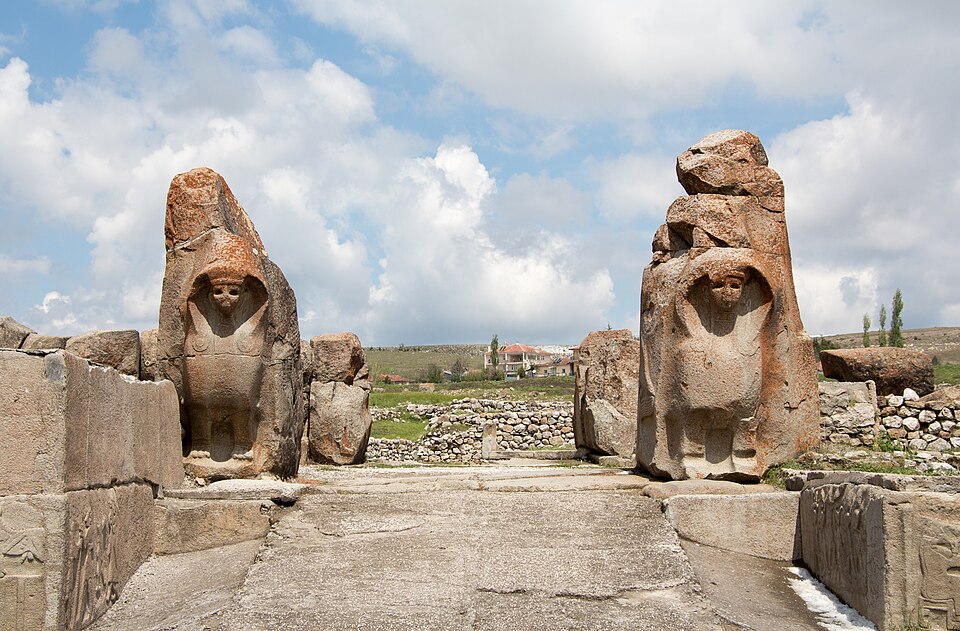
On a modest mound northeast of Boğazkale, in Çorum Province, farmers once walked over the graves of kings without knowing it. The höyük itself is unassuming — 310 meters by 275 meters, rising only about 14 meters — but beneath its surface lie fourteen occupational layers stretching from the Chalcolithic Age to Ottoman times. It was William John Hamilton who first noted the site in 1835, though serious excavation would wait decades.
The first true digging came in 1907, when Ottoman archaeologist Theodor Makridi Bey spent two weeks probing the mound on behalf of the Istanbul museums. German teams followed in the 1910s, uncovering royal tombs from the third millennium BC and the remains of a Hittite town beneath — a town entered through a sphinx-flanked gate carved with reliefs. But it was in 1935 that the excavation gained its most unusual patron: Mustafa Kemal Atatürk personally ordered the work resumed, funding it in part from his own budget, with Turkish archaeologists Remzi Oğuz Arık and Hamit Koşay leading the effort.
What they found rewrote the site's importance. Fourteen shaft graves, dated roughly 2850–2450 BC, held the so-called 'Royal Tombs' — contemporaries of the Royal Tombs of Ur and Troy's second level. Each grave was a simple shaft about 1.5 meters deep, sealed with wooden beams, holding the dead with legs folded, facing west. Around them lay the heads and horns of bulls placed on platforms, as if the animals themselves stood guard.
The grave goods were staggering for their age. Gold fibulae, diadems, belt buckles, and repoussé gold-leaf figures adorned the dead. Seven metal figurines — four bronze, three silver — were recovered. Tomb H, belonging to a woman, contained a golden diadem, copper mace heads, a bronze sun standard, animal statuettes, gold and silver ornaments, gold and clay vessels, axes, five pairs of twin gold idols, and three female figurines. Tomb A, also an adult woman's grave, yielded a golden diadem, four sun standards, an animal statuette, metal ornaments, fragments of an iron object, and two anthropomorphic metal figurines.
Among all these treasures, the bronze standards remain the most enigmatic. Cast in copper, often shaped as flat circles, half-circles, or squares filled with openwork crossbars, central crosses, and swastika motifs, some bear bulls or stags mounted on pedestals. Archaeologists still debate their exact purpose — ceremonial standards, perhaps, or symbols tied to sun worship. Excavator Leonard Woolley observed that the tombs 'seem to belong to the end of a period,' marked by a layer of destruction and a burned citadel, with the culture of the tombs not continuing into the following era of Kültepe.
More from Archaeology

The Bronze Disc That Rewrote the Sky
Two looters with a metal detector dug up something illegal, invisible in value, and older than Stonehenge's final stones — a map of the heavens buried for over three thousand years.

The Faceless Women of the Ice Age
Long before writing, before cities, before the wheel, someone carved a woman's body into stone and ivory — and left no name, no face, no explanation.

The Pebble That Might Be Human
A palm-sized stone found on a Moroccan riverbank may be humanity's oldest attempt to see itself — or simply a trick of erosion.

The Crown That Vanished: Deshret and the Red Land
A crown worn by kings for three thousand years has never once been found in a tomb — not one. So where did it go?

The Face That Traveled Between Empires
A farm worker's shovel struck stone in 1897 and unearthed a face so striking it would be sold to France, seized as war booty, and finally traded back for a Velázquez.

The Boy in the Dark Tunnel
A schoolboy fell into black water inside an ancient tunnel and surfaced with his fingers brushing letters no one had noticed for 2,600 years.