Angkor: The City the Jungle Swallowed
A king leapt onto a rival's war elephant and killed him — then built the largest city on Earth to prove he was a god.
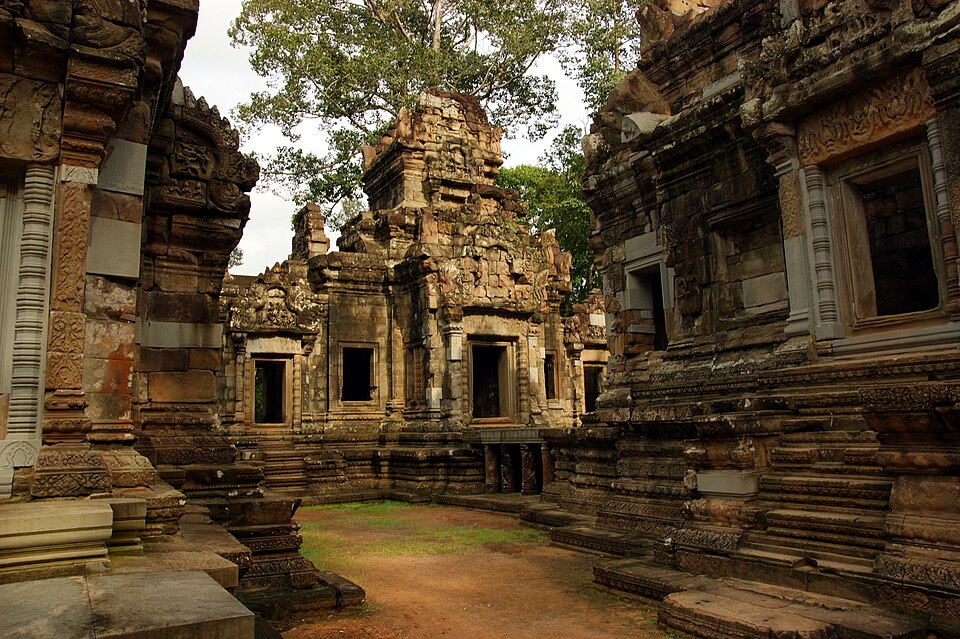
Long before satellites ever photographed it, Angkor was already a secret hiding in plain sight, buried under farmland and forest north of the Tonlé Sap lake and south of the Kulen Hills, in what is now Siem Reap Province, Cambodia. For centuries travelers knew only fragments of it: towers rising from vines, moats choked with lily pads, stone faces staring out from collapsing corridors. It took modern archaeology, and eventually lidar scans from the air, to reveal what those fragments belonged to — the capital of an empire that once ruled much of Southeast Asia.
The story of the place stretches back further than any king. Radiocarbon dating of bivalve shells found in graves at Angkor pushed evidence of settlement to around 420 BC, at the transition from the Late Bronze Age to the Early Iron Age. Those early inhabitants left behind iron and bronze spearheads, iron-bladed knives, hoes for tilling land, and bangles. Iron slag found near the Preah Khan temple complex suggests the area was already tied to networks of craft and trade linking the coasts of Southeast Asia centuries before any temple tower was raised.
Angkor as an imperial capital begins in AD 802, when the Hindu monarch Jayavarman II declared himself a 'universal monarch' and 'god-king,' launching what historians call the Angkorian period. The city took the name Yasodharapura, after the foster mother of Krishna in Hindu tradition, once a major temple under that name was completed around 921. The word Angkor itself comes from the Khmer nokor, meaning 'kingdom,' rooted in the Sanskrit nagara, meaning 'city' — a name that quietly announces the ambition behind the place.
That ambition reached its peak under King Suryavarman II, who took the throne after defeating a rival prince in battle; an inscription claims he leapt onto his rival's war elephant and killed him in the fighting. Once his rule was secure through military campaigns, diplomacy, and firm domestic administration, Suryavarman turned to building Angkor Wat as his personal temple mausoleum, constructed between 1113 and 1150. Its walls run nearly half a mile on each side, and its layout encodes Hindu cosmology in stone: central towers standing for Mount Meru, home of the gods; outer walls for the mountains ringing the world; and the moat for the oceans beyond.
Suryavarman had the temple's walls carved with bas reliefs mixing mythological scenes with images of his own court — in one, the king sits cross-legged on his throne, deliberately rendered larger than the subjects around him, a visual claim to divine status that echoed the old Khmer idea of the devaraja, the god-king whose palace mirrored the home of the celestials.
More from History

The Morning Bingham Climbed to Machu Picchu
On a cold July morning in 1911, an American historian scrambled up a jungle-choked ridge above the Urubamba River — and by afternoon, a forgotten Inca citadel would belong to the world.

The Last Half-Hour of the Hindenburg
It was already half a day late, and the public had been told to keep away — but at seven o'clock that evening, the Hindenburg finally turned toward its mooring mast for the last time.

The Last Hours of Pompeii: August 24, 79 AD
By noon it was just another hot day beside the Bay of Naples. By evening, an entire mountain had rewritten the fate of thousands.

The Longest Walk: Mandela's Last Steps to Freedom
After 27 years behind bars, a 71-year-old man had to relearn how to walk out of a prison gate — into a waiting world of cameras, crowds, and a country holding its breath.

The Document Lincoln Signed on the First Day of 1863
On a single January morning, a president's pen would change the legal status of more than three million people — if the ink held and his hand did not shake.

The Day of the Dream: August 28, 1963
Two hundred and fifty thousand people converged on the National Mall that morning — by nightfall, one voice from the steps of the Lincoln Memorial would echo for generations.