Angkor Wat: The Mountain of God
A king built a temple to become his own tomb — and instead created the largest religious complex on Earth, one that would outlive his empire, his gods, and his name.
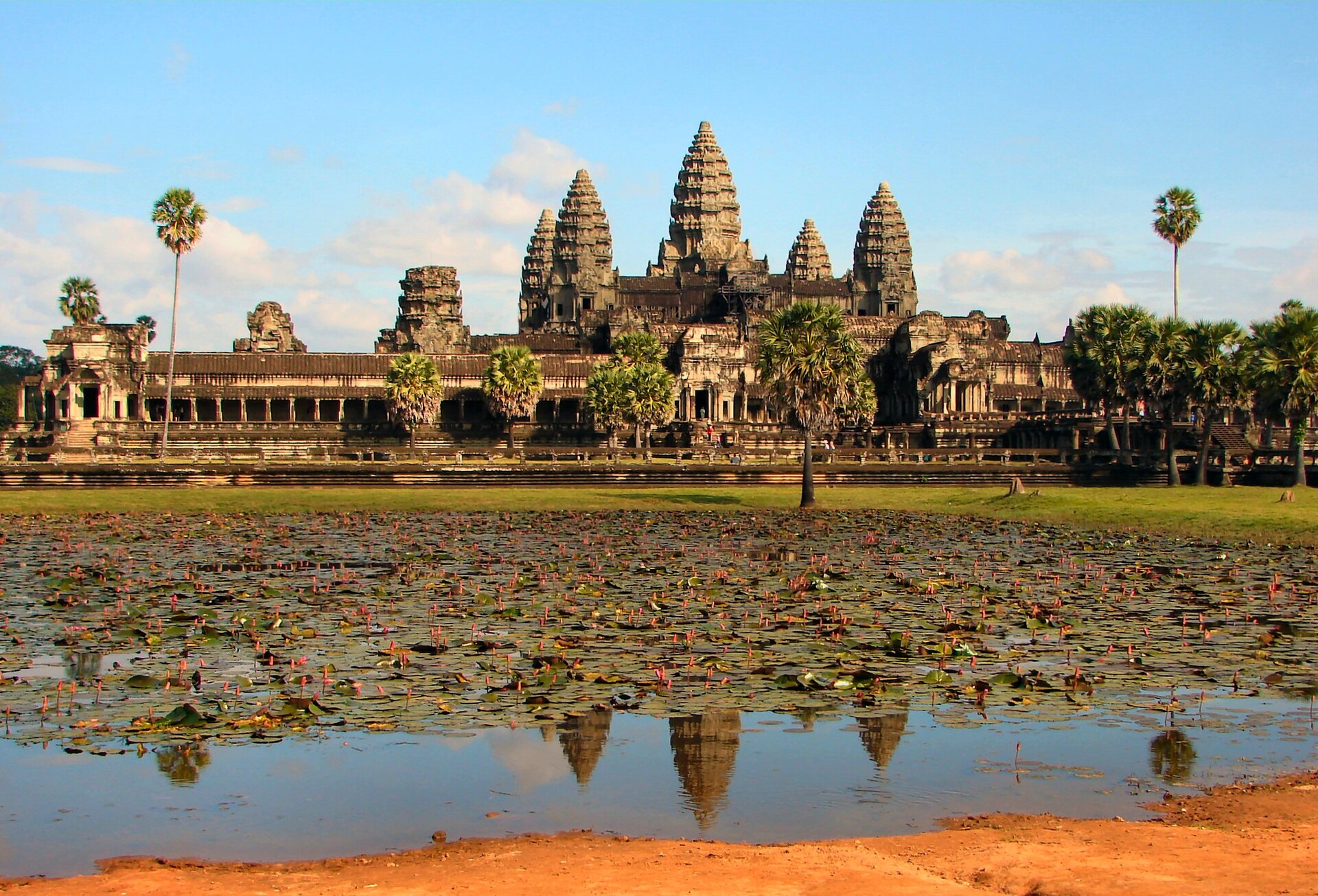
In the early 12th century, in the Khmer capital of Yaśodharapura, King Suryavarman II commissioned a monument on the suggestion of a court priest named Divākarapaṇḍita. Construction took place between 1113 and 1150, spanning decades of labor on a site covering 162.6 hectares within the ancient city of Angkor, in what is now Siem Reap, Cambodia. The result would become the largest religious complex in the world.
Angkor Wat was dedicated to Vishnu, and its design fused two forms characteristic of Khmer architecture: the temple-mountain and the galleried temple. Surrounded by a broad moat and enclosed by an outer wall, the complex rises through three progressively elevated galleries toward a central quincunx of towers. The overall layout is widely interpreted as a symbolic representation of Mount Meru, a cosmological mountain shared by both Hindu and Buddhist traditions. Unusually for Angkorian temples, it faces west rather than east.
Historians long assumed Angkor Wat functioned purely as a ceremonial temple-city, but modern analysis suggests it actually housed a resident population of between 3,000 and 4,300 people. No foundation stela or contemporary inscription naming the temple has ever been found, so its original name remains uncertain — it may have been called Vrah Viṣṇuloka, 'the sacred dwelling of Vishnu,' after its presiding deity. It is generally believed the temple was intended as Suryavarman II's mausoleum. When the king died, work on the temple stopped, leaving some of its extensive bas-relief carvings unfinished.
About 27 years later, in 1178, the Chams — traditional rivals of the Khmer — sacked Angkor. The empire was restored by King Jayavarman VII, who built a new capital, Angkor Thom, with the Bayon as its state temple. Jayavarman VII's wife, Indradevi, was a devout Mahayana Buddhist, and under her influence the king converted, gradually transforming Angkor Wat itself into a Buddhist site as many Hindu sculptures were replaced with Buddhist art.
From the late 13th century onward, Angkor Wat became predominantly associated with Theravāda Buddhism, a role it has never relinquished. Chinese envoy Zhou Daguan and the great voyager Zheng He both visited the temple in the 13th and 14th centuries; Zheng He is said to have studied its architecture, later drawing on it for the Dabaoen Temple and its Glazed Pagoda in China. Archaeologists believe Angkor Wat may also have served defensive purposes in this era — gateway blockages and holes in its outer wall suggest fortifications built as the Khmer capital faced the rising Ayutthaya Empire. Even after the Khmer fell to Ayutthaya in 1431, Angkor Wat remained inhabited, its ponds regularly maintained.
More from Architecture

Stonehenge: The Stones That Refuse to Explain Themselves
For more than 4,500 years, a ring of leaning giants has watched the sun rise and set on the same two days each year — and no one alive can say for certain why.

The Dome That Refused to Fall
Two thousand years ago, Roman engineers poured a dome so vast that no one has dared build a bigger one from unreinforced concrete since. It still stands, open to the sky.

A Minaret Rising Over Kingsland Road
On a busy London street better known for shops and buses, the tallest minaret in Britain quietly reaches into the sky. Its story began not in Sinan's sixteenth-century Istanbul, but in 1990s Hackney.

The Bridge That Was Killed Twice
For 427 years it arched over the Neretva like a stone rainbow. Then, in a matter of days in 1993, it simply ceased to exist.

Hoover Dam: The Concrete That Tamed a River
In the scorched depths of Black Canyon, thousands of men built the largest concrete structure the world had ever seen — and finished it two years early, at a cost of over a hundred lives.

Neuschwanstein: The Castle Built for a Ghost
A king who despised his own palace built the most famous fairy-tale castle on earth — and died before he ever truly lived in it.