Anıtkabir: The Monument That Became a Nation's Address
After a leader died in a palace bedroom, an entire country argued for years over where — and how — to bury him. The answer became a hill visible from every part of Ankara.
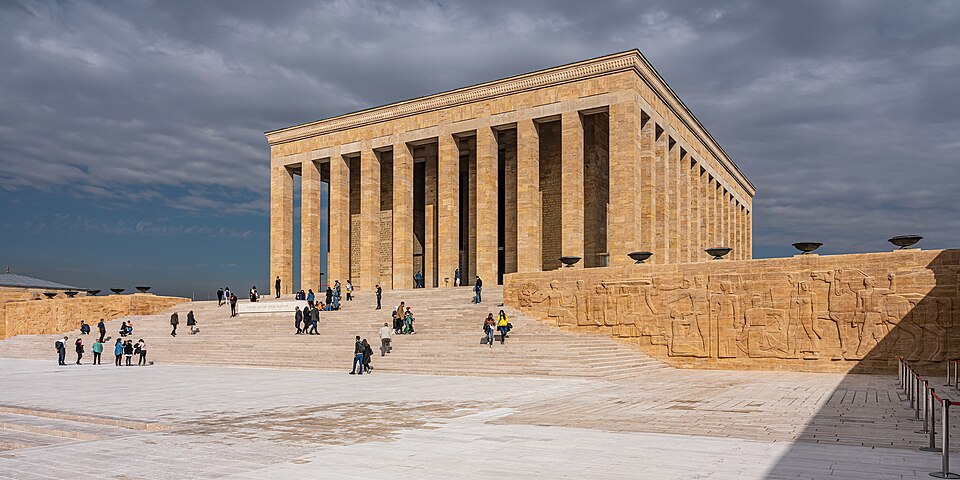
On November 10, 1938, Mustafa Kemal Atatürk died at Dolmabahçe Palace in Istanbul. Almost immediately, arguments broke out in the press over where his remains should rest. On November 13, the government announced a compromise: his body would stay at the Ethnography Museum of Ankara until a proper mausoleum could be built. His funeral cortege reached Ankara on November 19, and on November 21, 1938, he was laid to temporary rest there.
A commission was formed to choose the site, consulting a panel of foreign architects. Their report went to the Republican People's Party parliamentary group, which on January 17, 1939, settled on a hill known as Rasattepe — Observation Hill — a spot then visible from nearly every part of the capital. Because parts of the land belonged to private owners, expropriation work began in June 1939.
Deciding on a design took longer still. On March 1, 1941, an international competition opened to select the mausoleum's architecture. Forty-nine projects arrived from Turkey, Germany, Italy, Austria, Czechoslovakia, France and Switzerland. After delays in assembling a jury, the competition finally closed on March 2, 1942, and jurors — among them Ivar Tengbom, Károly Weichinger and Paul Bonatz — reviewed 47 qualifying entries. The winning concept, by Turkish architects Emin Onat and Orhan Arda, was approved for construction with modifications.
Ground was broken on October 9, 1944. Before builders could lay a single stone properly, archaeologists excavated the hill and uncovered Phrygian artifacts, later placed in Ankara's Museum of Anatolian Civilizations. Construction unfolded in four stages over nine years. The first stage — excavation and the retaining wall of what would become the Lions' Road — finished in 1945. The second, covering the mausoleum itself and its surrounding buildings, ran until August 1950 and required revisions after problems with the masonry and concrete foundations; engineers eventually poured an 11-meter concrete foundation reinforced with steel to resist ground settlement.
The third stage built the roads, the Lions' Road itself, the ceremonial ground, the mausoleum's upper stone pavement, the grand stairs, the tombstone's placement, and the plumbing, electrical and heating systems. The fourth and final stage — laying the Hall of Honor's pavement, vaults, and decorative stone profiles — was completed on September 1, 1953, months later than originally planned.
More from Architecture

Stonehenge: The Stones That Refuse to Explain Themselves
For more than 4,500 years, a ring of leaning giants has watched the sun rise and set on the same two days each year — and no one alive can say for certain why.

The Dome That Refused to Fall
Two thousand years ago, Roman engineers poured a dome so vast that no one has dared build a bigger one from unreinforced concrete since. It still stands, open to the sky.

A Minaret Rising Over Kingsland Road
On a busy London street better known for shops and buses, the tallest minaret in Britain quietly reaches into the sky. Its story began not in Sinan's sixteenth-century Istanbul, but in 1990s Hackney.

The Bridge That Was Killed Twice
For 427 years it arched over the Neretva like a stone rainbow. Then, in a matter of days in 1993, it simply ceased to exist.

Hoover Dam: The Concrete That Tamed a River
In the scorched depths of Black Canyon, thousands of men built the largest concrete structure the world had ever seen — and finished it two years early, at a cost of over a hundred lives.

Neuschwanstein: The Castle Built for a Ghost
A king who despised his own palace built the most famous fairy-tale castle on earth — and died before he ever truly lived in it.