Assur: The City That Refused to Die
For three thousand years, on a bend of the Tigris, a fortress-city rose and fell and rose again — outlasting empires that thought themselves eternal.
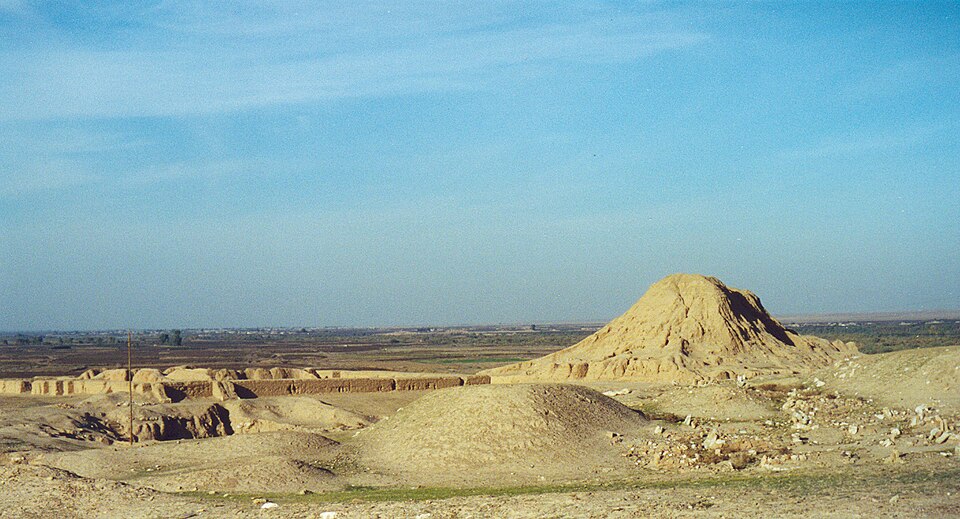
Long before Nineveh's walls gleamed or Babylon's ziggurats climbed toward heaven, there was Assur — a triangular spur of land above the Tigris, sixty-five kilometers south of Nimrud and a hundred south of Nineveh. Early excavators had dated the founding of its Ishtar temple to early in the 3rd millennium BC, and later scholarship had revised that estimate to the Early Dynastic III period, roughly 2600 to 2350 BC. A radiocarbon test on a charcoal sample taken in 2024 from beneath the temple's oldest foundation — laid on a thick bed of pure sand, a technique common in southern Mesopotamia but rare so far north — now pushes the date even earlier still, to somewhere between 2896 and 2702 BC.
Assur did not begin as a conqueror's capital. During the Third Dynasty of Ur, around 2112–2004 BC, it was a provincial outpost, governed by an official named Zariqum, who left an inscription in the Ishtar temple recording his building work there. It was trade, not war, that first made the city rich: kings Ilushuma and Erishum I — rulers of the Old Assyrian period, active around 1939–1900 BC — turned Assur into a hub for tin and textiles flowing between Anatolia and southern Mesopotamia. Within a few generations, merchants at the Anatolian colony of Kanesh had grown wealthy enough to be counted among the millionaires of the ancient world.
From this commercial foundation grew a kingdom. By the 19th century BC, Assur was the seat of a state that would expand for a thousand years — through the Old Assyrian, Middle Assyrian, and finally the Neo-Assyrian Empire, which endured from 911 to 609 BC. Kings like Shalmaneser I, Tiglath-Pileser I, and later Sargon II and Sennacherib pushed the empire's reach from the Persian Gulf to the Mediterranean and briefly to Egypt. Under Ashurbanipal, in the 7th century BC, the empire's power stretched from the Nile to the Persian Gulf — though this brilliance proved brief, and the Assyrian state collapsed under Median attack in 612 BC.
Assur itself, though eventually eclipsed by Nineveh as the imperial capital, remained sacred — the dwelling place of the god Ashur, for whom it was named, and home to temples of Anu, Adad, Sin, Shamash, and Ishtar. Even after the empire's fall, the city endured. It became a semi-independent state under the Parthian Empire between the 2nd century BC and the mid-3rd century AD, before finally being sacked by the Sasanian Empire — a settlement that had persisted, in one form or another, for roughly three thousand years.
After the Sasanian sack, Assur grew sparse, though Assyrian Christian communities lingered nearby until Tamurlane's massacres in the 14th century AD scattered the remaining population into the countryside. The mound of ruins, later known as Qal'at Sherqat, lay quiet for centuries until 19th-century excavators Austen Henry Layard and Hormuzd Rassam made brief forays there while working at Nineveh.
More from History

The Morning Bingham Climbed to Machu Picchu
On a cold July morning in 1911, an American historian scrambled up a jungle-choked ridge above the Urubamba River — and by afternoon, a forgotten Inca citadel would belong to the world.

The Last Half-Hour of the Hindenburg
It was already half a day late, and the public had been told to keep away — but at seven o'clock that evening, the Hindenburg finally turned toward its mooring mast for the last time.

The Last Hours of Pompeii: August 24, 79 AD
By noon it was just another hot day beside the Bay of Naples. By evening, an entire mountain had rewritten the fate of thousands.

The Longest Walk: Mandela's Last Steps to Freedom
After 27 years behind bars, a 71-year-old man had to relearn how to walk out of a prison gate — into a waiting world of cameras, crowds, and a country holding its breath.

The Document Lincoln Signed on the First Day of 1863
On a single January morning, a president's pen would change the legal status of more than three million people — if the ink held and his hand did not shake.

The Day of the Dream: August 28, 1963
Two hundred and fifty thousand people converged on the National Mall that morning — by nightfall, one voice from the steps of the Lincoln Memorial would echo for generations.