Bartolomeu Dias and the Cape of Storms
Blown off course into the open Atlantic, a small Portuguese fleet vanished from sight of land for thirty days — and sailed straight into history.
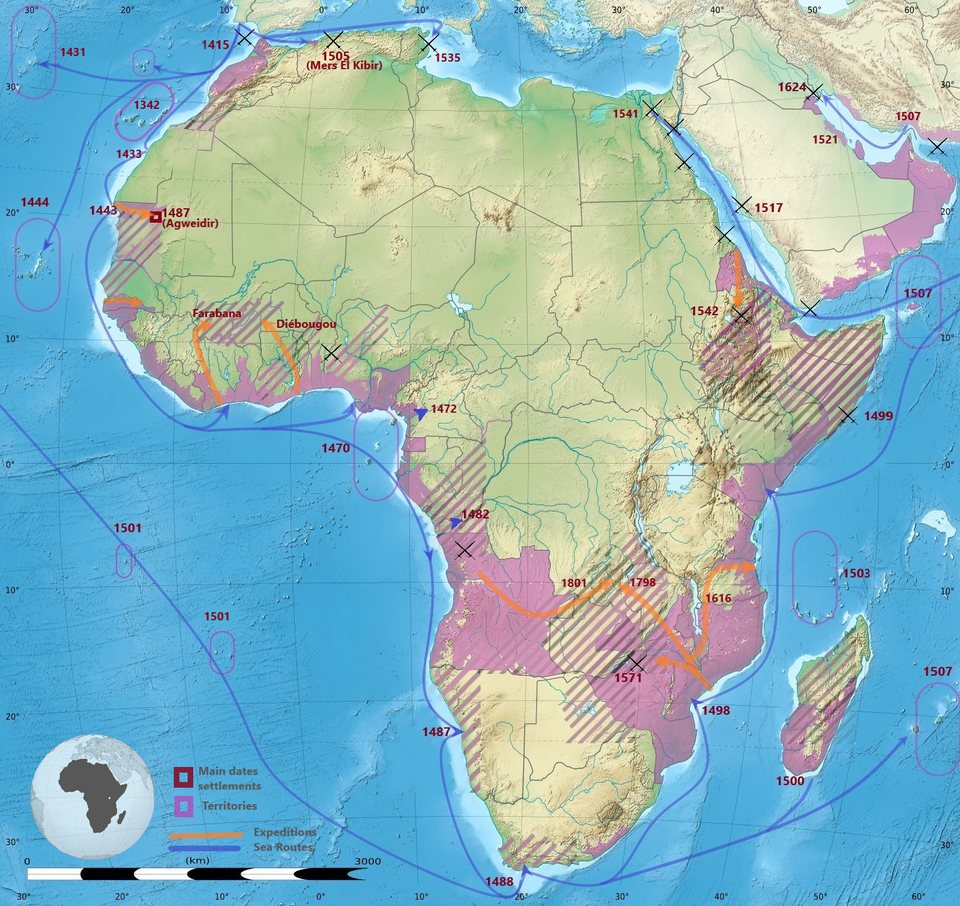
In 1487, Bartolomeu Dias left Lisbon with three ships on a mission carrying centuries of ambition: to push past the farthest point any Portuguese sailor had reached along the African coast, and to search for the legendary Christian ruler known as Prester John. His two caravels, São Cristóvão and São Pantaleão, were commanded alongside a supply ship captained by his brother Diogo. Among his crew were skilled pilots like Pero de Alenquer, veterans of earlier voyages down the same coast, and six Africans previously taken by explorer Diogo Cão, now fluent in Portuguese, meant to be dropped ashore to spread word of the Portuguese kingdom.
Dias carried padrões — carved stone pillars — to plant at each significant landfall, marking Portugal's claim and progress. The fleet sailed to the Congo, then crept down the coast, naming features after saints as they went. At Porto Alexandre in Angola, Dias left the supply ship behind for later resupply. By December 1487 he had already surpassed Cão's earlier record, reaching the Golfo da Conceição — today's Walvis Bay in Namibia.
Then, somewhere along the Namibian coast, the two ships turned southwest, away from land entirely. Whether this was a deliberate search for better winds or the result of being driven off course by a storm remains debated by historians. Whatever the reason, the maneuver worked: for thirty days the ships traced a wide arc through open ocean, out of sight of Africa, until on 4 February 1488 they came upon land again — the southern tip of the continent, at what became known as Mossel Bay.
Continuing east, Dias watched the coastline curve northeast, and it dawned on him what this meant: Portugal's long-sought goal, a route around Africa's southern edge, had been achieved. The expedition pushed to its furthest point on 12 March 1488, anchoring near the mouth of the Boesmans River at Kwaaihoek, where the Padrão de São Gregório was raised. But the crew, exhausted and low on supplies after months at sea, wanted to turn back.
Dias himself wished to press on, but his officers voted unanimously to return, and he yielded to them. Sailing homeward, the ships passed close to the cape they had rounded blind, seeing it for the first time in May 1488. Tradition holds that Dias named it Cabo das Tormentas — the Cape of Storms — a fitting name for the ordeal that had carried them there. King John II would later rename it the Cape of Good Hope, a name meant to celebrate the promise of a sea route to the east.
More from Explorations

Humboldt: The Man Who Measured the World
A Prussian noble's son, once mocked as a sickly child, would climb a volcano to a world-record height and rewrite how humanity understood nature itself.

The Man Who Named Canada
A Breton mariner planted a wooden cross on a foreign shore and claimed a kingdom he did not understand — then spent a winter frozen into its river, praying a stranger's remedy would save his men.

Sixty Ships Into the Unknown: Hanno's Voyage Down the African Coast
A Carthaginian fleet of sixty ships and thousands of settlers vanished past the Pillars of Hercules to found cities on an unmapped coast — and came home with the skins of hairy, hostile 'gorillas' as proof of how far they had gone.

HMS Challenger: The Voyage That Charted the Deep
A stripped-down warship, its guns torn out to make room for microscopes, set sail from Portsmouth to answer a question no one had ever properly asked: what lies at the bottom of the sea?

Scott's Last Expedition: The Letters Written at the End of the World
Five men reached the bottom of the world only to find a Norwegian flag already planted there. What followed was not glory, but a slow, frozen unraveling that the world would remember for a century.

Marco Polo: In the Court of Kublai Khan
A fifteen-year-old boy meets the father he barely knew — and is soon swept toward the richest court on Earth. Twenty-four years later, he returns home with tales so vast that Venice simply calls him 'Mister Millions'.