Borobudur: The Stone Mandala Hidden in Ash and Jungle
A mountain of carved stone, buried for centuries under volcanic ash and creeping jungle, waited in silence until a colonial governor's curiosity brought it back into the world.
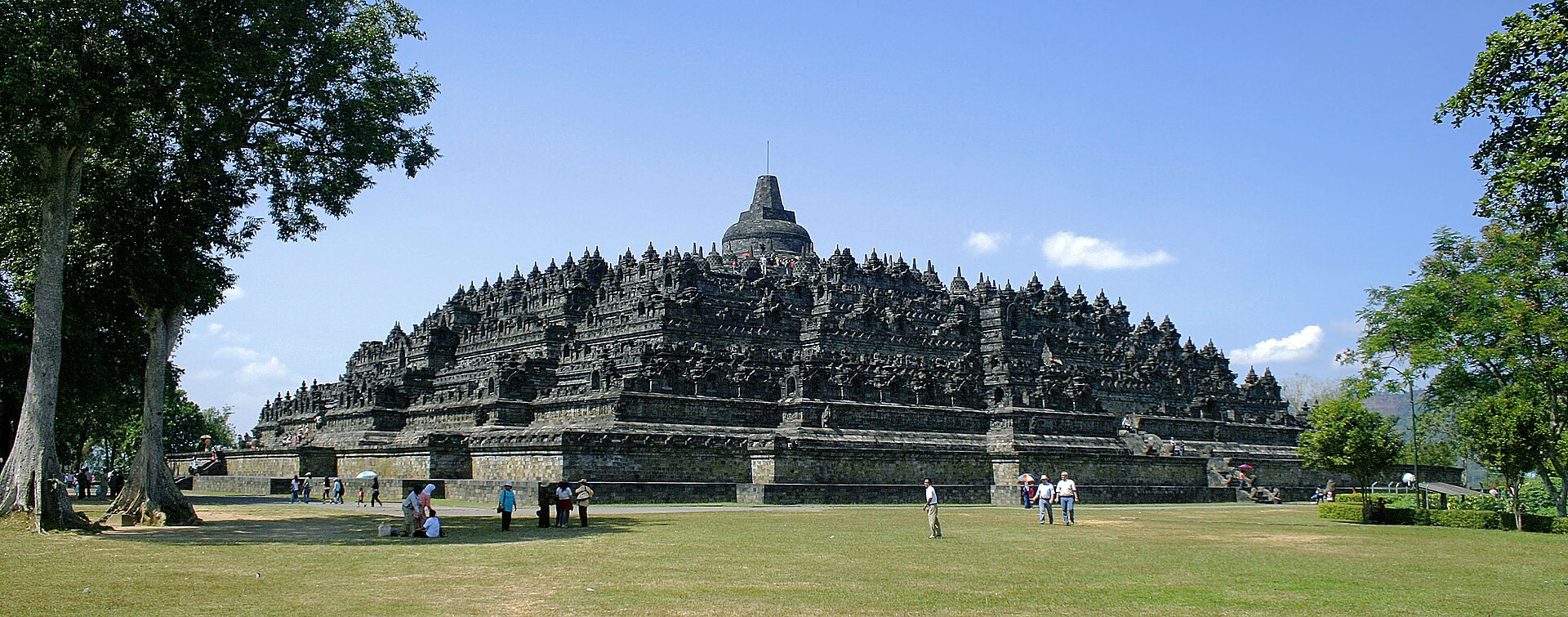
Rising from the fertile Kedu Plain in Central Java, between the twin volcanoes of Sundoro-Sumbing and Merbabu-Merapi, and cradled by the Progo and Elo rivers, Borobudur is not merely a temple but a mountain built by human hands. Constructed of gray andesite-like stone under the Sailendra Dynasty, it was likely founded around 800 CE, during a period between 760 and 830 when Sailendra power reached its height. Construction is estimated to have taken 75 years, reaching completion around 825 during the reign of Samaratungga. Two million blocks of stone, each weighing about 40 kilograms, were fitted together to raise nine stacked platforms — six square, three circular — crowned by a central dome.
The structure is a staggering canvas of devotion. It carries 2,672 relief panels, including 1,460 narrative reliefs lining the walls and balustrades, guiding pilgrims through corridors and stairways in a journey meant to mirror the path to enlightenment. Originally, 504 Buddha statues populated the monument, with 72 more seated inside perforated stupas encircling the central dome. Seen from above, the entire complex forms the shape of a mandala — a cosmic diagram rendered permanently in stone.
Borobudur's design fuses two spiritual traditions: the indigenous Indonesian veneration of ancestors and the Buddhist pursuit of nirvana. Inscriptions found in the Kedu region, including the Karangtengah inscription of 824 and the Tri Tepusan inscription of 842, mention a sacred building — possibly Borobudur itself — inaugurated by Pramodhawardhani, daughter of Samaratungga, and connected to a structure called Bhūmisambhāra, meaning a mountain uniting virtues achieved through the stages of Boddhisattvahood.
The temple's name has puzzled scholars for two centuries. Stamford Raffles, who first brought Borobudur to global attention, recorded it as 'Bóro Bódo' in 1817, suggesting 'Boro' referred to a district and 'bódo' meant ancient. Other researchers have proposed meanings ranging from 'great Buddha' to 'monastery of Buddha on a high place,' derived from Old Javanese and Sanskrit roots. No single explanation has been definitively confirmed, and the true meaning remains part of Borobudur's mystery.
During early 20th-century restoration work, Dutch engineer Theodoor van Erp discovered that Borobudur aligns in a straight line with two other Buddhist temples nearby, Pawon and Mendut, suggesting a ritual relationship between the three sites whose exact nature remains unknown. Some scholars have also speculated that an ancient lake once surrounded the temple, a theory debated intensely among archaeologists throughout the 20th century.
More from Architecture

Stonehenge: The Stones That Refuse to Explain Themselves
For more than 4,500 years, a ring of leaning giants has watched the sun rise and set on the same two days each year — and no one alive can say for certain why.

The Dome That Refused to Fall
Two thousand years ago, Roman engineers poured a dome so vast that no one has dared build a bigger one from unreinforced concrete since. It still stands, open to the sky.

A Minaret Rising Over Kingsland Road
On a busy London street better known for shops and buses, the tallest minaret in Britain quietly reaches into the sky. Its story began not in Sinan's sixteenth-century Istanbul, but in 1990s Hackney.

The Bridge That Was Killed Twice
For 427 years it arched over the Neretva like a stone rainbow. Then, in a matter of days in 1993, it simply ceased to exist.

Hoover Dam: The Concrete That Tamed a River
In the scorched depths of Black Canyon, thousands of men built the largest concrete structure the world had ever seen — and finished it two years early, at a cost of over a hundred lives.

Neuschwanstein: The Castle Built for a Ghost
A king who despised his own palace built the most famous fairy-tale castle on earth — and died before he ever truly lived in it.