Cannae: The Day Hannibal Perfected Annihilation
On a hot August day in 216 BC, Rome sent its greatest army ever assembled onto a dusty plain — and watched Hannibal turn its own numbers into a trap.
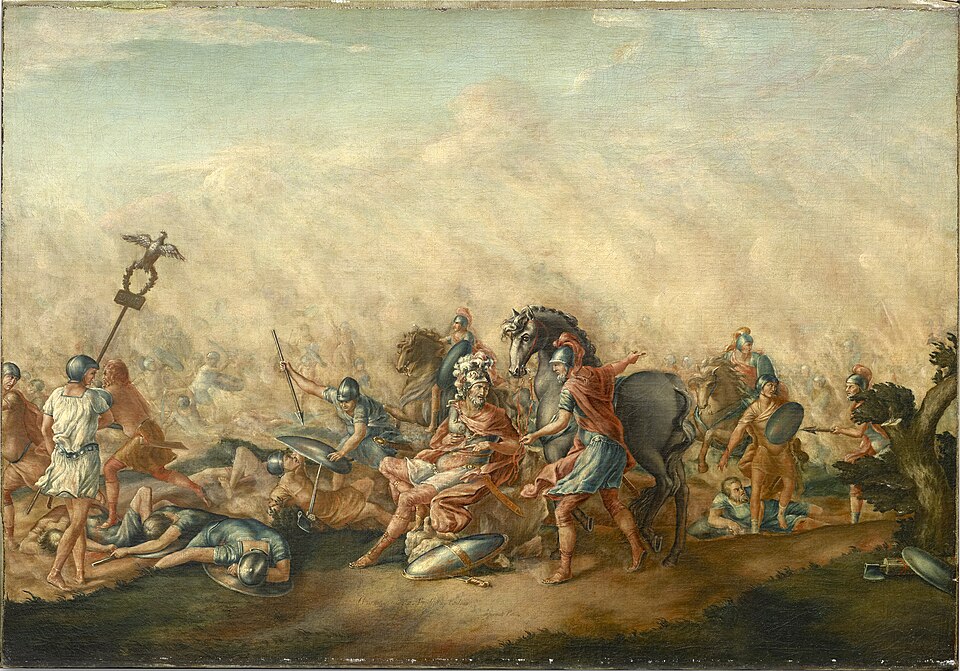
On 2 August 216 BC, near a small Apulian village called Cannae, two armies met that would decide the fate of the Second Punic War. The Romans, still smarting from crushing losses at Trebia and Lake Trasimene, had raised an unprecedented force: eight legions instead of the usual four, roughly 86,000 Roman and allied troops under the joint command of consuls Lucius Aemilius Paullus and Gaius Terentius Varro. Facing them was Hannibal, the Carthaginian general who had already humiliated Rome twice, commanding a smaller army of about 40,000 heavy infantry, 6,000 light infantry and 8,000 cavalry — some 54,000 men in all.
The road to Cannae had been shaped by frustration. After Rome's early disasters, the Senate appointed Quintus Fabius Maximus Verrucosus dictator, and he pursued a strategy of attrition — avoiding pitched battle, harassing Hannibal's supply lines, wearing him down slowly. It worked militarily but not politically: Romans grew impatient watching their countryside plundered while their allies wavered. When Fabius's term ended, the Senate did not renew it. Instead, Varro and Paullus were elected consul and given the largest army Rome had ever fielded, with orders to finish Hannibal decisively.
Hannibal made the first move that spring, seizing a major supply depot at Cannae, cutting the Romans off from a vital source of grain. This forced Rome's hand — the new army marched to confront him rather than let the crisis fester. Roman law required the two consuls to alternate command daily. Paullus, the more cautious of the two, worried about facing Hannibal's superior cavalry in open terrain, but a recent skirmish victory under Varro had boosted Roman confidence, and the army camped near the river regardless.
Hannibal, aware that command would pass to the more impetuous Varro, sent cavalry to harass the Roman camp's water supply. As he anticipated, Varro could not tolerate the threat and led the army out to fight. The Romans arranged their infantry in an unusually deep formation, hoping sheer mass would crack the Carthaginian center. Hannibal placed his weakest infantry in the middle, with his strongest cavalry on the flanks — a deliberate invitation.
When the Roman legions surged forward, Hannibal's center bent backward under the pressure but did not break. The Romans, sensing victory, pressed deeper into what was actually a widening pocket. Meanwhile, Hannibal's cavalry crushed the Roman horsemen on the wings and then wheeled around behind the Roman infantry. The result was a double envelopment: the Roman army, packed too tightly to maneuver, found itself surrounded on all sides and was slaughtered where it stood.
More from History

The Morning Bingham Climbed to Machu Picchu
On a cold July morning in 1911, an American historian scrambled up a jungle-choked ridge above the Urubamba River — and by afternoon, a forgotten Inca citadel would belong to the world.

The Last Half-Hour of the Hindenburg
It was already half a day late, and the public had been told to keep away — but at seven o'clock that evening, the Hindenburg finally turned toward its mooring mast for the last time.

The Last Hours of Pompeii: August 24, 79 AD
By noon it was just another hot day beside the Bay of Naples. By evening, an entire mountain had rewritten the fate of thousands.

The Longest Walk: Mandela's Last Steps to Freedom
After 27 years behind bars, a 71-year-old man had to relearn how to walk out of a prison gate — into a waiting world of cameras, crowds, and a country holding its breath.

The Document Lincoln Signed on the First Day of 1863
On a single January morning, a president's pen would change the legal status of more than three million people — if the ink held and his hand did not shake.

The Day of the Dream: August 28, 1963
Two hundred and fifty thousand people converged on the National Mall that morning — by nightfall, one voice from the steps of the Lincoln Memorial would echo for generations.