Çatalhöyük: The People of the First City
Beneath a wheat field near Konya lie the stacked rooftops of a nine-thousand-year-old town — a place with no palaces, no temples, and no streets, entered only through the roof.
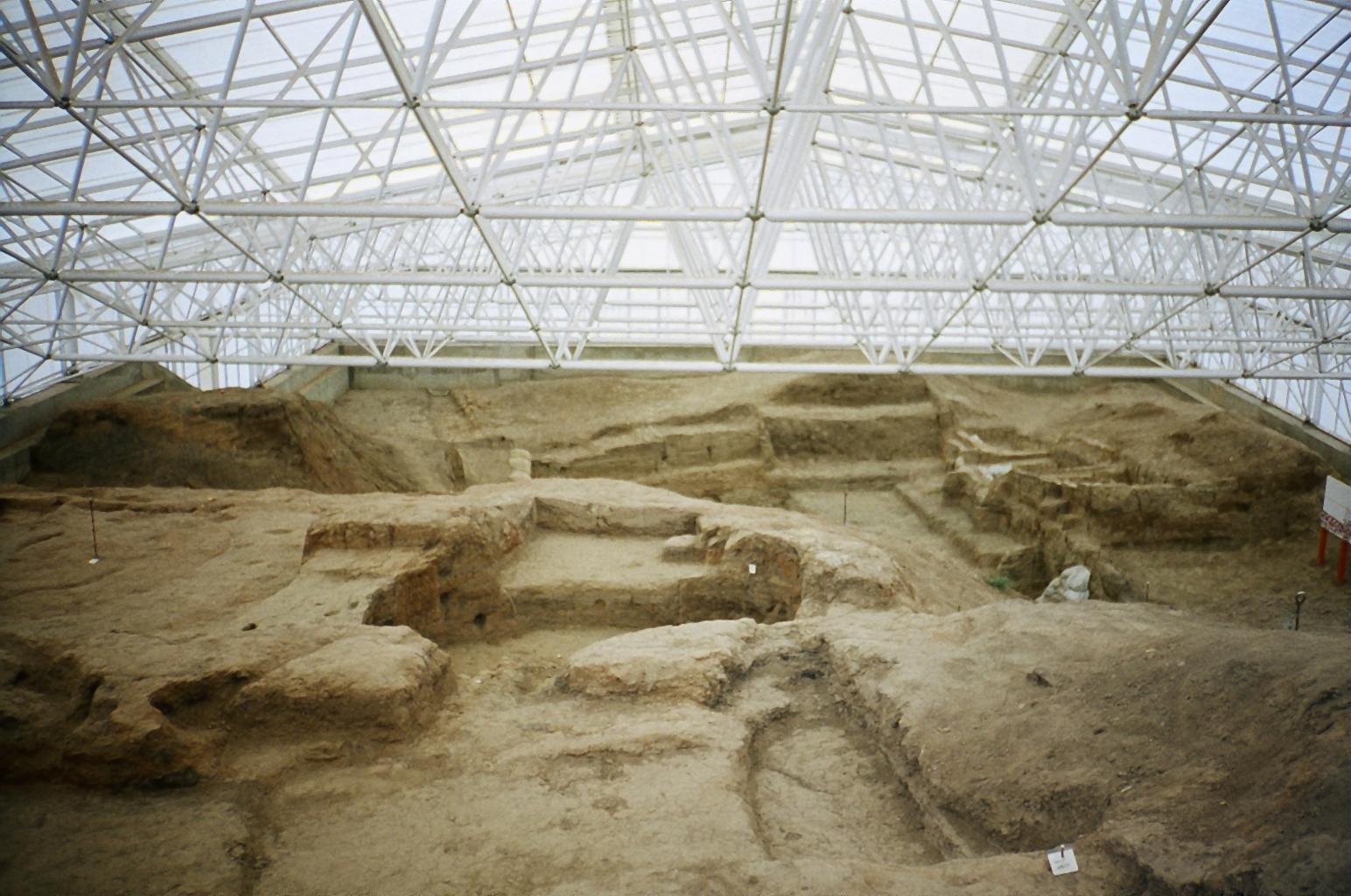
On a mound overlooking the Konya Plain, roughly 140 kilometres from the twin-coned volcano of Mount Hasan, lie the remains of one of the most extraordinary settlements ever uncovered from the Neolithic world. Çatalhöyük existed from around 7500 BC to 5600 BC, flourishing near 7000 BC, and it consists of two mounds — an Eastern Mound about 12.5 hectares in area and 20 metres high, and a smaller Western Mound roughly 400 metres across, occupied later, beginning around 5600 BC in the Early Chalcolithic period.
The site was first noticed by British archaeologist James Mellaart in 1958 during a survey of the Konya Plain. He excavated there for four seasons between 1961 and 1965, uncovering eighteen successive layers of buildings and revealing this corner of Anatolia as a centre of advanced Neolithic culture. Mellaart's career later became entangled in controversy: he was banned from Turkey over the Dorak affair, in which he had published drawings of supposedly important Bronze Age artifacts that subsequently vanished, and it has been suggested that some of the wall paintings and figurines he reported were fabricated.
After Mellaart, the site lay idle until 1993, when Ian Hodder, then at the University of Cambridge and once a student of Mellaart's, began a new excavation project that continued until 2018. Hodder chose Çatalhöyük as a real-world test of his theory of post-processual archaeology, and the project became known for progressive methods — adaptable digital recording, computerised technologies, and community involvement. Surface surveys began the work in the mid-1990s, with excavation starting in earnest in 1995.
On the Western Mound, where Mellaart had opened only two trenches in 1961, later teams took up the work: Jonathan Last and Catriona Gibson in 1998, followed in 2006 by teams under Burçin Erdoğu and under Peter Biehl and Eva Rosenstock. Excavations there continue under Ali Umut Türkcan of Anadolu University.
Most recently, in August 2025, a team led by Prof. Dr. Arkadiusz Marciniak of Poznań University uncovered a mortuary structure dubbed the 'House of the Dead' or 'Spiritual House.' Inside, the remains of twenty individuals had been placed beneath the floor, suggesting ritual use. Nearby stood a large ceremonial building with painted walls, supported by fourteen platforms, along with a smaller, plastered structure.
More from History

The Morning Bingham Climbed to Machu Picchu
On a cold July morning in 1911, an American historian scrambled up a jungle-choked ridge above the Urubamba River — and by afternoon, a forgotten Inca citadel would belong to the world.

The Last Half-Hour of the Hindenburg
It was already half a day late, and the public had been told to keep away — but at seven o'clock that evening, the Hindenburg finally turned toward its mooring mast for the last time.

The Last Hours of Pompeii: August 24, 79 AD
By noon it was just another hot day beside the Bay of Naples. By evening, an entire mountain had rewritten the fate of thousands.

The Longest Walk: Mandela's Last Steps to Freedom
After 27 years behind bars, a 71-year-old man had to relearn how to walk out of a prison gate — into a waiting world of cameras, crowds, and a country holding its breath.

The Document Lincoln Signed on the First Day of 1863
On a single January morning, a president's pen would change the legal status of more than three million people — if the ink held and his hand did not shake.

The Day of the Dream: August 28, 1963
Two hundred and fifty thousand people converged on the National Mall that morning — by nightfall, one voice from the steps of the Lincoln Memorial would echo for generations.