Desert Storm: The War the World Watched Live
Within two days of crossing the border, Iraqi tanks had swallowed Kuwait whole. What followed was a five-week bombing campaign, a hundred-hour ground war, and the birth of a new kind of conflict — one broadcast live into living rooms around the globe.
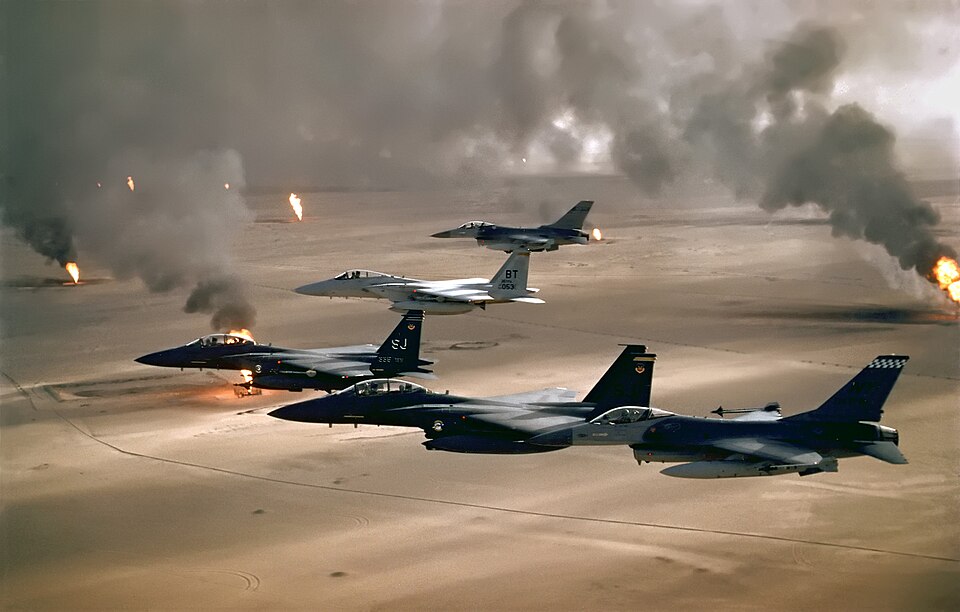
On 2 August 1990, Iraqi forces under Saddam Hussein rolled across the border into Kuwait and occupied the small, oil-rich emirate within two days. The invasion had roots in Iraq's crushing debt from its recently ended war with Iran, disputes over the Rumaila oil field, and long-standing grievances about Kuwait's borders. Baghdad soon annexed the country, carving it into the Basra and Kuwait governorates, as if Kuwait had simply ceased to exist.
The world reacted swiftly. The United Nations Security Council demanded immediate withdrawal and slapped a total embargo on Iraqi and Kuwaiti trade. Under U.S. President George H. W. Bush, a coalition began assembling in the Persian Gulf — eventually numbering 42 nations, the broadest military alliance since the Second World War. The United States, Saudi Arabia, the United Kingdom, and Egypt were its largest contributors, while Saudi Arabia alone shouldered 36 billion dollars of the war's roughly 60-billion-dollar cost.
This buildup phase, known as Operation Desert Shield, ran from August 1990 to January 1991. On 29 November, the Security Council issued an ultimatum: withdraw by 15 January or face 'all necessary means' to force the issue. Iraq did not move. On 17 January 1991, the coalition unleashed Operation Desert Storm, opening with a relentless five-week campaign of aerial and naval bombardment against targets across Iraq and Kuwait.
Saddam tried to fracture the coalition by firing Scud missiles at Israel, hoping to provoke an Israeli response that would alienate the coalition's Muslim-majority members. Israel held back, and the missiles — also aimed at Saudi Arabia — failed to achieve their strategic purpose. Meanwhile, the war was becoming something new: CNN's live front-line broadcasts turned distant desert combat into nightly television, and cockpit-camera footage from American aircraft earned the conflict the nickname 'Video Game War.'
On 24 February 1991, the coalition launched its ground offensive, sweeping Iraqi forces out of Kuwait and pushing into Iraqi territory itself. The ground war lasted a hundred hours, and the coalition halted its advance and declared a ceasefire once Kuwait was liberated — but the operation as a whole, which had begun with the air campaign on 17 January, did not formally conclude until 28 February 1991. Some of the largest tank battles in American military history unfolded in this brief window — the Battle of Medina Ridge, the Battle of Norfolk, and the Battle of 73 Easting — surpassed in scale only by the Battle of the Bulge.
More from History

The Morning Bingham Climbed to Machu Picchu
On a cold July morning in 1911, an American historian scrambled up a jungle-choked ridge above the Urubamba River — and by afternoon, a forgotten Inca citadel would belong to the world.

The Last Half-Hour of the Hindenburg
It was already half a day late, and the public had been told to keep away — but at seven o'clock that evening, the Hindenburg finally turned toward its mooring mast for the last time.

The Last Hours of Pompeii: August 24, 79 AD
By noon it was just another hot day beside the Bay of Naples. By evening, an entire mountain had rewritten the fate of thousands.

The Longest Walk: Mandela's Last Steps to Freedom
After 27 years behind bars, a 71-year-old man had to relearn how to walk out of a prison gate — into a waiting world of cameras, crowds, and a country holding its breath.

The Document Lincoln Signed on the First Day of 1863
On a single January morning, a president's pen would change the legal status of more than three million people — if the ink held and his hand did not shake.

The Day of the Dream: August 28, 1963
Two hundred and fifty thousand people converged on the National Mall that morning — by nightfall, one voice from the steps of the Lincoln Memorial would echo for generations.