Dolmabahçe: The Last Palace on the Bosphorus
A sultan filled in a bay to build a palace that would swallow a quarter of his empire's yearly revenue — and, in the end, outlive it.
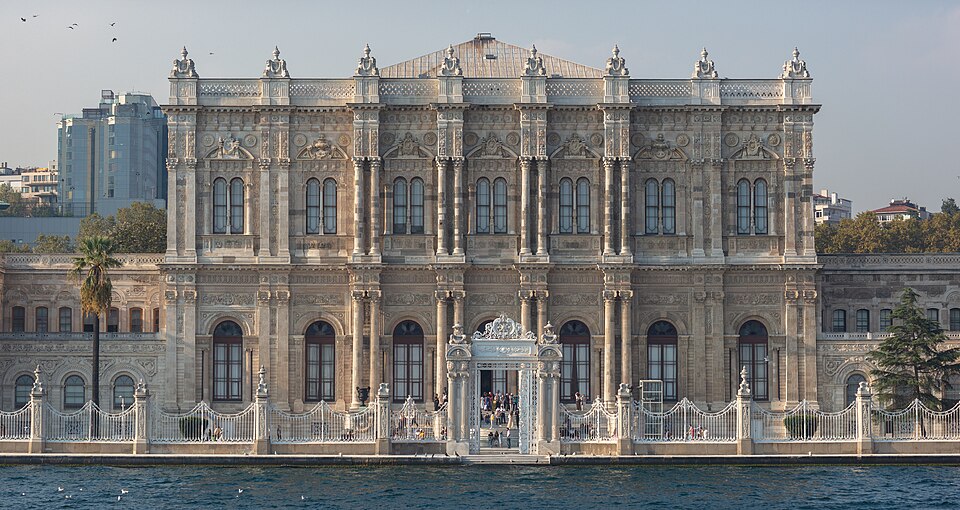
Where the Bosphorus once lapped against an open bay, Ottoman admirals had for centuries anchored their fleets. Slowly, over generations, the water was filled in, turning the cove into an imperial garden the Ottomans called dolma bahçe — 'filled garden.' Small wooden pavilions and kiosks rose there over the eighteenth and nineteenth centuries, forming a loose complex known as the Beşiktaş Waterfront Palace, a favorite retreat of sultans who found the ancient Topkapı Palace too austere for a modern age.
It was Sultan Abdülmecid I, the empire's 31st ruler, who decided the dynasty needed something grander — a palace to rival the courts of Europe. Construction began in 1843 under the supervision of Hacı Said Ağa, with the design carried out by the Armenian court architects Garabet Balyan, his son Nigoğayos Balyan, and Evanis Kalfa. By 1853 the palace was largely built, though a French visitor that year noted the decorations were still unfinished and the furniture not yet in place. The palace was formally inaugurated on June 7, 1856, following the Treaty of Paris that ended the Crimean War.
The cost was staggering: five million Ottoman lira, the equivalent of roughly 35 tonnes of gold — about a quarter of the empire's entire annual tax revenue, or some three billion dollars in today's terms. The treasury paid for it through debased currency, floods of paper money, and foreign loans, burdens that helped push the Ottoman state toward the default of October 1875 and the foreign-controlled Public Debt Administration established in 1881. Abdülmecid himself lived in his monumental creation for only about five years before his death.
What rose on that reclaimed shoreline was unlike anything the empire had built before. The palace building itself covers 45,000 square meters, set within a larger 250,000-square-meter riverside grounds, and contains 285 rooms, 46 halls, six hammams and 68 toilets. Dolmabahçe blended Baroque, Rococo and Neoclassical flourishes with the internal logic of a traditional Ottoman household. From the water, its facade — stretching some 600 meters along the European shore — presented a thoroughly European face, twin wings flanking a grand central block. Inside, it remained rigidly Ottoman: a southern wing, the Mabeyn-i Hümâyûn, for state business and male visitors, and a northern harem wing, the Harem-i Hümâyûn, with eight interconnected apartments for the sultan's wives, favorites, and mother, sealed off from outside eyes.
Between these two worlds stood the Ceremonial Hall, a soaring space of 2,000 square meters crowned by a 36-meter dome, used twice yearly under Sultan Abdülhamid II for holiday receptions. Overhead hung the palace's most famous object: the world's largest crystal chandelier, weighing 4.5 tonnes and carrying 750 lamps. Long believed to be a gift from Queen Victoria, a receipt discovered in 2006 revealed the sultan had paid for it himself. Fourteen tonnes of gold gilded the ceilings throughout the palace, and the Crystal Staircase, shaped like a double horseshoe, was built from Baccarat crystal, brass and mahogany — one part of the largest collection of Bohemian and Baccarat chandeliers anywhere in the world.
More from Architecture

Stonehenge: The Stones That Refuse to Explain Themselves
For more than 4,500 years, a ring of leaning giants has watched the sun rise and set on the same two days each year — and no one alive can say for certain why.

The Dome That Refused to Fall
Two thousand years ago, Roman engineers poured a dome so vast that no one has dared build a bigger one from unreinforced concrete since. It still stands, open to the sky.

A Minaret Rising Over Kingsland Road
On a busy London street better known for shops and buses, the tallest minaret in Britain quietly reaches into the sky. Its story began not in Sinan's sixteenth-century Istanbul, but in 1990s Hackney.

The Bridge That Was Killed Twice
For 427 years it arched over the Neretva like a stone rainbow. Then, in a matter of days in 1993, it simply ceased to exist.

Hoover Dam: The Concrete That Tamed a River
In the scorched depths of Black Canyon, thousands of men built the largest concrete structure the world had ever seen — and finished it two years early, at a cost of over a hundred lives.

Neuschwanstein: The Castle Built for a Ghost
A king who despised his own palace built the most famous fairy-tale castle on earth — and died before he ever truly lived in it.