Dunkirk: The Town Built on Dunes and Sieges
Long before its name became shorthand for a wartime miracle, this small Flemish fishing village on the North Sea had already been fought over, flooded, sold, and rebuilt a dozen times.
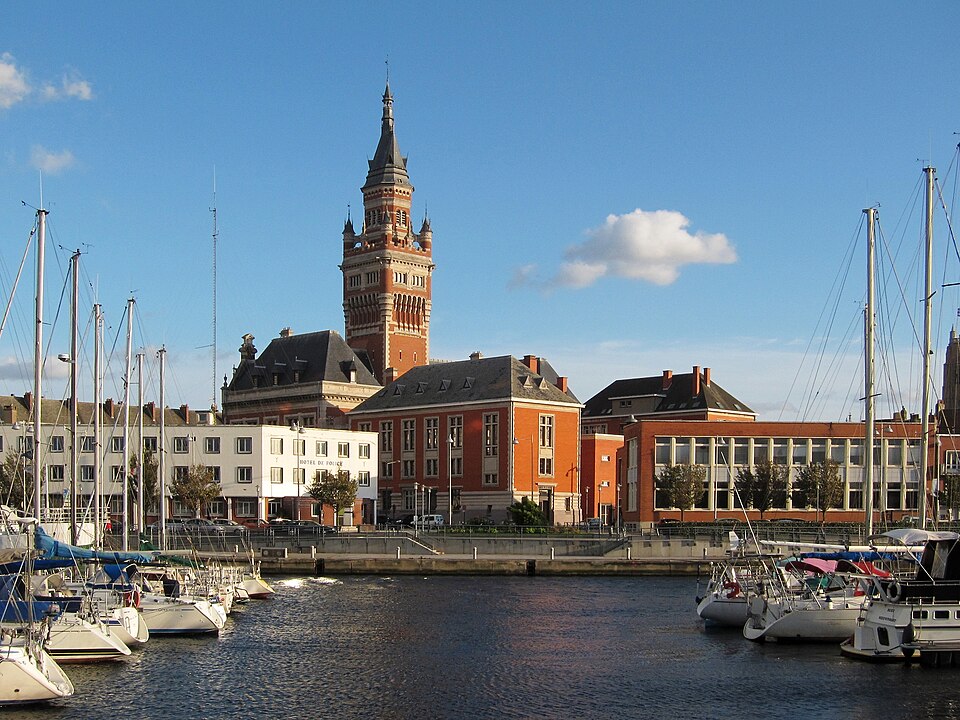
The city of Dunkirk sits on the North Sea coast of northern France, just 10 kilometres from the Belgian border, in the department of Nord. Its name comes from the West Flemish words for 'dune' and 'church' — literally, 'church in the dunes' — a fitting description for a settlement that rose out of flooded coastal wetlands late in the tenth century. Today it holds the third-largest harbour in France and a population of roughly 90,995, but its origins were humble: a fishing village protected by a wall built around 960 AD by Count Baldwin III to guard against Viking raids.
The monks of nearby Bergues Abbey drained and cultivated the surrounding marshland, and on 27 May 1067 the name 'Dunkirka' was first mentioned in a tithe privilege issued by Count Baldwin V of Flanders. Count Philip I expanded the cultivated land further in the twelfth century, laid the first plans for a canal linking Dunkirk to Bergues, and granted the town market rights. Dunkirk's people were never passive bystanders in these feudal struggles — in the late thirteenth century they sided with the French crown against their own count, Guy of Flanders, during the Franco-Flemish War, a decision that brought both defeat and eventual autonomy.
The fourteenth century brought upheaval after upheaval. After becoming count in 1322, Louis I faced the Peasant Revolt of 1323–1328, crushed by King Philippe VI of France at the Battle of Cassel, after which Dunkirk suffered repressive royal measures. When the Hundred Years' War broke out in 1337, Louis banned maritime trade, provoking yet another revolt from the town's frustrated citizens. After his death at the Battle of Crécy in 1346, his son Louis II signed a truce with England, and Dunkirk's port flourished and expanded — until English partisans of Pope Urban VI seized and flooded the town during the Western Schism, leaving devastation before King Charles VI drove them out.
With the death of Louis II in 1384, the line of the Counts of Flanders ended, and the region passed to the Burgundian Duke Philip the Bold. Dunkirk's fortifications grew, including a belfry daymark used for navigation. Its strategic position made it a constant prize: claimed by the Duke of Bar in 1395, by Louis de Luxembourg in 1435, and eventually secured through marriage by Archduke Maximilian of Habsburg in 1477. After a French seizure and a Habsburg military victory, Dunkirk became part of the Spanish Netherlands, an arrangement that would hold for a century.
In the chaos of the Eighty Years' War, Dunkirk changed hands again — briefly Dutch from 1577, reclaimed by Spanish forces under Alexander Farnese in 1583. It became the home port of the Dunkirkers, a notorious band of privateers. French forces captured the city in 1646, only for Spain to retake it in 1652. Then in 1658, after a siege following the Battle of the Dunes, Franco-English forces seized Dunkirk, and it was handed to England the following year as part of an anti-Spanish alliance. English governors — Sir William Lockhart, Sir Edward Harley, and Lord Rutherford — administered the town for four short years.
More from History

The Morning Bingham Climbed to Machu Picchu
On a cold July morning in 1911, an American historian scrambled up a jungle-choked ridge above the Urubamba River — and by afternoon, a forgotten Inca citadel would belong to the world.

The Last Half-Hour of the Hindenburg
It was already half a day late, and the public had been told to keep away — but at seven o'clock that evening, the Hindenburg finally turned toward its mooring mast for the last time.

The Last Hours of Pompeii: August 24, 79 AD
By noon it was just another hot day beside the Bay of Naples. By evening, an entire mountain had rewritten the fate of thousands.

The Longest Walk: Mandela's Last Steps to Freedom
After 27 years behind bars, a 71-year-old man had to relearn how to walk out of a prison gate — into a waiting world of cameras, crowds, and a country holding its breath.

The Document Lincoln Signed on the First Day of 1863
On a single January morning, a president's pen would change the legal status of more than three million people — if the ink held and his hand did not shake.

The Day of the Dream: August 28, 1963
Two hundred and fifty thousand people converged on the National Mall that morning — by nightfall, one voice from the steps of the Lincoln Memorial would echo for generations.