Ephesus: The City the Sea Left Behind
A fish, a wild boar, and a exiled prince — that is how legend says one of the ancient world's greatest cities was born. Its ruins still stand, though the sea that made it rich vanished centuries ago.
Long before marble columns rose along its streets, the ground where Ephesus would stand was already alive with human footsteps. Excavations at the nearby mounds of Arvalya and Çukuriçi show people settled here as early as 6000 BC, during the Neolithic Age. By the Bronze Age, a settlement had taken root on Ayasuluk Hill, and Hittite records speak of a place called Apasa, capital of the kingdom of Arzawa — a name scholars believe is the ancestor of 'Ephesus' itself. A Mycenaean burial ground discovered in 1954 near the ruins of the Basilica of St. John, dated to around 1500–1400 BC, hints at the Greek world's earliest reach into this corner of Anatolia.
The city's Greek story begins properly in the 10th century BC, when Attic and Ionian colonists built Ephesus atop the old Arzawan capital. Legend credits its founding to Androklos, a prince of Athens forced from his homeland after his father King Kodros died. An oracle at Delphi told him a fish and a boar would reveal where to build his city — and so, the story goes, he did. Androklos went on to unite the twelve cities of Ionia into the Ionian League, prospering as king until he fell in battle defending the city of Priene. His image, with his dog, was later carved into the frieze of the Temple of Hadrian.
Ephesus's fortunes were tied early to Lydia, the inland kingdom whose rulers intermarried with Ephesian leaders and depended on the city's port for trade. That closeness had a price: around 640 BC, Cimmerian raiders sacked Ephesus and its sacred Artemis sanctuary, following an earlier attack on Sardis. Decades later, Lydia's King Croesus besieged the city himself, only to relent — struck, perhaps, by the Ephesians' clever trick of tying a rope from the city walls to the sanctuary of Artemis for protection. Croesus later became a major patron in rebuilding the Temple of Artemis, an act of contrition for the near-sacrilege.
That temple, completed around 550 BC, would become one of the Seven Wonders of the Ancient World — the largest building in the ancient world, according to the geographer Pausanias. Here, the Greek goddess Artemis merged with the Anatolian mother goddess Kybele into the many-breasted 'Lady of Ephesus,' worshipped in a sanctuary of extraordinary scale. Scarcely a trace of the original structure survives today, but its fame outlived its stones.
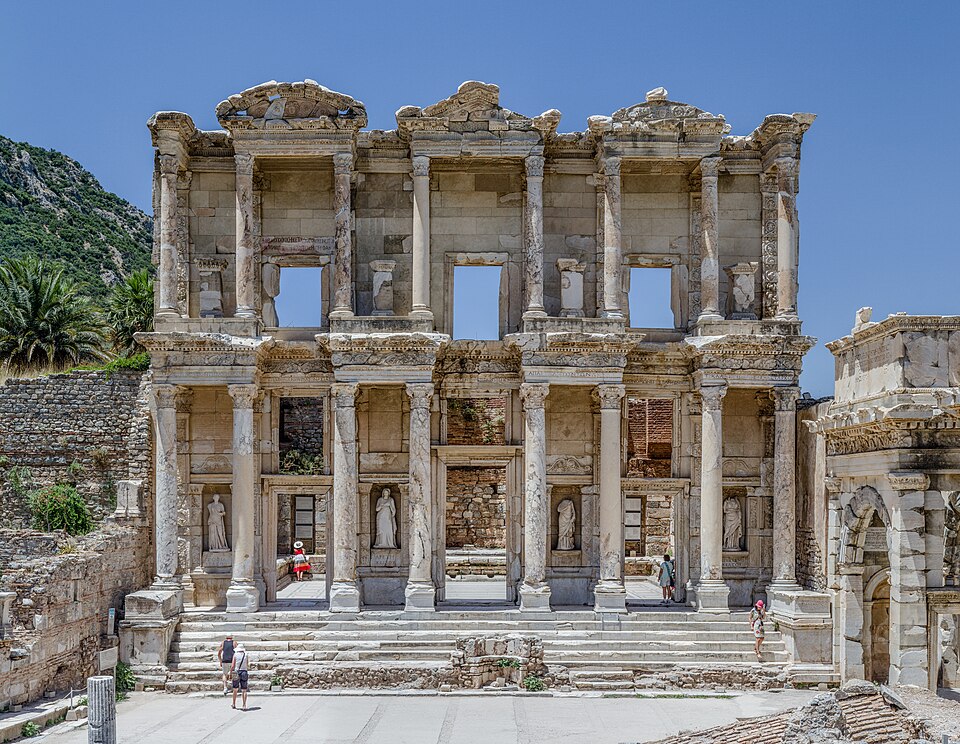
Roman rule arrived in 129 BC, when Ephesus came under the control of the Roman Republic, and the city entered its golden age. Under Emperor Augustus it became the capital of the Roman province of Asia, its population swelling past 200,000 by some estimates. Marble buildings multiplied — the Library of Celsus, and a theatre eventually completed under Emperor Trajan capable of holding 24,000 spectators. Ephesus was, by any measure, one of the great cities of the Mediterranean world.
More from Archaeology

The Bronze Disc That Rewrote the Sky
Two looters with a metal detector dug up something illegal, invisible in value, and older than Stonehenge's final stones — a map of the heavens buried for over three thousand years.

The Faceless Women of the Ice Age
Long before writing, before cities, before the wheel, someone carved a woman's body into stone and ivory — and left no name, no face, no explanation.

The Pebble That Might Be Human
A palm-sized stone found on a Moroccan riverbank may be humanity's oldest attempt to see itself — or simply a trick of erosion.

The Crown That Vanished: Deshret and the Red Land
A crown worn by kings for three thousand years has never once been found in a tomb — not one. So where did it go?

The Face That Traveled Between Empires
A farm worker's shovel struck stone in 1897 and unearthed a face so striking it would be sold to France, seized as war booty, and finally traded back for a Velázquez.

The Boy in the Dark Tunnel
A schoolboy fell into black water inside an ancient tunnel and surfaced with his fingers brushing letters no one had noticed for 2,600 years.