Four Voyages West: How Columbus Stumbled Into a New World
He was chasing spices and silk in Asia. What he found instead would rewrite the map of the world — and he never quite admitted the difference.
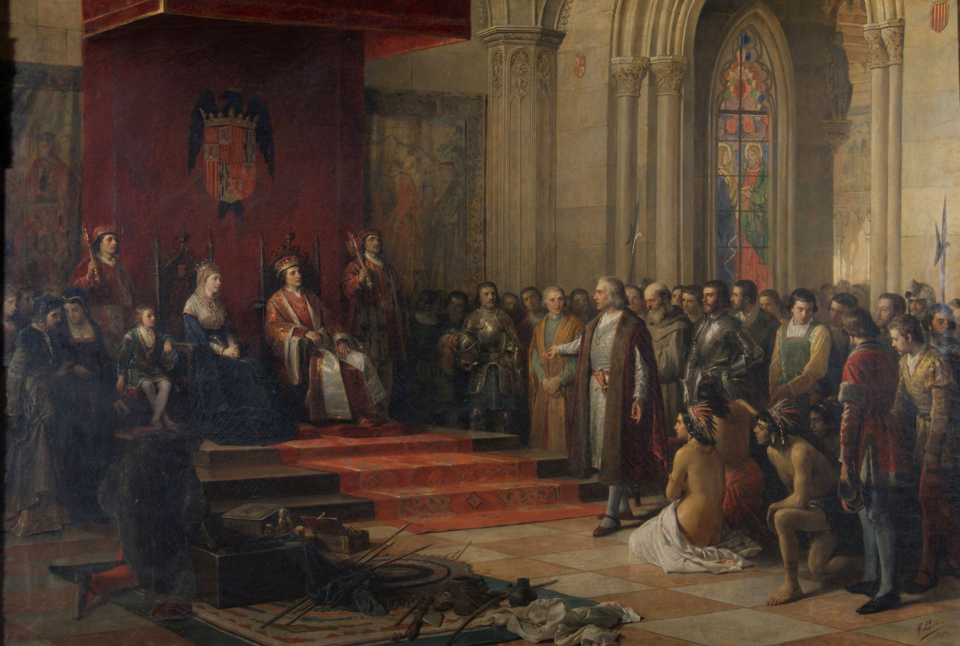
In the summer of 1492, three modest ships slipped out of the Spanish port of Huelva and turned their bows toward an ocean most Europeans believed had no far shore worth reaching. Christopher Columbus, a Genoese navigator who had spent years pitching an audacious idea to any crown that would listen, finally had his chance. His plan was simple in concept and wildly wrong in detail: sail directly west across the Atlantic — the single, supposedly uninterrupted 'Ocean Sea' — and reach Asia, the fabled Indies of silk, spices and Marco Polo's tales.
Columbus was not fighting flat-earth ignorance, despite the myth that later took hold. Educated Europeans of his day knew the Earth was round; the science went back to the ancient Greeks and had been reinforced through the Middle Ages. What Columbus got wrong was scale. He believed the Earth was far smaller than scholars like Ptolemy calculated, and that Asia lay just a few thousand nautical miles west of Europe. That miscalculation, absurd as it was, happened to work in his favor: it meant an unknown landmass was there to be found roughly where he expected land to appear.
His timing mattered as much as his math. The fall of Constantinople to the Ottomans in 1453 had unsettled old trade routes to Asia, pushing European powers to hunt for new paths by sea. Portugal already dominated the African coast and Indian Ocean routes, sealed in by a 1481 papal bull. Spain, newly unified through the marriage of Isabella of Castile and Ferdinand of Aragon and freshly triumphant after completing the Reconquista in 1492 with the conquest of Granada, was hungry for its own route to riches — and willing to gamble on Columbus's westward scheme.
The fleet that set out was small: the Santa María, a larger carrack under Columbus's direct command, and two lighter caravels, the Pinta and the Niña, captained by the Pinzón brothers. Trouble began almost immediately — the Pinta's rudder broke just three days out, repaired only after a stop in the Canary Islands, where the crews resupplied and the Niña's sails were reconfigured before the ships committed to five weeks of open Atlantic crossing.
That first voyage, in 1492–1493, delivered Columbus to islands he was certain were the outer edges of Asia — hence the enduring, mistaken label 'West Indies' still attached to the Bahamas and the Caribbean. He would return three more times between then and 1504, each voyage probing further into the Caribbean and the coasts of Central and South America, each time convinced he was closing in on Chinese or Japanese shores that, in truth, did not lie where he thought.
More from Explorations

Humboldt: The Man Who Measured the World
A Prussian noble's son, once mocked as a sickly child, would climb a volcano to a world-record height and rewrite how humanity understood nature itself.

The Man Who Named Canada
A Breton mariner planted a wooden cross on a foreign shore and claimed a kingdom he did not understand — then spent a winter frozen into its river, praying a stranger's remedy would save his men.

Sixty Ships Into the Unknown: Hanno's Voyage Down the African Coast
A Carthaginian fleet of sixty ships and thousands of settlers vanished past the Pillars of Hercules to found cities on an unmapped coast — and came home with the skins of hairy, hostile 'gorillas' as proof of how far they had gone.

HMS Challenger: The Voyage That Charted the Deep
A stripped-down warship, its guns torn out to make room for microscopes, set sail from Portsmouth to answer a question no one had ever properly asked: what lies at the bottom of the sea?

Scott's Last Expedition: The Letters Written at the End of the World
Five men reached the bottom of the world only to find a Norwegian flag already planted there. What followed was not glory, but a slow, frozen unraveling that the world would remember for a century.

Marco Polo: In the Court of Kublai Khan
A fifteen-year-old boy meets the father he barely knew — and is soon swept toward the richest court on Earth. Twenty-four years later, he returns home with tales so vast that Venice simply calls him 'Mister Millions'.