Gordion: The King's Tomb Beneath Midas Mound
Beneath a earthen mound outside Ankara lies a wooden chamber untouched for nearly three thousand years — and a name that still echoes through legend: Midas.
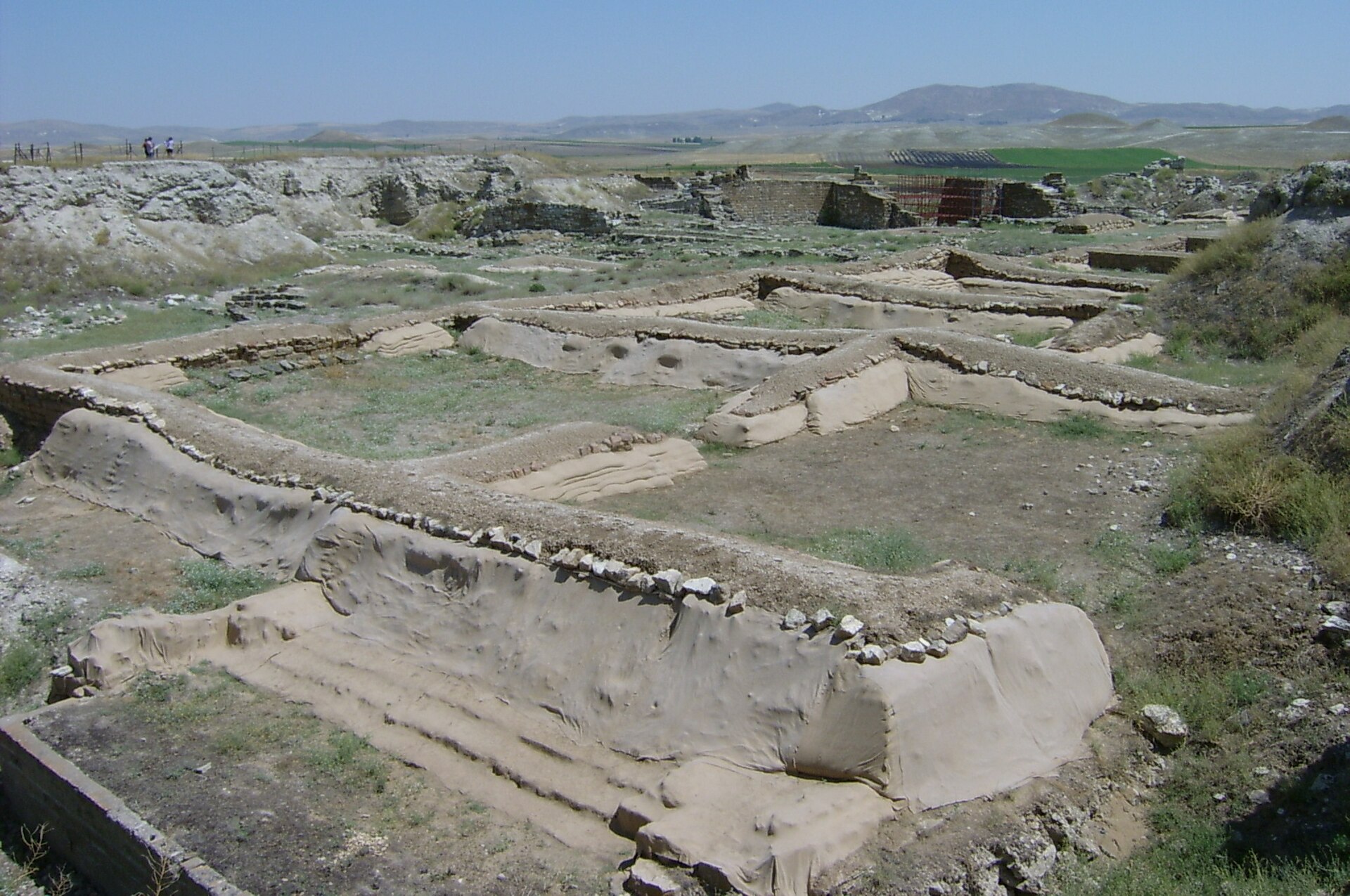
Seventy kilometers southwest of Ankara, where the Sakarya and Porsuk rivers meet near the town of Polatlı, a modest village called Yassıhüyük sits atop one of the most consequential archaeological sites in Anatolia. This was Gordion, capital of ancient Phrygia, occupied continuously from around 2300 BCE through the 4th century CE, and again briefly in the 13th and 14th centuries. Its position at the crossing of the ancient road linking Lydia to Assyria and Babylonia made it a strategic prize, controlling fertile land and a river crossing that merchants, armies, and kings all had to reckon with.
The first excavations at Gordion began in the early 1900s under Gustav and Alfred Körte. Decades later, from 1950 to 1973, the University of Pennsylvania Museum of Archaeology and Anthropology, led by Rodney S. Young, undertook a far more extensive campaign. What they uncovered was a citadel mound of about 13.5 hectares, once part of a settlement sprawling across 100 hectares at its height — the type site of Phrygian civilization itself.
Gordion's most dramatic chapter unfolds around 800 BCE, when a massive fire swept the eastern side of the Citadel Mound. Young initially attributed this destruction to a Cimmerian raid around 700 BCE, an event later Greek and Roman writers — Strabo and Eusebius — connected to the death of King Midas. But the fire did something remarkable for archaeology: it sealed buildings and hundreds of objects beneath as much as five meters of clay, preserving an elite Iron Age district almost intact, unmatched anywhere else in Anatolia.
Among the buildings frozen by that fire were monumental megarons with pebble mosaic floors — among the earliest known examples of such decorative flooring — and the Terrace Building, a chain of eight interconnected structures over a hundred meters long, where grain was ground, food cooked, and textiles woven. The East Citadel Gate, still standing ten meters high, remains the best-preserved gate of its kind in Anatolia, a monument to the power projected by Phrygian rulers.
Before that fire, around 850 BCE, Gordion's inhabitants had already begun a tradition that would define the site for centuries: the tumulus burial. Tumulus W, built at that time, is the earliest known example of this practice in Anatolia, and it marked the beginning of a long line of elite burial mounds — roughly 85 of them eventually surrounding the city, a tradition likely brought by Phrygian migrants from the Balkans.
More from Archaeology

The Bronze Disc That Rewrote the Sky
Two looters with a metal detector dug up something illegal, invisible in value, and older than Stonehenge's final stones — a map of the heavens buried for over three thousand years.

The Faceless Women of the Ice Age
Long before writing, before cities, before the wheel, someone carved a woman's body into stone and ivory — and left no name, no face, no explanation.

The Pebble That Might Be Human
A palm-sized stone found on a Moroccan riverbank may be humanity's oldest attempt to see itself — or simply a trick of erosion.

The Crown That Vanished: Deshret and the Red Land
A crown worn by kings for three thousand years has never once been found in a tomb — not one. So where did it go?

The Face That Traveled Between Empires
A farm worker's shovel struck stone in 1897 and unearthed a face so striking it would be sold to France, seized as war booty, and finally traded back for a Velázquez.

The Boy in the Dark Tunnel
A schoolboy fell into black water inside an ancient tunnel and surfaced with his fingers brushing letters no one had noticed for 2,600 years.