Into the Unmapped West
Two young Army officers, a river of unknown length, and a president's dream of an ocean route — what could go wrong?
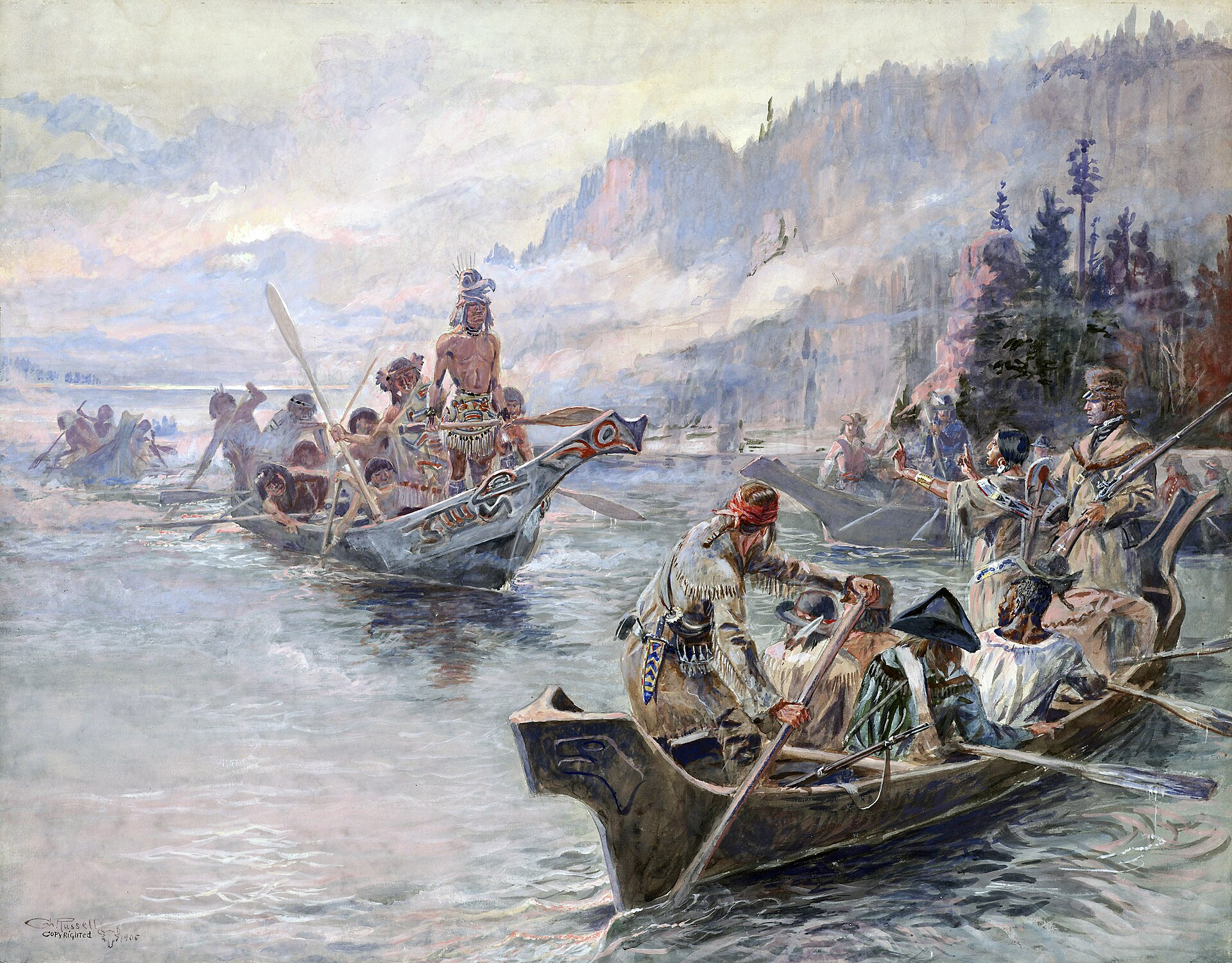
In the spring of 1804, a keelboat pushed off from Camp Dubois in Illinois carrying William Clark and thirty companions into a landscape the United States had only just purchased and barely understood. President Thomas Jefferson had bought the vast Louisiana Territory from France in 1803, doubling the size of the young nation overnight, but no American had mapped what lay within it. Jefferson wanted answers, and he wanted them fast, before European powers could stake their own claims.
Jefferson's ambitions were not merely territorial. For years he had devoured travel accounts — Captain James Cook's voyages to the Pacific, Le Page du Pratz's history of Louisiana — and he had once discussed a Pacific expedition with the adventurer John Ledyard in Paris during his time as Minister to France. He was especially unsettled by the Scottish explorer Alexander Mackenzie, who in 1793 had already crossed mainland North America to reach the Pacific coast of British Columbia, a full twelve years before any American would manage the feat. Mackenzie's published account convinced Jefferson that Britain intended to seize control of the Columbia River fur trade, and that the United States needed to move first.
To lead the mission, Jefferson chose his own secretary, Army Captain Meriwether Lewis, praising him as a rare figure who combined scientific knowledge with the physical toughness and frontier instincts the journey demanded. Lewis in turn asked his close friend, Second Lieutenant William Clark, to share command. Before departure, Jefferson made sure Lewis was properly prepared: he sent him to Philadelphia to study medicine under Benjamin Rush, navigation under astronomer Andrew Ellicott, botany and specimen preservation under Benjamin Smith Barton, and geographic computation under Robert Patterson, while naturalist Caspar Wistar briefed him on fossils.
Congress funded the venture with $2,324, a sum Jefferson requested through a secret message to avoid friction with the opposition Federalist Party, even as he offered other, more diplomatic explanations to Spanish, French, and British officials watching his moves. In Philadelphia, the purveyor of public supplies, Israel Whelen, assembled an eclectic cargo list from Lewis's requirements: 193 pounds of portable soup, 130 rolls of pigtail tobacco, 30 gallons of strong spirit of wine, mosquito netting, oilskin bags, medical supplies, and a wide assortment of goods meant as gifts for Native American tribes.
Clark's party set out from Camp Dubois on May 14, 1804, and rendezvoused with Lewis and ten more men at St. Charles, Missouri, before the combined Corps of Discovery — roughly thirty-three people in all — began working its way up the Missouri River. Their mission carried multiple purposes at once: to find a practical water route to the Pacific that would avoid the harsh deserts of the Southwest, to assert American sovereignty over lands inhabited by numerous Native nations, to catalog the West's plants, animals, and terrain, and to open trade relations wherever possible.
More from Explorations

Humboldt: The Man Who Measured the World
A Prussian noble's son, once mocked as a sickly child, would climb a volcano to a world-record height and rewrite how humanity understood nature itself.

The Man Who Named Canada
A Breton mariner planted a wooden cross on a foreign shore and claimed a kingdom he did not understand — then spent a winter frozen into its river, praying a stranger's remedy would save his men.

Sixty Ships Into the Unknown: Hanno's Voyage Down the African Coast
A Carthaginian fleet of sixty ships and thousands of settlers vanished past the Pillars of Hercules to found cities on an unmapped coast — and came home with the skins of hairy, hostile 'gorillas' as proof of how far they had gone.

HMS Challenger: The Voyage That Charted the Deep
A stripped-down warship, its guns torn out to make room for microscopes, set sail from Portsmouth to answer a question no one had ever properly asked: what lies at the bottom of the sea?

Scott's Last Expedition: The Letters Written at the End of the World
Five men reached the bottom of the world only to find a Norwegian flag already planted there. What followed was not glory, but a slow, frozen unraveling that the world would remember for a century.

Marco Polo: In the Court of Kublai Khan
A fifteen-year-old boy meets the father he barely knew — and is soon swept toward the richest court on Earth. Twenty-four years later, he returns home with tales so vast that Venice simply calls him 'Mister Millions'.