Korea: The War Nobody Wanted to Remember
It began at dawn on a summer Sunday, and by 28 June, three days later, Seoul had fallen. Three years, a million military dead, and an armistice later, nothing had really been decided.
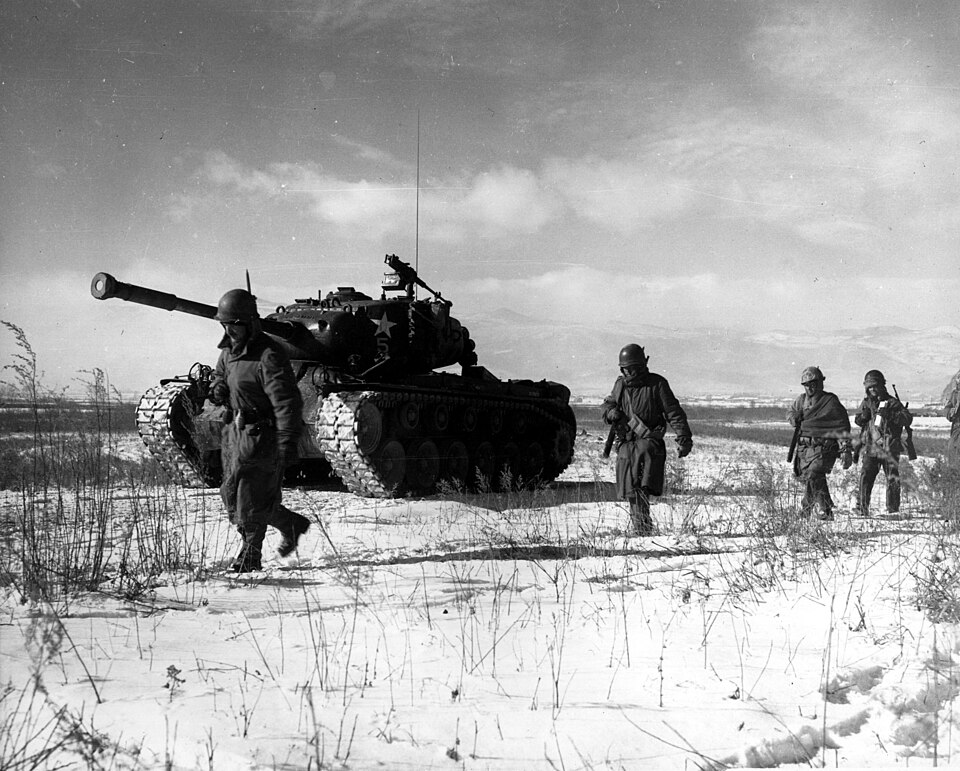
On the morning of 25 June 1950, the Korean People's Army rolled south across the 38th parallel in an operation code-named Pokpung. Kim Il Sung, ruling from Pyongyang, wanted the peninsula unified under Communist rule, and his Soviet-trained and Soviet-equipped forces caught South Korea's army badly unprepared. Seoul, the southern capital, was captured by the KPA on 28 June, just three days after the invasion began. It was the first hot conflict of the Cold War, and it erupted along a border that had barely existed five years earlier.
That border was itself an accident of the war's aftermath. Korea had been a Japanese colony since 1910, following Japan's victories over China and Russia and Japan's move to make Korea its protectorate through the Eulsa Treaty of 1905. When Japan surrendered in 1945, the United States and the Soviet Union divided the peninsula at the 38th parallel into occupation zones, intending eventually to unite it. Instead, by 1948 each zone had formed its own government — Syngman Rhee's Republic of Korea in Seoul, Kim Il Sung's Democratic People's Republic of Korea in Pyongyang — and both claimed sole legitimacy over all of Korea.
Washington read the invasion as evidence of a coordinated Soviet-Chinese thrust. President Harry Truman ordered General Douglas MacArthur to supply South Korea and pushed the matter to the United Nations Security Council. With the Soviet delegate boycotting the session over China's UN representation, the Council passed American-backed resolutions condemning the invasion and calling on member states to help repel it. Twenty-one countries eventually contributed to the UN Command, though the United States supplied roughly 90 percent of the personnel.
Despite the UN resolution, North Korean forces pushed on, and within three months they controlled most of the peninsula, squeezing South Korean and allied troops into the Pusan Perimeter around the port city of Busan. An attempt to break the allied line at Daegu failed after a month and a half of fighting. Then, on 15 September, UN forces staged a landing at Inchon, near Seoul, severing North Korean supply lines. The breakout from Pusan followed on 18 September, Seoul was recaptured, and UN troops pushed north into North Korea, taking Pyongyang and advancing toward the Yalu River, the border with China.
That advance provoked the war's next turn: on 19 October, the Chinese People's Volunteer Army crossed the Yalu. Turkey had already committed troops under the UN banner — the Turkish parliament had voted on 30 June 1950 to send forces, partly as a bid to secure NATO membership against the perceived Soviet threat. The 1st Turkish Brigade, roughly 5,090 strong under Brigadier General Tahsin Yazıcı, sailed from İskenderun in September 1950 and landed at Busan in October, later training with American equipment at Taegu. In late November, ordered north toward the Chinese border, the brigade was caught near Kunuri when Chinese forces infiltrated behind the front. Its 1st Battalion was surrounded and forced into bayonet fighting; the 9th Company of the 3rd Battalion, holding the line to cover the retreat, was wiped out.
More from History

The Morning Bingham Climbed to Machu Picchu
On a cold July morning in 1911, an American historian scrambled up a jungle-choked ridge above the Urubamba River — and by afternoon, a forgotten Inca citadel would belong to the world.

The Last Half-Hour of the Hindenburg
It was already half a day late, and the public had been told to keep away — but at seven o'clock that evening, the Hindenburg finally turned toward its mooring mast for the last time.

The Last Hours of Pompeii: August 24, 79 AD
By noon it was just another hot day beside the Bay of Naples. By evening, an entire mountain had rewritten the fate of thousands.

The Longest Walk: Mandela's Last Steps to Freedom
After 27 years behind bars, a 71-year-old man had to relearn how to walk out of a prison gate — into a waiting world of cameras, crowds, and a country holding its breath.

The Document Lincoln Signed on the First Day of 1863
On a single January morning, a president's pen would change the legal status of more than three million people — if the ink held and his hand did not shake.

The Day of the Dream: August 28, 1963
Two hundred and fifty thousand people converged on the National Mall that morning — by nightfall, one voice from the steps of the Lincoln Memorial would echo for generations.