Kush: The Black Pharaohs of the Nile
For a hundred years, the pharaohs of Egypt were not Egyptian at all — they came from a kingdom south of the cataracts that Egypt had once ruled, and then feared.
South of Egypt, where the Nile churns through granite cataracts, a civilization rose long before pyramids capped Giza. Around 7500 BC, the people of Nabta Playa built stone alignments that may be among the world's earliest astronomical devices, predating Stonehenge by nearly two thousand years. Their planned villages and deep, permanent wells hint at a society already organizing itself around order and observation, long before written history began.
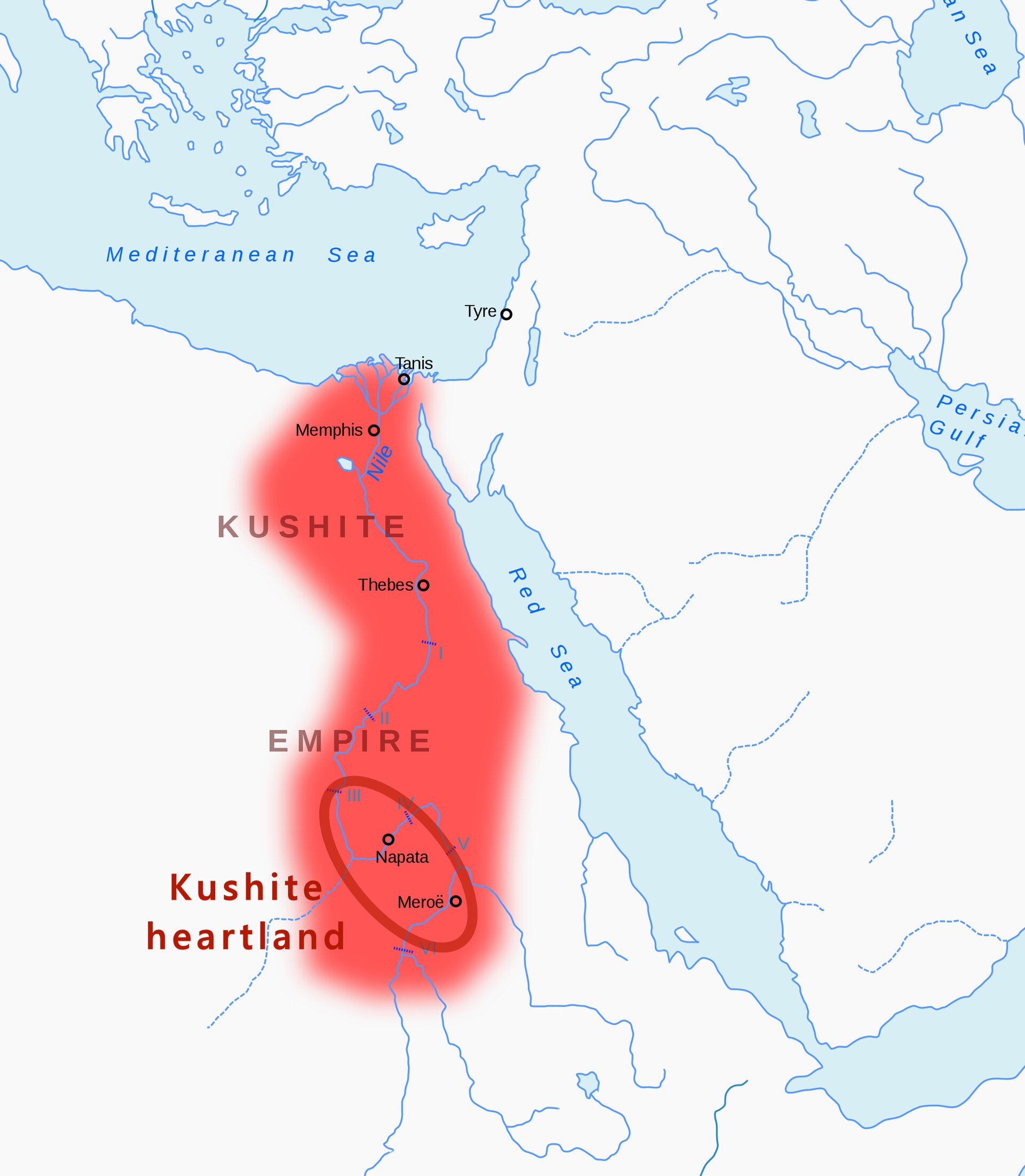
Out of this deep past came successive Nubian cultures — the A-Group, which reached its climax around 3100 BC before fading two centuries later, and then the Kerma culture, which flourished from around 2500 BC to 1500 BC and controlled the Nile Valley between the first and fourth cataracts, a territory as large as Egypt itself. Egyptians called this land and its people Kush, likely from the indigenous name Kasu. For centuries the two civilizations traded, intermarried among royalty, and fought — Egypt eventually absorbing much of Nubia during its New Kingdom, from 1550 to 1070 BC.
But empires crack. As the Late Bronze Age collapse tore through the eastern Mediterranean and Egypt's own power crumbled, the Kushites reasserted themselves, founding a new kingdom centered at Napata, near modern Karima, Sudan. They kept some Egyptian customs — worship of the god Amun chief among them — yet Egyptian artists themselves noted that the Kushites dressed, looked, and traveled differently. This was no colony; it was a distinct civilization with its own identity.
Then came the reversal nobody in Thebes expected. In the 8th century BC, King Kashta — his very name meaning 'one from the land of Kush' — peacefully assumed the throne of Upper Egypt. His daughter Amenirdis was installed as divine adoratrice of Amun in Thebes, a position of immense religious authority. Kashta's successor, Piye, pushed further, invading Lower Egypt and founding the Kushite-ruled Twenty-fifth Dynasty. Piye's daughter, Shepenupet II, likewise became divine adoratrice — Kushite women anchoring Kushite rule in the heart of Egyptian religion.
For over a century, Kushite kings sat as pharaohs over a unified Egypt and Nubia. It did not last. In the mid-7th century BC, the Assyrian kings Esarhaddon and Ashurbanipal drove the Kushites out of Egypt, severing the link between the two lands forever. The Kushite court retreated south, eventually centering itself at Meroë, a city the Greeks would come to know as the capital of 'Aethiopia.'
More from History

The Morning Bingham Climbed to Machu Picchu
On a cold July morning in 1911, an American historian scrambled up a jungle-choked ridge above the Urubamba River — and by afternoon, a forgotten Inca citadel would belong to the world.

The Last Half-Hour of the Hindenburg
It was already half a day late, and the public had been told to keep away — but at seven o'clock that evening, the Hindenburg finally turned toward its mooring mast for the last time.

The Last Hours of Pompeii: August 24, 79 AD
By noon it was just another hot day beside the Bay of Naples. By evening, an entire mountain had rewritten the fate of thousands.

The Longest Walk: Mandela's Last Steps to Freedom
After 27 years behind bars, a 71-year-old man had to relearn how to walk out of a prison gate — into a waiting world of cameras, crowds, and a country holding its breath.

The Document Lincoln Signed on the First Day of 1863
On a single January morning, a president's pen would change the legal status of more than three million people — if the ink held and his hand did not shake.

The Day of the Dream: August 28, 1963
Two hundred and fifty thousand people converged on the National Mall that morning — by nightfall, one voice from the steps of the Lincoln Memorial would echo for generations.