Leif the Lucky and the Land of Wild Grapes
Five hundred years before Columbus ever set sail, a Norse mariner blown off course found vines heavy with fruit on a shore no European had ever named.
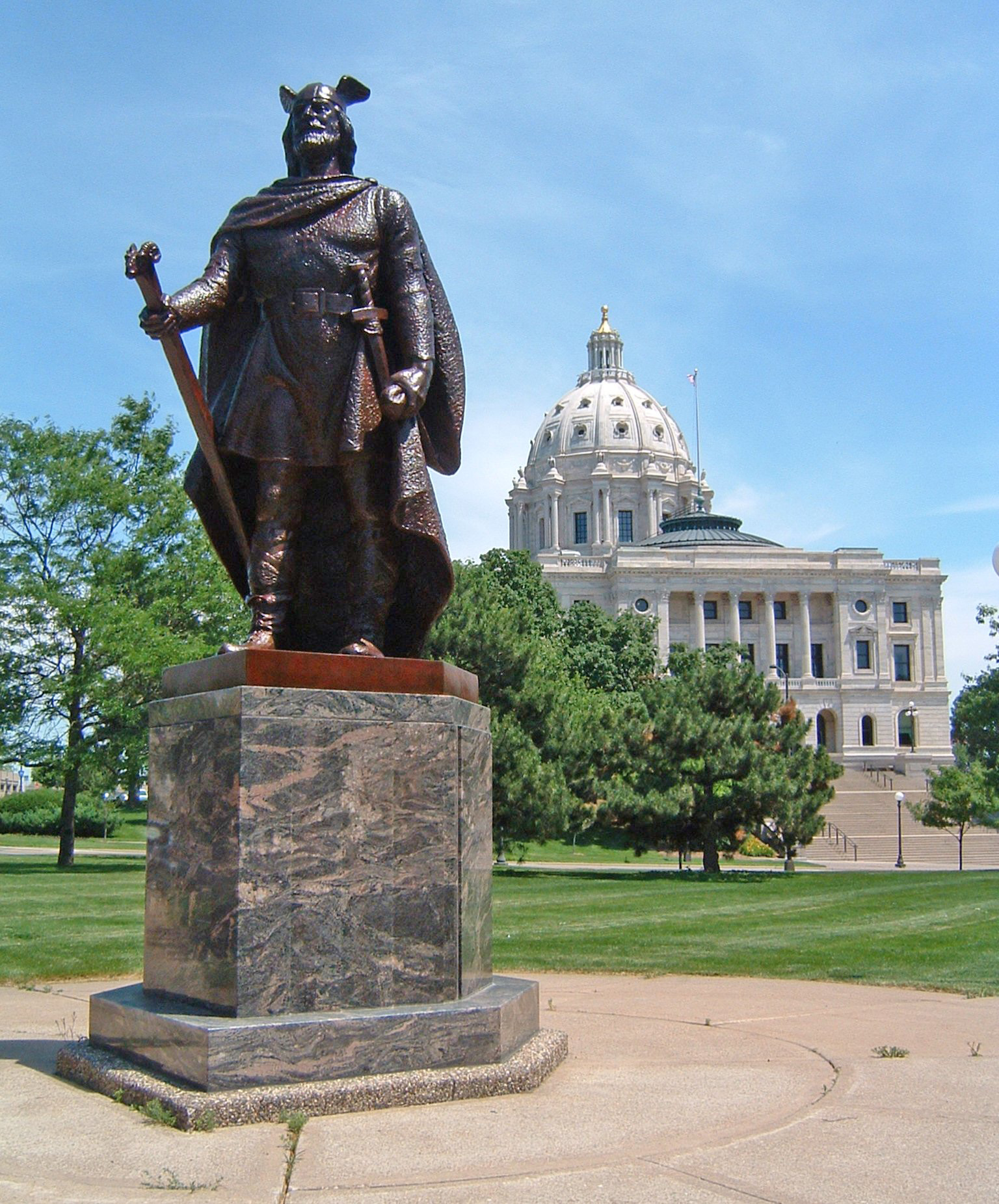
Leif Erikson was born around the 970s, most likely somewhere near Breiðafjörður in Iceland, into a family already marked by exile. His father, Erik the Red, had been banished from Norway for manslaughter and then, after further trouble, driven out of Iceland too, sailing west to a frozen coast he optimistically called Greenland. In 986, Erik returned to Iceland to gather colonists and family, establishing Greenland's first permanent Norse settlement. Leif grew up on the family estate of Brattahlíð, alongside his brothers Thorstein and Thorvald and his sister Freydís, raised partly by a trusted thrall named Tyrker, whom Leif later called his foster father.
As a young man, Leif traveled to Norway and spent time at the court of King Olaf Tryggvesson, where he converted to Christianity. According to the Saga of Erik the Red, it was on a return voyage to Greenland, meant to bring the new faith to its settlers, that a storm blew him off course and toward an unknown shore. There his crew found wild grapes, self-sown wheat, and maple trees unlike anything in Greenland or Iceland. They loaded the ship with samples and turned east, rescuing a group of shipwrecked sailors on the way home — an act of fortune and mercy that earned Leif the nickname 'Leif the Lucky.'
The other major account, the Saga of the Greenlanders, tells a different story of how Vinland was found. It credits Bjarni Herjólfsson, a sailor blown off his route between Iceland and Greenland, with sighting the unfamiliar coasts first, though he never went ashore. Roughly fifteen years later, Leif bought Bjarni's ship, gathered thirty-five men, and set out deliberately to find the lands Bjarni had only glimpsed. His father Erik nearly joined the voyage but turned back after falling from his horse en route to the ship — taken as an ill omen.
Following Bjarni's route in reverse, Leif first reached a bleak, rocky coast he named Helluland, 'Flat-Rock Land,' likely Baffin Island or northern Labrador. Sailing on, he found a forested shore he called Markland, 'Forest Land,' possibly near Cape Porcupine in Labrador. Two more days at sea brought him to an island, then back to the mainland past a northern cape, before he turned west into a milder, greener country rich with salmon.
As winter approached, Leif chose to make camp there. While his men explored, Tyrker wandered off and returned with news that changed everything: the land was thick with vines and wild grapes. Leif named the place Vinland, 'Wineland,' and his crew built a small settlement later remembered by visitors from Greenland as Leifsbudir, Leif's Booths. Many now connect this story to L'Anse aux Meadows in Newfoundland, a Norse site excavated roughly a thousand years after it was occupied.
More from Explorations

Humboldt: The Man Who Measured the World
A Prussian noble's son, once mocked as a sickly child, would climb a volcano to a world-record height and rewrite how humanity understood nature itself.

The Man Who Named Canada
A Breton mariner planted a wooden cross on a foreign shore and claimed a kingdom he did not understand — then spent a winter frozen into its river, praying a stranger's remedy would save his men.

Sixty Ships Into the Unknown: Hanno's Voyage Down the African Coast
A Carthaginian fleet of sixty ships and thousands of settlers vanished past the Pillars of Hercules to found cities on an unmapped coast — and came home with the skins of hairy, hostile 'gorillas' as proof of how far they had gone.

HMS Challenger: The Voyage That Charted the Deep
A stripped-down warship, its guns torn out to make room for microscopes, set sail from Portsmouth to answer a question no one had ever properly asked: what lies at the bottom of the sea?

Scott's Last Expedition: The Letters Written at the End of the World
Five men reached the bottom of the world only to find a Norwegian flag already planted there. What followed was not glory, but a slow, frozen unraveling that the world would remember for a century.

Marco Polo: In the Court of Kublai Khan
A fifteen-year-old boy meets the father he barely knew — and is soon swept toward the richest court on Earth. Twenty-four years later, he returns home with tales so vast that Venice simply calls him 'Mister Millions'.