Lucy: Grandmother of Humankind
In 1974, in the dust of Ethiopia's Afar desert, researchers uncovered fragments of bone that would rewrite the story of how humans learned to walk upright.
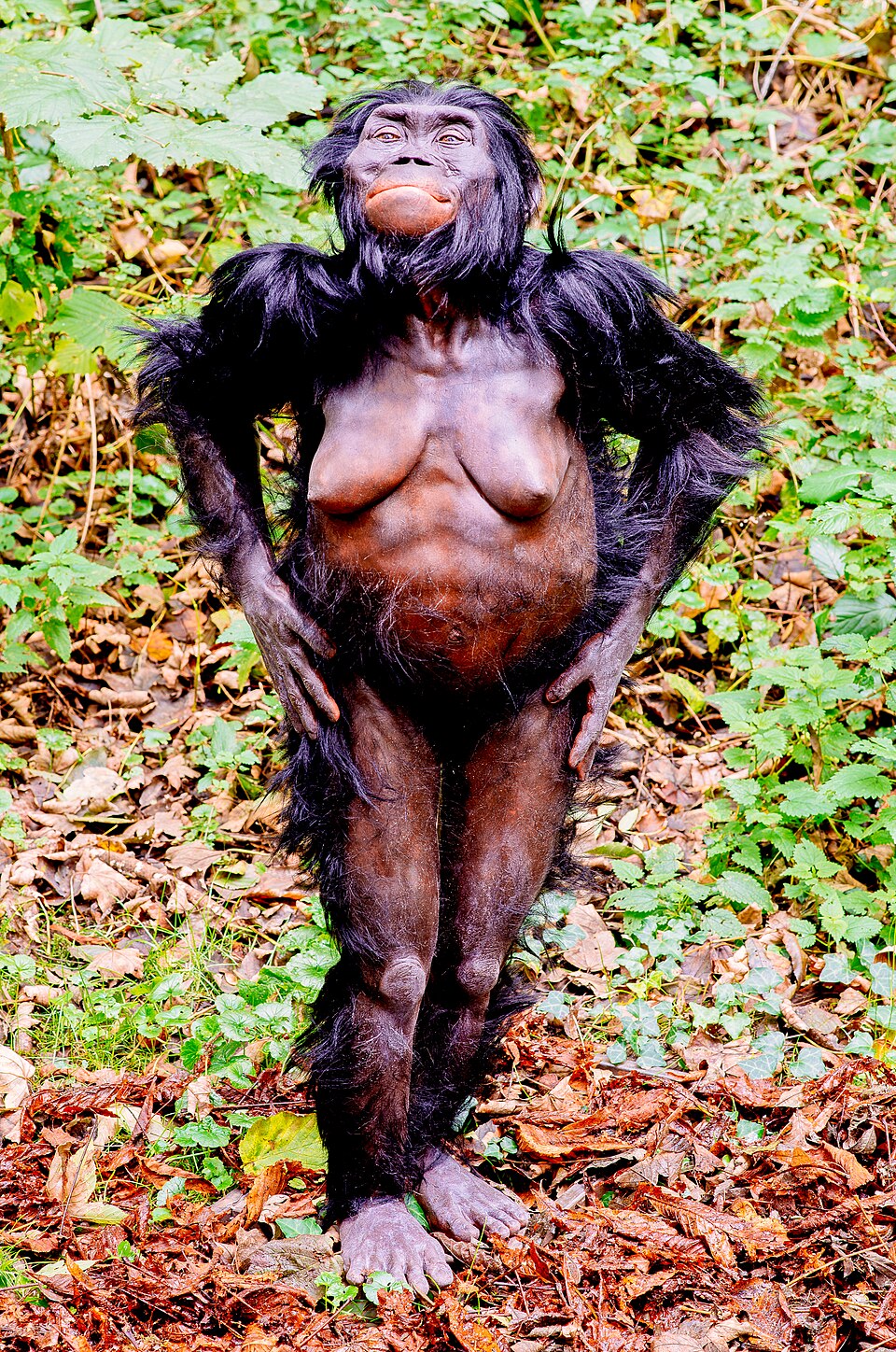
The find came at Hadar, Ethiopia, where a partial skeleton — remarkably well preserved for something 3.2 million years old — emerged from the earth. Scientists gave the fossil a name that would become world-famous: Lucy. She belonged to a species now called Australopithecus afarensis, one branch of a much larger family tree of early hominins that lived across Africa between roughly 4.2 million and 1.9 million years ago.
Lucy's skeleton told a striking story. She could walk upright on two legs, her spine curved to support a vertical posture, her pelvis short and wide enough to balance her body over her legs the way modern humans do. Yet her arms were proportionally longer than those of people today, a hint that her ancestors — and perhaps she herself — still spent time climbing trees. This mix of ground-walking and tree-climbing anatomy captured exactly the kind of transitional creature paleoanthropologists had long sought.
Lucy was not the first Australopithecus fossil ever found, but she became the most famous. That distinction belongs to the Taung Child, a skull unearthed in 1924 in a lime quarry by workers at Taung, near the city of Vryburg in South Africa. Anatomist Raymond Dart studied the skull of this three-year-old bipedal primate and named it Australopithecus africanus, publishing his findings in Nature in 1925. Dart was convinced the fossil showed human-like features suggesting an early ancestor, though most scientists at the time dismissed the idea, believing it belonged to nothing more than an extinct ape.
It took roughly two decades for the scientific community to come around. Scottish paleontologist Robert Broom joined Dart in searching for more specimens, and further A. africanus remains slowly built the case. By the late 1940s, attitudes were shifting, and further discoveries — including an A. boisei skull excavated in 1959 by Mary Leakey at Olduvai Gorge in Tanzania — cemented the genus Australopithecus as a genuine branch of the human family tree.
Four years after Lucy's discovery, in 1978, researchers found footprints preserved in volcanic ash at Laetoli, Tanzania, dating back 3.6 million years, alongside bones from a hominin of the same era. Combined with Lucy's skeleton, these tracks offered direct physical evidence that Australopithecus afarensis walked upright on two feet long before the emergence of the genus Homo.
More from Archaeology

The Bronze Disc That Rewrote the Sky
Two looters with a metal detector dug up something illegal, invisible in value, and older than Stonehenge's final stones — a map of the heavens buried for over three thousand years.

The Faceless Women of the Ice Age
Long before writing, before cities, before the wheel, someone carved a woman's body into stone and ivory — and left no name, no face, no explanation.

The Pebble That Might Be Human
A palm-sized stone found on a Moroccan riverbank may be humanity's oldest attempt to see itself — or simply a trick of erosion.

The Crown That Vanished: Deshret and the Red Land
A crown worn by kings for three thousand years has never once been found in a tomb — not one. So where did it go?

The Face That Traveled Between Empires
A farm worker's shovel struck stone in 1897 and unearthed a face so striking it would be sold to France, seized as war booty, and finally traded back for a Velázquez.

The Boy in the Dark Tunnel
A schoolboy fell into black water inside an ancient tunnel and surfaced with his fingers brushing letters no one had noticed for 2,600 years.