Mungo Park: Into the Heart of the Niger
He set off believing a river could redraw the map of an entire continent — and vanished into its currents, having proven half his theory and lost his life to the other half.
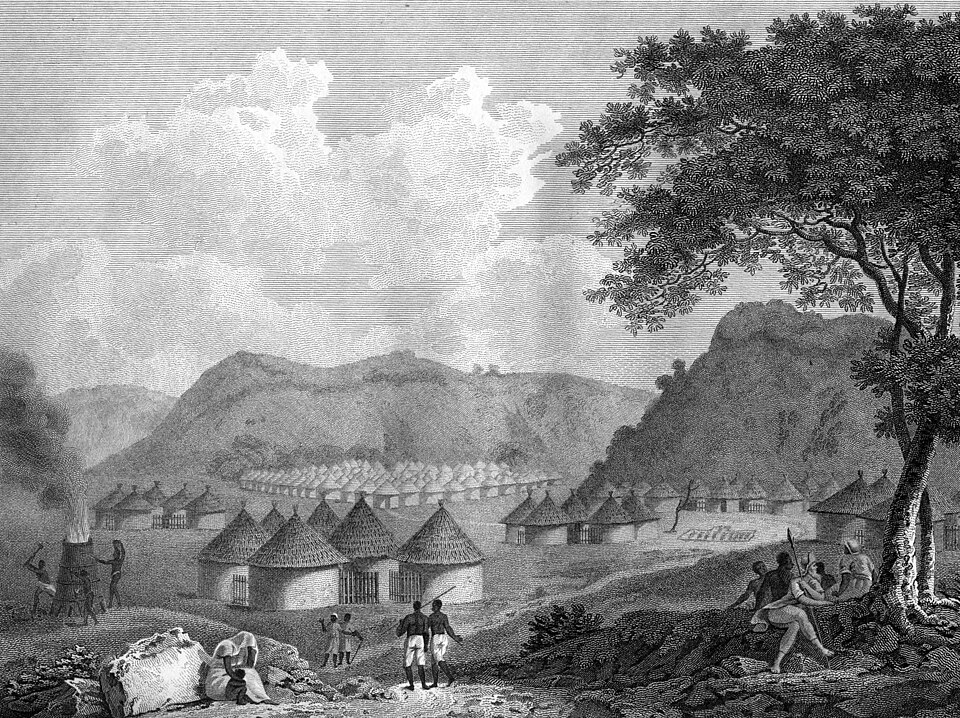
Mungo Park was born on 10 September 1771 at Foulshiels on the Yarrow Water in Selkirkshire, Scotland, the seventh of thirteen children on a tenant farm rented from the Duke of Buccleuch. Though tenants, the Parks were comfortable enough to educate him well, and his parents first imagined him bound for the ministry. Instead, apprenticed at fourteen to a Selkirk surgeon, he found his calling in medicine and natural history, later studying at the University of Edinburgh under the botanist John Walker and joining fieldwork expeditions with his brother-in-law James Dickson, a founder of the Linnean Society of London.
A recommendation from Sir Joseph Banks carried Park to sea as a surgeon's mate aboard the East India Company ship Worcester, bound for Sumatra in 1793. He returned the following year with new botanical specimens and a lecture to the Linnaean Society describing eight previously unknown Sumatran fish. But it was Africa, not Asia, that would define him.
In 1794, the African Association needed a successor to Major Daniel Houghton, who had died searching for the course of the Niger River. Backed again by Banks, Park was chosen. He sailed from Portsmouth in May 1795, reached the Gambia River, and pushed inland to the trading post of Pisania, where he spent months preparing and studying local languages before beginning his journey into the interior in December.
The route through Kaarta and the upper Senegal basin proved brutal. At Ludamar, a Moorish chief imprisoned him for four months in harsh desert conditions. On 1 July 1796 he escaped alone, with only his horse and a pocket compass, and on 21 July reached the Niger at Ségou — the first European known to have done so. He followed the river 80 miles (130 km) downstream to Silla before turning back, unable to continue without resources, often mistaken by locals for a Moor rather than a European.
His return journey traced roughly 300 miles (500 km) of the river's course toward Bamako. Illness struck him at Kamalia, where he survived seven months only through a local man's kindness. He finally reached Pisania in June 1797, then made his way home via a slave ship bound for Charleston — serving as its doctor using Mandinka he had learned on his travels — before the vessel was diverted to Antigua and he returned to Britain that December, having been presumed dead.
More from Explorations

Humboldt: The Man Who Measured the World
A Prussian noble's son, once mocked as a sickly child, would climb a volcano to a world-record height and rewrite how humanity understood nature itself.

The Man Who Named Canada
A Breton mariner planted a wooden cross on a foreign shore and claimed a kingdom he did not understand — then spent a winter frozen into its river, praying a stranger's remedy would save his men.

Sixty Ships Into the Unknown: Hanno's Voyage Down the African Coast
A Carthaginian fleet of sixty ships and thousands of settlers vanished past the Pillars of Hercules to found cities on an unmapped coast — and came home with the skins of hairy, hostile 'gorillas' as proof of how far they had gone.

HMS Challenger: The Voyage That Charted the Deep
A stripped-down warship, its guns torn out to make room for microscopes, set sail from Portsmouth to answer a question no one had ever properly asked: what lies at the bottom of the sea?

Scott's Last Expedition: The Letters Written at the End of the World
Five men reached the bottom of the world only to find a Norwegian flag already planted there. What followed was not glory, but a slow, frozen unraveling that the world would remember for a century.

Marco Polo: In the Court of Kublai Khan
A fifteen-year-old boy meets the father he barely knew — and is soon swept toward the richest court on Earth. Twenty-four years later, he returns home with tales so vast that Venice simply calls him 'Mister Millions'.