Mycenae: The Gold Mask of Agamemnon's City
On a rocky hill overlooking the Argolid, a lost civilization once ruled the Aegean world—then vanished so completely that later Greeks could only explain its walls as the work of giants.
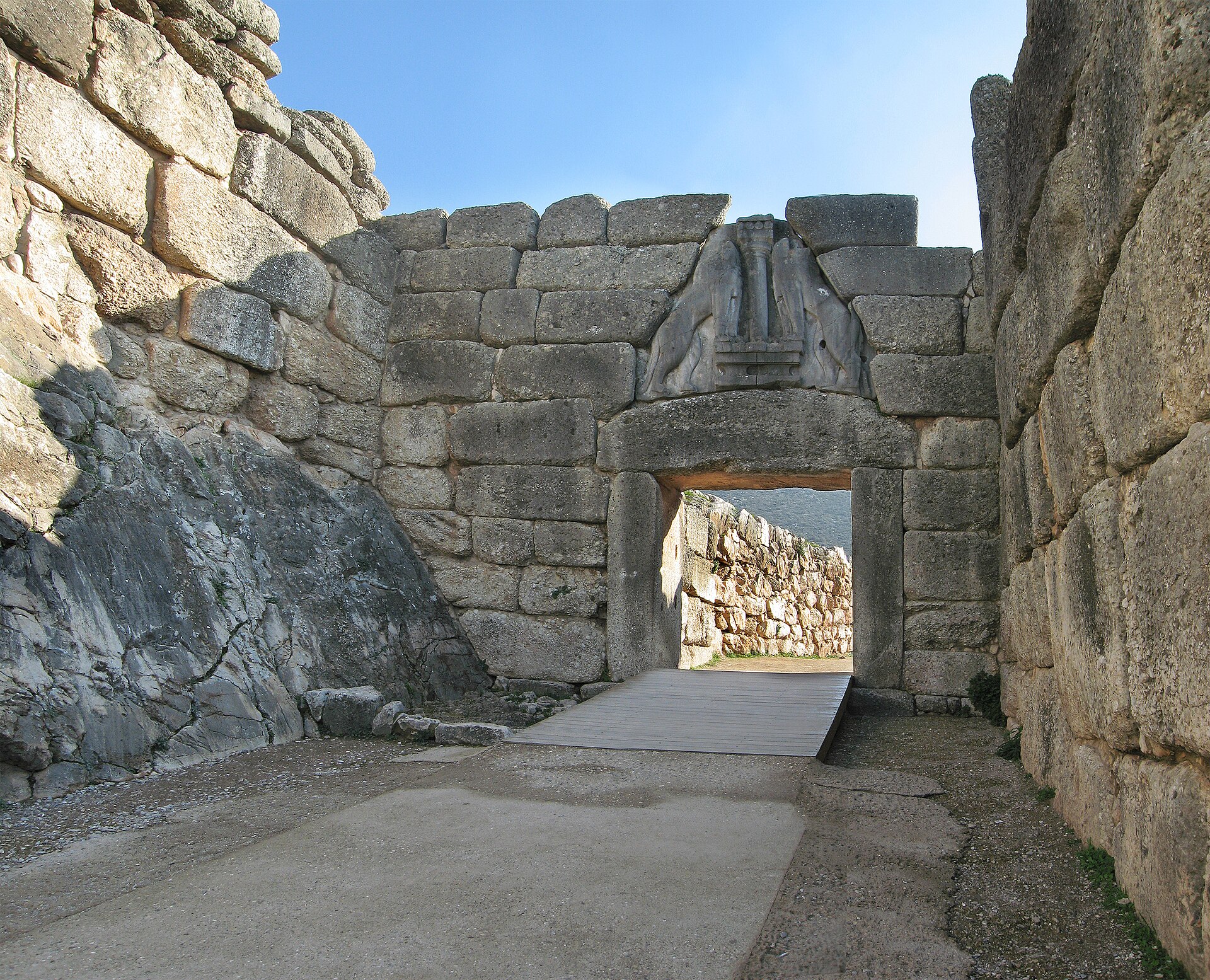
High above the Argolid plain, some 120 kilometres southwest of Athens and 19 kilometres inland from the Saronic Gulf, a hill rises 274 metres above sea level. On its summit sits Mycenae, a fortress-city whose name would eventually give its label to an entire age of Greek history. From this height, ancient rulers could survey the whole plain below and command every easy route toward the Isthmus of Corinth—a position chosen as much for power as for farmland and water.
People had lived on this hill since the Early Neolithic period, around 5000 to 4000 BC, leaving behind faint traces including Rainbow Ware pottery, among the earliest ceramic evidence found at the site. Occupation continued through the Early Bronze Age, known on the Greek mainland as the Early Helladic period, roughly 3200 to 2000 BC. Excavator Panagiotis Stamatakis found pottery from this span in 1877, buried deep within one of the site's most famous features: a sixth shaft grave in what came to be called Circle A.
The population grew considerably during the following Middle Bronze Age, or Middle Helladic period, from about 2050 to 1550 BC. It was in 1876 that the German archaeologist Heinrich Schliemann dug into this layer and uncovered evidence of extensive Cretan, or Minoan, influence dating to around 1600 BC. His discoveries there became known as Circle A. Later, archaeologists found an earlier, less wealthy set of burials nearby, dated to roughly 1650 to 1550 BC, which they named Circle B to distinguish it from Schliemann's find—even though Circle B graves are, confusingly, the older of the two.
The first burials at Mycenae in simple pits or stone-lined cist graves appeared around 1800 BC, on the acropolis's west slope, within a circuit wall that was only partially built at the time. As the Late Bronze Age dawned—the Late Helladic period, from about 1550 to 1200 BC—Mycenae's fortunes changed dramatically. During Late Helladic I, roughly 1550 to 1450 BC, the city grew into a major power, and by the fifteenth century BC it is thought to have become the leading centre of Aegean civilization.
The two centuries stretching from about 1400 to 1200 BC were so dominated by this city's influence that they are now simply called the Mycenaean Age. Minoan hegemony on Crete collapsed around 1450 BC, and evidence suggests Mycenaeans themselves occupied Knossos until it, too, was destroyed around 1370 BC. From that point, Mycenaean expansion across the Aegean world continued largely unchecked—until a sweeping societal collapse in the early twelfth century BC brought the entire civilization down, culminating in the destruction of Mycenae itself around 1150 BC.
More from History

The Morning Bingham Climbed to Machu Picchu
On a cold July morning in 1911, an American historian scrambled up a jungle-choked ridge above the Urubamba River — and by afternoon, a forgotten Inca citadel would belong to the world.

The Last Half-Hour of the Hindenburg
It was already half a day late, and the public had been told to keep away — but at seven o'clock that evening, the Hindenburg finally turned toward its mooring mast for the last time.

The Last Hours of Pompeii: August 24, 79 AD
By noon it was just another hot day beside the Bay of Naples. By evening, an entire mountain had rewritten the fate of thousands.

The Longest Walk: Mandela's Last Steps to Freedom
After 27 years behind bars, a 71-year-old man had to relearn how to walk out of a prison gate — into a waiting world of cameras, crowds, and a country holding its breath.

The Document Lincoln Signed on the First Day of 1863
On a single January morning, a president's pen would change the legal status of more than three million people — if the ink held and his hand did not shake.

The Day of the Dream: August 28, 1963
Two hundred and fifty thousand people converged on the National Mall that morning — by nightfall, one voice from the steps of the Lincoln Memorial would echo for generations.