Notre-Dame: The Cathedral That Refused to Die
A Gallo-Roman temple once stood where the spire fell in 2019 — and eight centuries of stone somehow survived a revolution, a fire, and a return from ash.
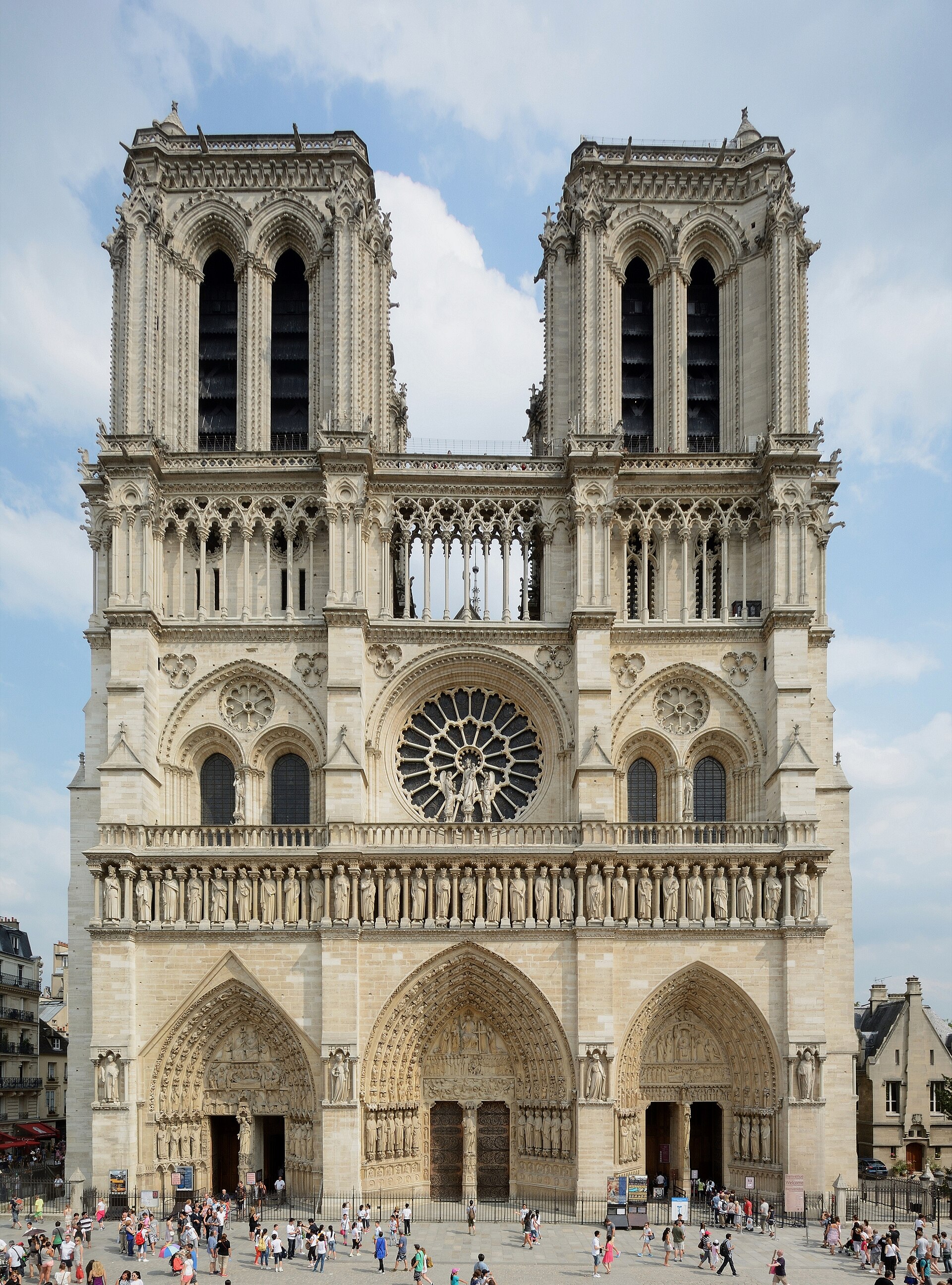
Before there was a cathedral, there may have been a god. Beneath Notre-Dame, workers in 1710 discovered the Pillar of the Boatmen, evidence that a Gallo-Roman temple to Jupiter once stood on the site. By the 4th or 5th century, a Christian church called Saint Étienne had replaced it, roughly half the size of what would come later, its entrance some 40 metres west of today's façade.
In 1163, Bishop Maurice de Sully began building something far grander. Construction stretched across a century: the choir was finished by 1182 or 1185, the nave with its flying buttresses by around 1200, the towers begun between 1210 and 1220, the west rose window completed in 1220. Jean de Chelles lengthened the north transept in the 1250s to let in more light, and by 1270 Pierre de Montreuil had finished the south transept and its rose window. It was, in its structure, one of the earliest buildings anywhere to use free-standing flying buttresses — a solution born of necessity after the thin Gothic walls began to crack under their own height.
The cathedral witnessed the turning points of French history. In 1804, Napoleon crowned himself Emperor within its walls. Decades earlier, during the Revolution, the Paris Commune had stripped the building of its bronze, lead, and precious metals in 1790, melting them down, and in 1793 converted the cathedral into a Temple of Reason and then a Temple of the Supreme Being. The statues of the Kings' Gallery, revolutionaries believed, depicted French monarchs; they beheaded them. The heads were only rediscovered in 1977 and now rest in the Musée de Cluny.
Napoleon restored the cathedral's use to the Catholic Church through the Concordat of 1801–1802, though ownership remained with the state — a arrangement that continues today, since 1905, under French law. By the 19th century the building had fallen into disrepair, and it took a novel — Victor Hugo's 1831 Notre-Dame de Paris — to reignite public passion for it. Between 1844 and 1864, Jean-Baptiste Lassus and Eugène Viollet-le-Duc led a major restoration, adding features in the spirit of the original Gothic design.
The cathedral nearly burned once before its famous 2019 fire. In 1871, during the final days of the Paris Commune, Communards prepared to set it alight, but abandoned the plan because the blaze would have consumed a crowded neighboring hospital for the elderly. In 1944, Notre-Dame witnessed a different kind of fire — of celebration. On 26 August, General Charles de Gaulle marked the Liberation of Paris with a special Mass and the singing of the Magnificat.
More from Architecture

Stonehenge: The Stones That Refuse to Explain Themselves
For more than 4,500 years, a ring of leaning giants has watched the sun rise and set on the same two days each year — and no one alive can say for certain why.

The Dome That Refused to Fall
Two thousand years ago, Roman engineers poured a dome so vast that no one has dared build a bigger one from unreinforced concrete since. It still stands, open to the sky.

A Minaret Rising Over Kingsland Road
On a busy London street better known for shops and buses, the tallest minaret in Britain quietly reaches into the sky. Its story began not in Sinan's sixteenth-century Istanbul, but in 1990s Hackney.

The Bridge That Was Killed Twice
For 427 years it arched over the Neretva like a stone rainbow. Then, in a matter of days in 1993, it simply ceased to exist.

Hoover Dam: The Concrete That Tamed a River
In the scorched depths of Black Canyon, thousands of men built the largest concrete structure the world had ever seen — and finished it two years early, at a cost of over a hundred lives.

Neuschwanstein: The Castle Built for a Ghost
A king who despised his own palace built the most famous fairy-tale castle on earth — and died before he ever truly lived in it.