Petra: The Rose City Carved From Rock
For centuries, a nomadic desert people turned a hidden gorge in southern Jordan into one of the ancient world's great trading capitals — then vanished from Western memory for over a thousand years.
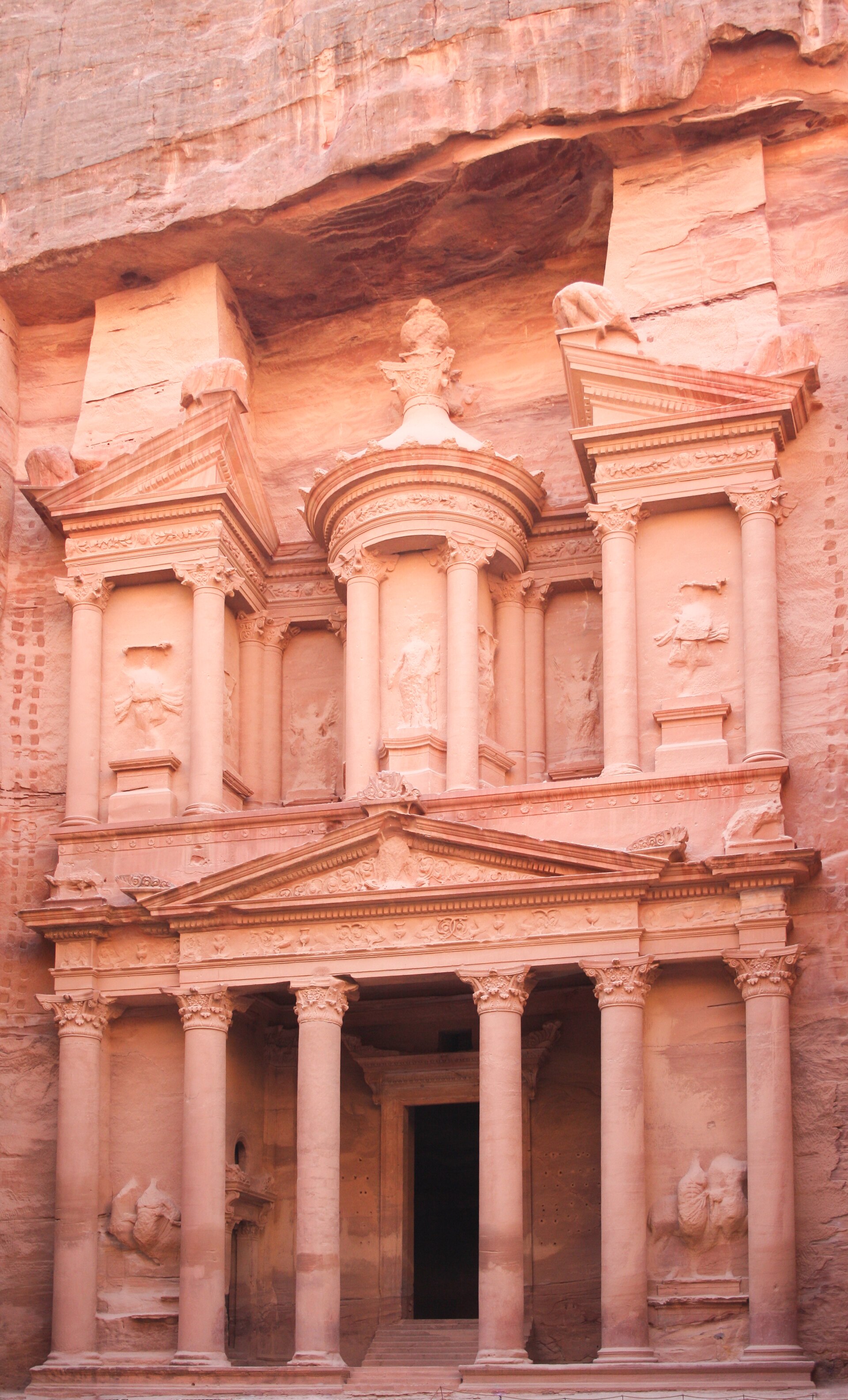
Deep in the deserts of southern Jordan, a narrow gorge opens onto a city that seems impossible: temples, tombs, and theaters carved directly into rose-colored sandstone cliffs. This is Petra, known to its own inhabitants as Raqmu. The area has been inhabited since as early as 7000 BC, when some of the earliest recorded farmers settled at nearby Beidha. Long before Petra became a city, the region appeared in Egyptian campaign accounts and the Amarna letters under names like Pel, Sela, or Seir, and during the Iron Age, between 1200 and 600 BC, it was home to the Edomites, who used its mountain configuration to store water and turned the site into a stopping point for merchants trading wine, olive oil, and wood.
Into this landscape came the Nabataeans, a nomadic Arab people who, unlike the Aramean-influenced cultures around them, were rooted in northern Arabian tribal traditions. By the 4th century BC they had settled in Petra, and by the 2nd century BC the city had become the capital of the Nabataean Kingdom. Their genius lay in survival: efficient rainwater collection and desert farming let them thrive where others could not, while Petra's position on the region's incense trade routes turned it into a wealthy commercial hub.
The city's golden age arrived in the 1st century AD. Its population swelled to an estimated 20,000 people, and its most famous structure, Al-Khazneh — possibly the mausoleum of Nabataean king Aretas IV — was carved into the cliffside during this period. Petra had become not just a refuge but a monument to ambition, a city that announced its wealth through stone.
That independence ended in 106 AD, when Rome, under the governorship of Aulus Cornelius Palma Frontonianus, absorbed Petra's territory into the empire, renaming it Arabia Petraea. Remarkably, the city continued to flourish under Roman rule; the Petra Roman Road was built, and the city reached the height of its splendor under Severus Alexander, when local coinage finally ceased to be minted, a sign of how thoroughly it had been folded into Roman economic life.
But Petra's fortunes were tied to trade routes, and when sea lanes began to replace overland caravans, its importance started to fade. The final blow came in 363 AD, when a massive earthquake destroyed many of its structures. In the Byzantine era that followed, Christian churches rose among the ruins, but the decline could not be reversed. By the early Islamic era, Petra was largely abandoned, inhabited only by a handful of nomads drifting through a city that had once held tens of thousands.
More from Architecture

Stonehenge: The Stones That Refuse to Explain Themselves
For more than 4,500 years, a ring of leaning giants has watched the sun rise and set on the same two days each year — and no one alive can say for certain why.

The Dome That Refused to Fall
Two thousand years ago, Roman engineers poured a dome so vast that no one has dared build a bigger one from unreinforced concrete since. It still stands, open to the sky.

A Minaret Rising Over Kingsland Road
On a busy London street better known for shops and buses, the tallest minaret in Britain quietly reaches into the sky. Its story began not in Sinan's sixteenth-century Istanbul, but in 1990s Hackney.

The Bridge That Was Killed Twice
For 427 years it arched over the Neretva like a stone rainbow. Then, in a matter of days in 1993, it simply ceased to exist.

Hoover Dam: The Concrete That Tamed a River
In the scorched depths of Black Canyon, thousands of men built the largest concrete structure the world had ever seen — and finished it two years early, at a cost of over a hundred lives.

Neuschwanstein: The Castle Built for a Ghost
A king who despised his own palace built the most famous fairy-tale castle on earth — and died before he ever truly lived in it.