Piccard and the Bottom of the World
On 23 January 1960, two men sealed themselves into a steel sphere and let the ocean swallow them for three hours, chasing a point deeper than Everest is tall.
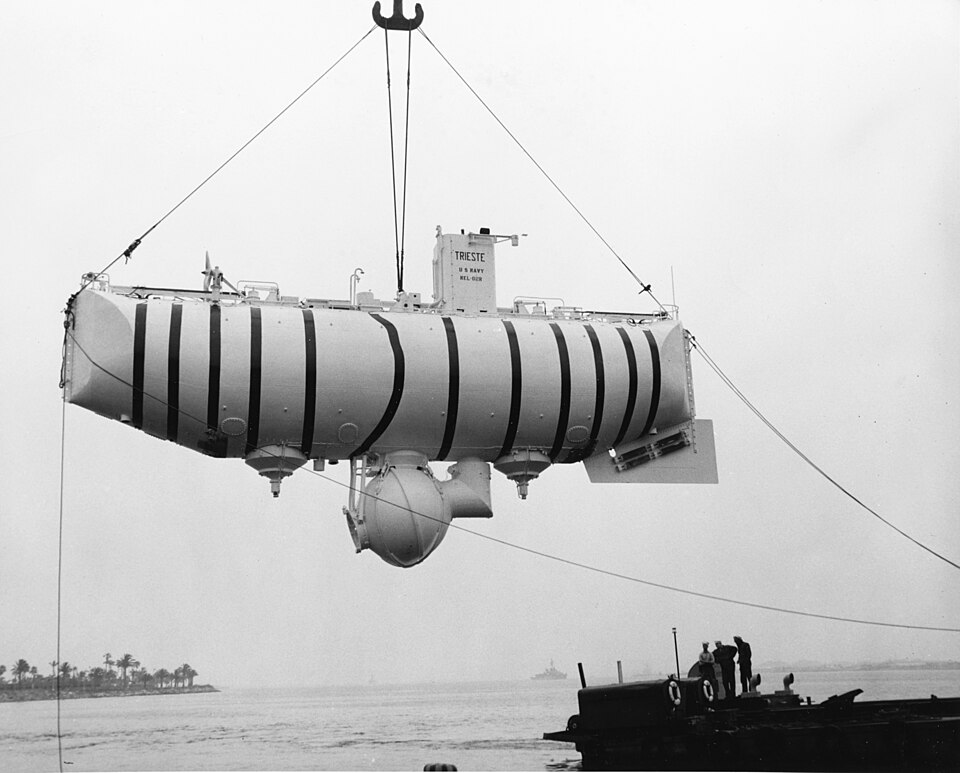
On 23 January 1960, Swiss scientist Jacques Piccard and US Navy Lieutenant Don Walsh climbed into the bathyscaphe Trieste and began a descent into the western Pacific, about 200 kilometres east of the Mariana Islands. Their target was the Challenger Deep, the southern end of a slot-shaped valley at the bottom of the Mariana Trench — the deepest known point on Earth, more than 2 kilometres farther from sea level than the summit of Mount Everest is above it.
The trench itself is a crescent-shaped scar roughly 2,550 kilometres long and 69 kilometres wide, formed where the ancient, dense Pacific plate — crust up to 170 million years old — is thrust beneath the smaller Mariana plate. It was first sounded in 1875 during the Challenger expedition, using nothing more than a weighted rope, which registered 8,184 metres. Decades of soundings followed: the USS Nero in 1899, the Challenger II in 1951 using echo sounding, the Soviet vessel Vityaz in 1957, and Japan's Takuyō in 1984, each refining the picture of a trench whose true floor exceeded 10,900 metres.
Piccard and Walsh's dive took about three hours and fifteen minutes to reach bottom. At the time, their instruments suggested a depth of 11,521 metres; a 1995 re-analysis corrected this to 10,916 metres. They spent only twenty minutes at the bottom before ascending, bringing the entire round trip to roughly five hours. At that depth, the water column exerts a pressure of about 1,086 bar — over a thousand times atmospheric pressure at sea level — while the temperature hovers between 1 and 4°C.
Despite the crushing conditions, the two men were not alone. Life persists in the Challenger Deep: microorganisms, fish, and crabs adapted to extreme cold and pressure, sustained in part by volcanic vents reaching 300°C and bacteria that metabolize the sulfur they release. Some fish species there are thought to live for centuries, and researchers believe organisms in the trench have remained essentially unchanged since prehistoric times.
More than half a century after Piccard and Walsh, others followed. In 2012, filmmaker James Cameron descended alone in the Deepsea Challenger, a submersible he helped design and Australian engineers built to withstand pressures exceeding 7,250 tons per square metre. He reached the bottom in 156 minutes, spent three hours exploring, and resurfaced in a mere 70 minutes.
More from Explorations

Humboldt: The Man Who Measured the World
A Prussian noble's son, once mocked as a sickly child, would climb a volcano to a world-record height and rewrite how humanity understood nature itself.

The Man Who Named Canada
A Breton mariner planted a wooden cross on a foreign shore and claimed a kingdom he did not understand — then spent a winter frozen into its river, praying a stranger's remedy would save his men.

Sixty Ships Into the Unknown: Hanno's Voyage Down the African Coast
A Carthaginian fleet of sixty ships and thousands of settlers vanished past the Pillars of Hercules to found cities on an unmapped coast — and came home with the skins of hairy, hostile 'gorillas' as proof of how far they had gone.

HMS Challenger: The Voyage That Charted the Deep
A stripped-down warship, its guns torn out to make room for microscopes, set sail from Portsmouth to answer a question no one had ever properly asked: what lies at the bottom of the sea?

Scott's Last Expedition: The Letters Written at the End of the World
Five men reached the bottom of the world only to find a Norwegian flag already planted there. What followed was not glory, but a slow, frozen unraveling that the world would remember for a century.

Marco Polo: In the Court of Kublai Khan
A fifteen-year-old boy meets the father he barely knew — and is soon swept toward the richest court on Earth. Twenty-four years later, he returns home with tales so vast that Venice simply calls him 'Mister Millions'.