Six Days That Redrew the Middle East
In less than a week, a surprise dawn raid on empty airfields turned into a war that quadrupled a nation's territory and reshaped the map for half a century.
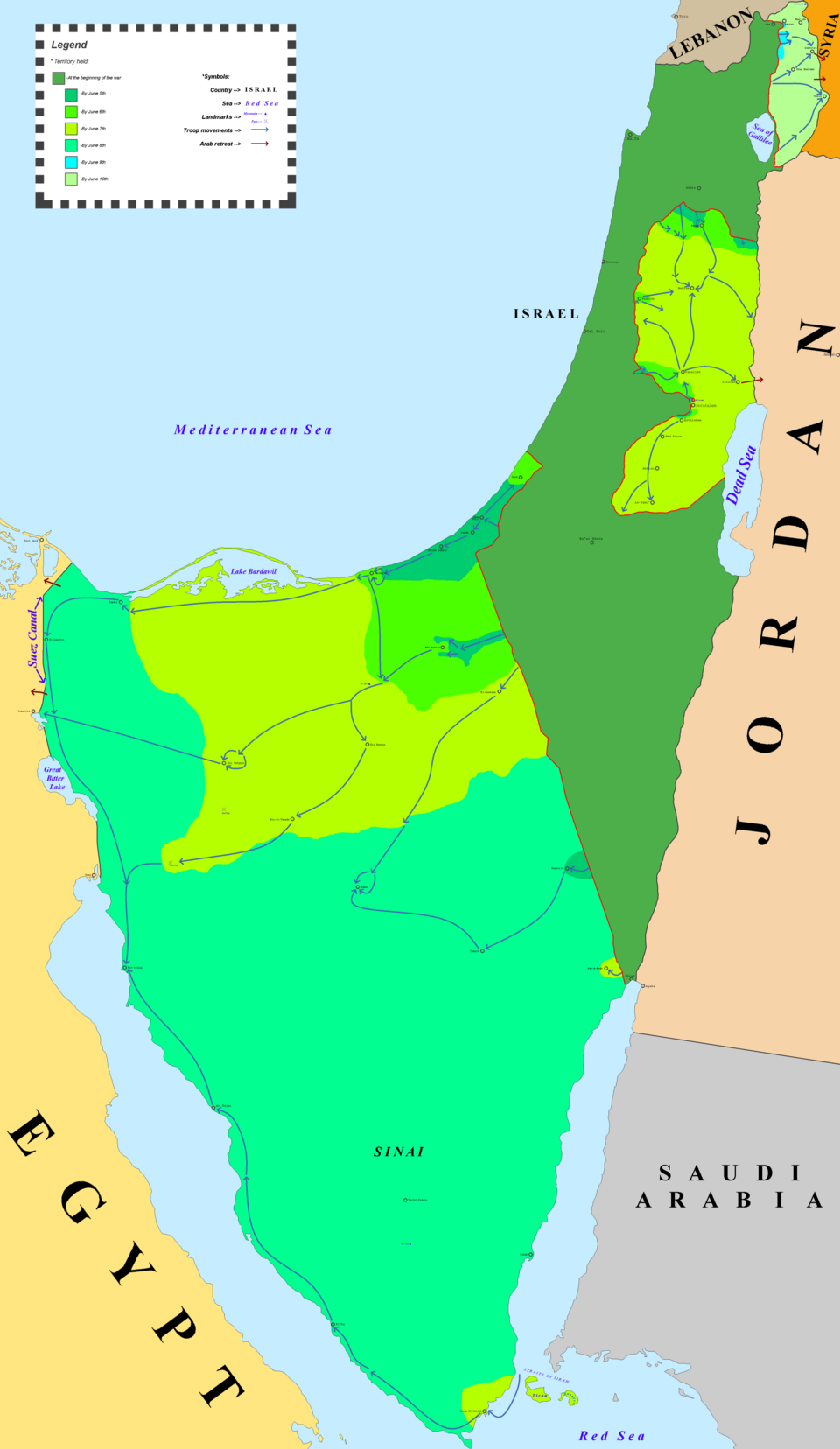
On the morning of 5 June 1967, Israeli warplanes rose from their bases and struck across the border into Egypt in what was code-named Operation Focus. The goal was simple and audacious: destroy Egypt's air force before it ever left the ground. Within hours, nearly all of Egypt's combat aircraft lay in ruins, and Israel had achieved something rare in modern warfare — total air supremacy on the first day of a conflict.
The roots of the crisis reached back to the 1956 Suez Crisis, when a United Nations Emergency Force (UNEF) had been stationed in the Sinai to keep the peace between Israel and Egypt. That peace proved fragile. Border clashes continued through the 1960s, especially between Israel and Syria, whose 1966 defense pact with Egypt tightened the web of alliances that would soon pull the whole region into war.
In May 1967, acting on false Soviet reports that Israel was massing troops against Syria, Egyptian President Gamal Abdel Nasser moved his own forces into the Sinai, expelled the UNEF peacekeepers, and seized the strategic post at Sharm el-Sheikh overlooking the Straits of Tiran. Days later, he announced the straits closed to Israeli shipping — a move Israel had long warned it would treat as an act of war. Jordan and Egypt signed a mutual defense pact on 30 May, and Iraq soon pledged troops to Jordan as well.
With diplomacy exhausted, Israel formed a National Unity Government on 1 June and decided for war three days later. At dawn on 5 June, as UNEF forces were still withdrawing from the border zone, Israeli jets struck Egyptian airfields in waves. Simultaneously, Israeli ground forces poured into the Sinai Peninsula and the Egyptian-held Gaza Strip. Egyptian resistance faltered, and Nasser ordered a full evacuation of Sinai; by the war's fourth day, Israel controlled the entire peninsula.
Jordan, bound by its defense pact, launched attacks to slow the Israeli advance without committing to full-scale offensive war. On the war's fifth day, Syria joined by shelling Israeli positions in the north. But the tide had already turned decisively against the Arab coalition. Egypt and Jordan accepted a ceasefire on 8 June, Syria followed on 9 June, and a formal ceasefire with Israel was signed on 11 June — just six days after the first bombs fell.
More from History

The Morning Bingham Climbed to Machu Picchu
On a cold July morning in 1911, an American historian scrambled up a jungle-choked ridge above the Urubamba River — and by afternoon, a forgotten Inca citadel would belong to the world.

The Last Half-Hour of the Hindenburg
It was already half a day late, and the public had been told to keep away — but at seven o'clock that evening, the Hindenburg finally turned toward its mooring mast for the last time.

The Last Hours of Pompeii: August 24, 79 AD
By noon it was just another hot day beside the Bay of Naples. By evening, an entire mountain had rewritten the fate of thousands.

The Longest Walk: Mandela's Last Steps to Freedom
After 27 years behind bars, a 71-year-old man had to relearn how to walk out of a prison gate — into a waiting world of cameras, crowds, and a country holding its breath.

The Document Lincoln Signed on the First Day of 1863
On a single January morning, a president's pen would change the legal status of more than three million people — if the ink held and his hand did not shake.

The Day of the Dream: August 28, 1963
Two hundred and fifty thousand people converged on the National Mall that morning — by nightfall, one voice from the steps of the Lincoln Memorial would echo for generations.