Six Men, Nine Logs, and a Bet Against the Ocean
In 1947, six men lashed together balsa logs, painted a sun god on their sail, and let the Pacific currents decide whether an old theory about human migration could survive the crossing.
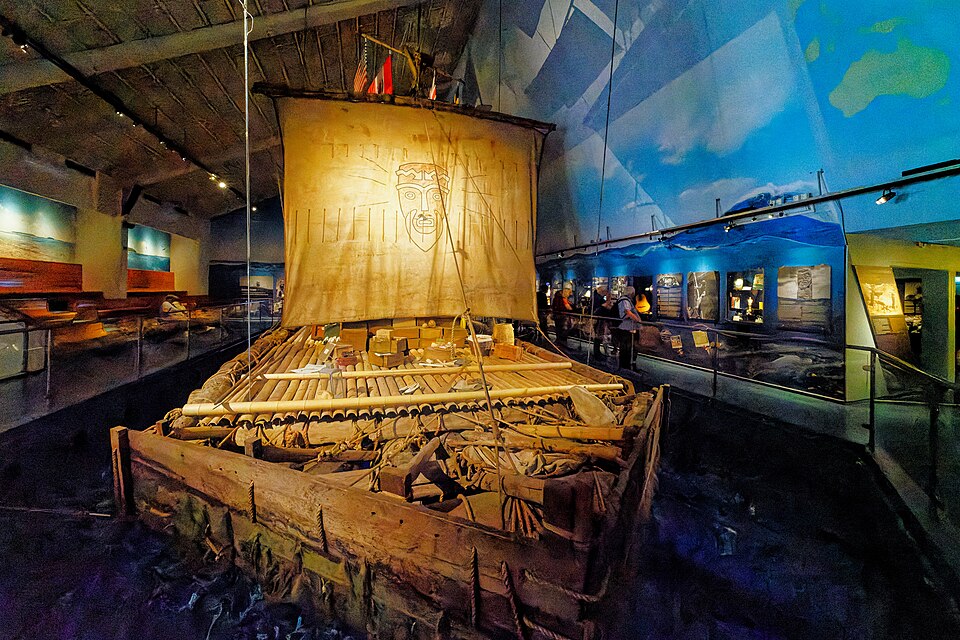
On April 28, 1947, a strange vessel slipped away from the coast of Peru: nine balsa logs, some up to 14 meters long and 60 centimeters thick, bound with hemp rope in a style copied from illustrations left by Spanish conquistadores. Cross-pieces of balsa and pine splashboards braced the hull. There was no engine, no steel hull, nothing that the ancient peoples of South America would not have recognized. This was precisely the point. The raft was named Kon-Tiki, after Viracocha, the Inca sun god also known by that older name.
Behind the voyage stood Thor Heyerdahl, a Norwegian explorer and ethnographer who had spent years studying the ancient peoples of South America and Polynesia. He believed the two were linked — that pre-Columbian South Americans could have drifted across the Pacific on rafts like this one, carried by wind and current, long before Europeans arrived. Rather than argue the point in academic papers alone, he decided to prove it was physically possible by doing it himself.
The expedition was scrappy by necessity, funded through private loans and stocked with equipment donated by the United States Army. Heyerdahl and his team traveled to Peru, where Peruvian authorities provided dockyard facilities for building the raft. Six men made up the crew: Heyerdahl himself; Erik Hesselberg, the navigator, who painted the large Kon-Tiki figure on the sail; Bengt Danielsson, a Swedish sociologist who served as steward and the crew's only Spanish speaker; Knut Haugland, a radio expert previously decorated for his role in wartime sabotage against Nazi heavy-water production; Torstein Raaby, who had once hidden behind German lines relaying secret radio reports that helped Allied bombers sink the battleship Tirpitz; and Herman Watzinger, an engineer who logged weather and technical data throughout the voyage. On land, Gerd Vold Hurum had spent the winter and spring of 1945–47 helping Heyerdahl organize the entire expedition. A parrot named Lorita joined them too, though she did not survive the trip.
For 101 days the six men drifted across roughly 6,900 kilometers — about 4,300 miles — of open Pacific water. They carried a few concessions to the modern world: a radio, watches, charts, a sextant, metal knives. Heyerdahl was careful to insist these tools were incidental, not the reason the voyage succeeded. The raft itself, built from native materials in an ancient style, was what had to prove itself against the ocean.
On August 7, 1947, the voyage ended violently: Kon-Tiki smashed into a reef at Raroia in the Tuamotu Islands. All six men survived and made it safely to land, their raft's final act being the one that mattered most — showing that the crossing could be endured start to finish.
More from Explorations

Humboldt: The Man Who Measured the World
A Prussian noble's son, once mocked as a sickly child, would climb a volcano to a world-record height and rewrite how humanity understood nature itself.

The Man Who Named Canada
A Breton mariner planted a wooden cross on a foreign shore and claimed a kingdom he did not understand — then spent a winter frozen into its river, praying a stranger's remedy would save his men.

Sixty Ships Into the Unknown: Hanno's Voyage Down the African Coast
A Carthaginian fleet of sixty ships and thousands of settlers vanished past the Pillars of Hercules to found cities on an unmapped coast — and came home with the skins of hairy, hostile 'gorillas' as proof of how far they had gone.

HMS Challenger: The Voyage That Charted the Deep
A stripped-down warship, its guns torn out to make room for microscopes, set sail from Portsmouth to answer a question no one had ever properly asked: what lies at the bottom of the sea?

Scott's Last Expedition: The Letters Written at the End of the World
Five men reached the bottom of the world only to find a Norwegian flag already planted there. What followed was not glory, but a slow, frozen unraveling that the world would remember for a century.

Marco Polo: In the Court of Kublai Khan
A fifteen-year-old boy meets the father he barely knew — and is soon swept toward the richest court on Earth. Twenty-four years later, he returns home with tales so vast that Venice simply calls him 'Mister Millions'.