Sumer: The People Who Invented Writing
Long before Egypt raised its pyramids, farmers along two rivers were already scratching symbols into wet clay — and changing history forever.
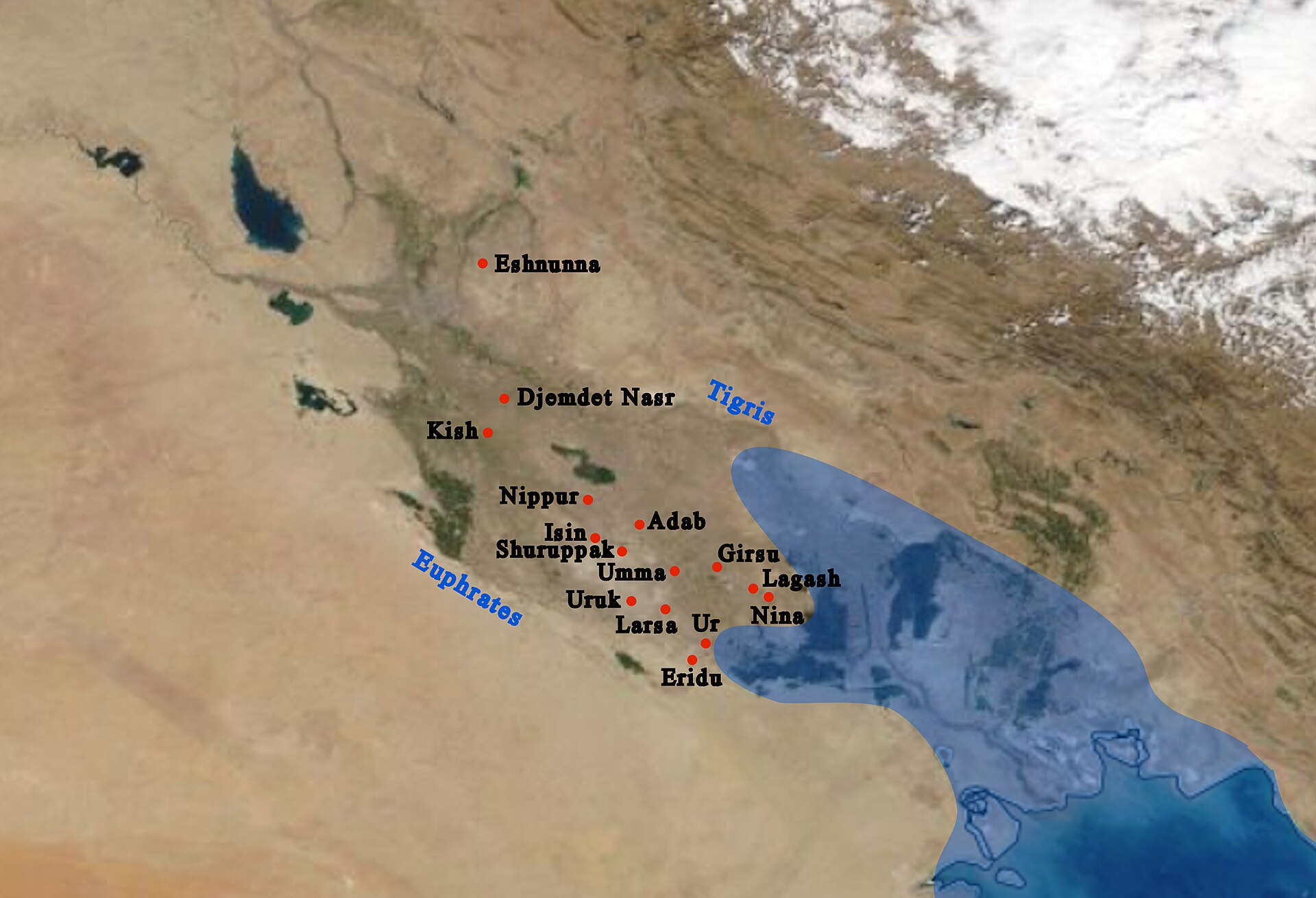
In the marshlands where the Tigris and Euphrates rivers met the Persian Gulf, a people the Akkadians would later call Sumerians built the world's first cities. Sometime between 5500 and 3300 BC, they settled the flat, fertile plains of southern Mesopotamia, in what is now south-central Iraq. Their farmers grew such abundant grain that surplus food allowed people to leave the fields, gather in towns, and specialize in new kinds of work.
The Sumerians called their own land Kengir, meaning the 'Country of the noble lords,' and their language Emegir. It was the Akkadians, the Semitic-speaking people who conquered them centuries later, who gave us the name 'Sumer' still used today. The Sumerian language itself is a mystery of linguistics — a non-Semitic, non-Indo-European isolate unrelated to any known tongue, which has fueled endless debate about where its speakers originally came from.
Scholars have proposed many origins: a West Asian farming people, migrants from a once-green Sahara, or fisherfolk from the shores of the Persian Gulf before rising seas submerged their homeland. Sumerian legends themselves point to Dilmun, often identified with the island of Bahrain, as an ancestral homeland and the dwelling place of the god Enki. Before the Sumerians, a shadowy people modern scholars call the Ubaidians are thought to have drained marshes, developed trade, and pioneered weaving, leatherwork, metalwork, and pottery in the same region.
One of the oldest Sumerian cities, Eridu, sat on the coast of the Persian Gulf and may have formed from the fusion of three distinct groups: Ubaidian farmers living in mud-brick huts, nomadic Semitic herders following their flocks in black tents, and marsh-dwelling fisherfolk in reed huts — possibly the direct ancestors of the Sumerians themselves.
By the fourth millennium BC, during what is called the Uruk period, Sumerian civilization had taken clear shape, and it continued through the Jemdet Nasr and Early Dynastic periods. It was in the cities of Uruk and Jemdet Nasr that the earliest known written texts appeared, dating to between roughly 3350 and 2500 BC, following centuries of proto-writing that stretched back to around 4000 BC. This was cuneiform — wedge-shaped marks pressed into clay — the very invention that lifted Sumer out of prehistory and into recorded history.
More from History

The Morning Bingham Climbed to Machu Picchu
On a cold July morning in 1911, an American historian scrambled up a jungle-choked ridge above the Urubamba River — and by afternoon, a forgotten Inca citadel would belong to the world.

The Last Half-Hour of the Hindenburg
It was already half a day late, and the public had been told to keep away — but at seven o'clock that evening, the Hindenburg finally turned toward its mooring mast for the last time.

The Last Hours of Pompeii: August 24, 79 AD
By noon it was just another hot day beside the Bay of Naples. By evening, an entire mountain had rewritten the fate of thousands.

The Longest Walk: Mandela's Last Steps to Freedom
After 27 years behind bars, a 71-year-old man had to relearn how to walk out of a prison gate — into a waiting world of cameras, crowds, and a country holding its breath.

The Document Lincoln Signed on the First Day of 1863
On a single January morning, a president's pen would change the legal status of more than three million people — if the ink held and his hand did not shake.

The Day of the Dream: August 28, 1963
Two hundred and fifty thousand people converged on the National Mall that morning — by nightfall, one voice from the steps of the Lincoln Memorial would echo for generations.