The Age of the Pyramid Builders
For roughly five centuries, a civilization on the Nile convinced itself its king was a living god — and built mountains of stone to prove it.
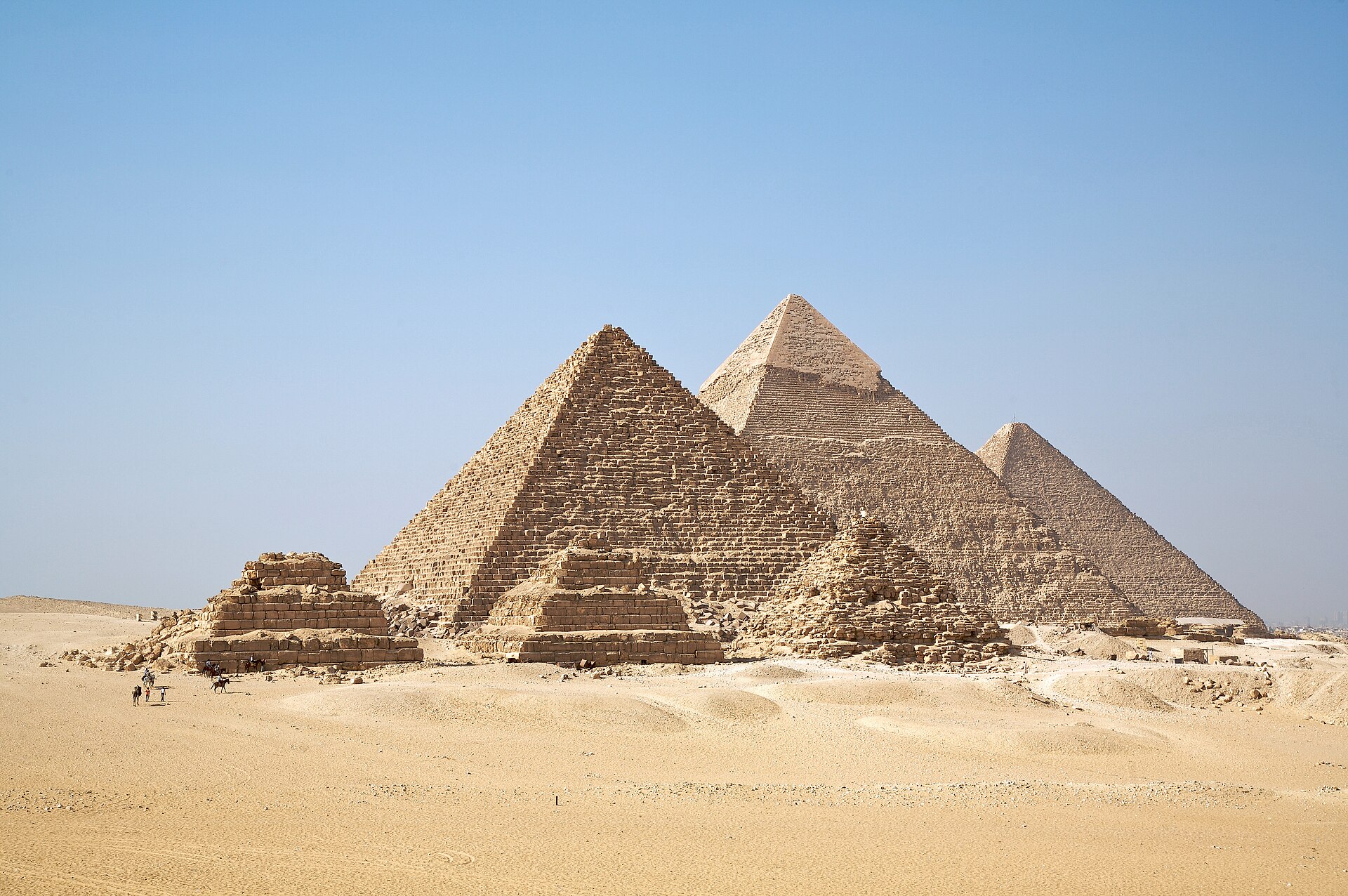
Sometime between 2691 and 2625 BC, on the west bank of the Nile near a city the Egyptians called Ineb-Hedj — Memphis to later ages — a king named Djoser ordered something no one had attempted before. His vizier Imhotep, credited with mastering the art of building in stone, designed a structure that rose in receding tiers above the necropolis of Saqqara: the Step Pyramid. It was the first monument of its kind, and it opened what historians now call the Old Kingdom, a period spanning roughly from 2700 to 2200 BC, most commonly dated from the Third Dynasty to the Sixth Dynasty, 2686 to 2181 BC.
This was not simply a new dynasty but a new kind of society. Formerly independent regions of Egypt were reorganized into administrative units called nomes, their old rulers reduced to governors or tax collectors under the king's authority. Egyptians of this era believed their king to be the living incarnation of the god Horus, a bridge between the human and divine worlds, and they saw themselves as a specially chosen people. The king's word extended not just over land but over the labor and wealth of every subject.
The Old Kingdom reached its peak under the Fourth Dynasty, spanning roughly 2613 to 2494 BC. Its first king, Sneferu, held territory stretching from Libya in the west to the Sinai in the east and Nubia in the south, and founded an Egyptian settlement at Buhen that endured for two centuries. Sneferu was also a builder on an unprecedented scale, commissioning three pyramids: the Meidum Pyramid, abandoned after its outer casing collapsed; the Bent Pyramid at Dahshur, named for its telltale change in angle partway up; and the Red Pyramid at North Dahshur. No pharaoh before or after used more stone.
Sneferu's son Khufu inherited both the throne and his father's ambition. He commissioned the Great Pyramid of Giza, the moment at which the pyramid form reached its fullest, most perfected expression. After Khufu's death, his sons Djedefre and Khafre may have contested the succession. Khafre commissioned the second pyramid at Giza and, in traditional accounts, the Great Sphinx — though some Egyptologists now argue the Sphinx was built by Djedefre as a monument to his father Khufu, or possibly by Khafre and Khufu together. Egyptian forces during this period also pushed military expeditions into Canaan and Nubia, extending influence far up the Nile.
The dynasty's later kings — Menkaure, who built the smallest of Giza's three great pyramids, and Shepseskaf — carried the tradition forward before it began to change shape. The Fifth Dynasty, starting around 2494 BC with Userkaf, shifted resources away from giant pyramid complexes and toward sun temples honoring the god Ra, reflecting the growing power of his cult. Kings like Sahure, who sent an expedition to Punt, and Neferirkare Kakai, who introduced a new element into royal titulary, kept the kingdom running, though the monumental ambitions of the Fourth Dynasty were never quite repeated.
More from History

The Morning Bingham Climbed to Machu Picchu
On a cold July morning in 1911, an American historian scrambled up a jungle-choked ridge above the Urubamba River — and by afternoon, a forgotten Inca citadel would belong to the world.

The Last Half-Hour of the Hindenburg
It was already half a day late, and the public had been told to keep away — but at seven o'clock that evening, the Hindenburg finally turned toward its mooring mast for the last time.

The Last Hours of Pompeii: August 24, 79 AD
By noon it was just another hot day beside the Bay of Naples. By evening, an entire mountain had rewritten the fate of thousands.

The Longest Walk: Mandela's Last Steps to Freedom
After 27 years behind bars, a 71-year-old man had to relearn how to walk out of a prison gate — into a waiting world of cameras, crowds, and a country holding its breath.

The Document Lincoln Signed on the First Day of 1863
On a single January morning, a president's pen would change the legal status of more than three million people — if the ink held and his hand did not shake.

The Day of the Dream: August 28, 1963
Two hundred and fifty thousand people converged on the National Mall that morning — by nightfall, one voice from the steps of the Lincoln Memorial would echo for generations.