The Bog That Kept a Silver Secret
In 1891, Danish peat cutters pulled a treasure from the mud so strange that scholars are still arguing about who made it — and why it was buried at all.
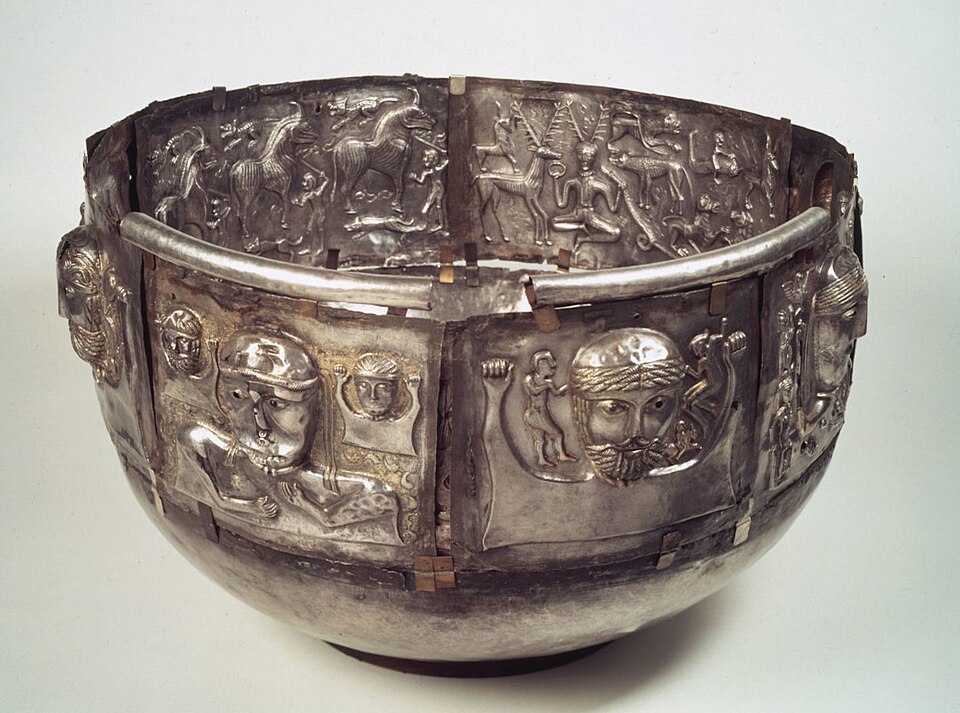
On 28 May 1891, workers cutting peat in a small bog called Rævemose, near the larger Borremose bog in the Aars parish of Himmerland, Denmark, struck something that was not turf. Buried inside the bog was a dismantled silver vessel: a curved base plate with five long interior plates, seven shorter exterior plates, and fragments of tubing all stacked together, as if someone had deliberately taken it apart and hidden it. The Danish government rewarded the finders generously, and the reward itself became a source of bitter quarrels among them.
What they had found came to be known as the Gundestrup cauldron, named for the nearby hamlet. It is the largest known example of European Iron Age silver work, measuring 69 centimetres across and 42 centimetres high, and weighing just under 9 kilograms. Palaeobotanical studies at the time, and again in 2002, suggested the land had been dry when the cauldron was placed there, with peat slowly growing over it in the centuries after.
The cauldron's missing eighth exterior plate — deduced because the circumference of the seven surviving outer plates is smaller than that of the five inner ones — has never been found. Reconstructing the order of the remaining plates fell first to Sophus Müller, who used traces of solder and two telling puncture marks running through both inner and outer plates to argue for an alternating arrangement of male and female figures. Later scholars, including Timothy Taylor, questioned whether the 2-centimetre gaps between plates allow for such certainty, though further study by Larsen supported much of Müller's sequence using rivet holes, solder alignment, and scrape marks.
The imagery is dense and disputed. The rounded base plate shows a bull attacked by a man leaping from behind with a spear, flanked by two dogs. The seven exterior plates each carry a bust, likely a deity: bearded men on four plates, women on three. One plate shows a horned figure — often called Cernunnos — gripping a torc in one hand and a horned serpent in the other, surrounded by other figures including one riding a fish or dolphin; the scene has even been compared to the Indus Valley figure Pashupati, the 'Lord of Animals,' and to depictions of the Buddha.
Other plates show a goddess flanked by wheeled and winged creatures with a large hound beneath her bust; a bearded god gripping a broken wheel while a small horned figure leaps at its rim, associated by some with the Irish god Dagda; a row of three bulls being slaughtered by swordsmen with dogs and cats running beside them; and, most debated of all, a scene apparently depicting a procession of soldiers with spears and shields, accompanied by carnyx players, while a large figure dips a man headfirst into a cauldron — a possible echo of later Celtic myths of the dead being revived through immersion in a cauldron.
More from Archaeology

The Bronze Disc That Rewrote the Sky
Two looters with a metal detector dug up something illegal, invisible in value, and older than Stonehenge's final stones — a map of the heavens buried for over three thousand years.

The Faceless Women of the Ice Age
Long before writing, before cities, before the wheel, someone carved a woman's body into stone and ivory — and left no name, no face, no explanation.

The Pebble That Might Be Human
A palm-sized stone found on a Moroccan riverbank may be humanity's oldest attempt to see itself — or simply a trick of erosion.

The Crown That Vanished: Deshret and the Red Land
A crown worn by kings for three thousand years has never once been found in a tomb — not one. So where did it go?

The Face That Traveled Between Empires
A farm worker's shovel struck stone in 1897 and unearthed a face so striking it would be sold to France, seized as war booty, and finally traded back for a Velázquez.

The Boy in the Dark Tunnel
A schoolboy fell into black water inside an ancient tunnel and surfaced with his fingers brushing letters no one had noticed for 2,600 years.