The Boxer Rebellion: China's Fight Against Foreign Powers
Between 1899 and 1901, a peasant movement armed with swords and faith in invulnerability rose against foreign powers in North China—and by the summer of 1900, it had drawn an empire into war.
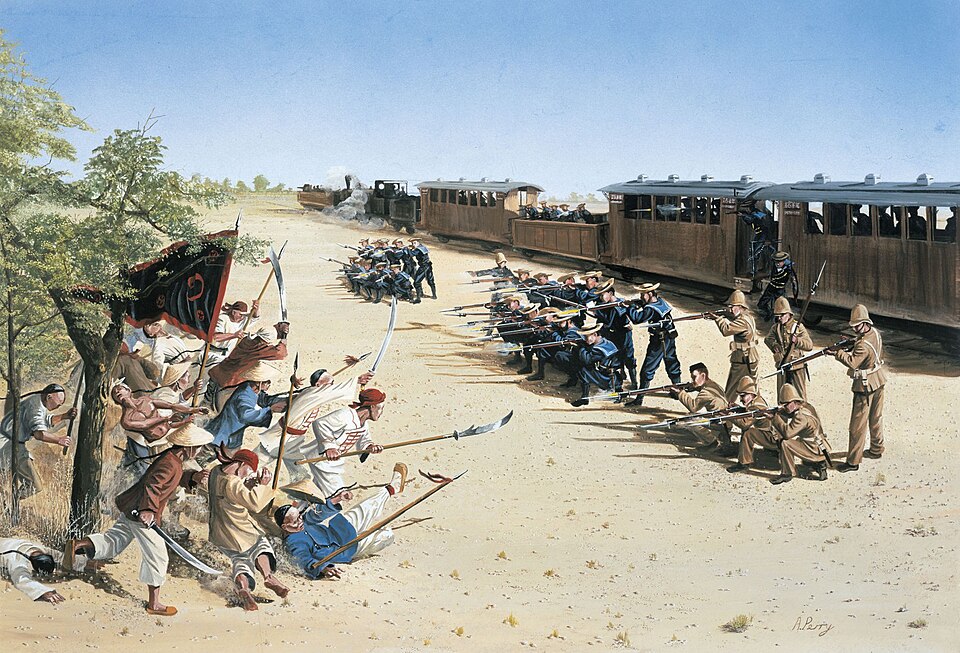
The Boxer Rebellion began as a grassroots movement in rural Shandong, where villagers faced natural disasters and foreign exploitation. In 1898, the Yellow River flooded and droughts devastated crops, pushing people to the brink. Many blamed these misfortunes on foreign influence, especially Christian missionaries who were seen as ignoring local customs and using their power to protect their followers in court. The Boxers, a group of martial artists and spiritualists, emerged as a symbol of resistance, promising protection through their rituals and martial skills.
Beginning in 1899, the movement spread across Shandong and the North China Plain, destroying foreign property such as railroads and attacking Chinese Christians and missionaries. The Boxers' belief in their own invulnerability to foreign weapons fueled their attacks. Events came to a head in June 1900, when Boxer fighters converged on Beijing under the slogan 'Support the Qing government and destroy the foreigners.' Some Chinese Christians were also targeted, seen as collaborators with foreign powers.
Diplomats, missionaries, soldiers, and some Chinese Christians took refuge in the Legation Quarter, which the Boxers besieged. The Eight-Nation Alliance—comprising American, Austro-Hungarian, British, French, German, Italian, Japanese, and Russian troops—invaded China to lift the siege, and on June 17, stormed the Dagu Fort at Tianjin. Empress Dowager Cixi, initially hesitant, then endorsed the Boxers, and on June 21 issued an imperial decree that amounted to a declaration of war on the invading powers.
Chinese officialdom split between those supporting the Boxers and those favoring conciliation, led by Prince Qing. Officials in the southern provinces ignored the imperial order to fight the foreigners. The Eight-Nation Alliance, after initially being repelled by Chinese forces and Boxer militia, brought 20,000 armed troops into China. They defeated the Imperial Army at Tianjin and arrived in Beijing on August 14, ending the 55-day Siege of the International Legations.
The capture of Beijing was followed by plunder and looting of the capital and surrounding countryside, along with summary executions of those suspected of being Boxers in retribution. The Boxers, once seen by many as heroes and protectors, were now hunted down. The violence and disorder that followed the alliance's victory left deep scars across the region.
More from History

The Morning Bingham Climbed to Machu Picchu
On a cold July morning in 1911, an American historian scrambled up a jungle-choked ridge above the Urubamba River — and by afternoon, a forgotten Inca citadel would belong to the world.

The Last Half-Hour of the Hindenburg
It was already half a day late, and the public had been told to keep away — but at seven o'clock that evening, the Hindenburg finally turned toward its mooring mast for the last time.

The Last Hours of Pompeii: August 24, 79 AD
By noon it was just another hot day beside the Bay of Naples. By evening, an entire mountain had rewritten the fate of thousands.

The Longest Walk: Mandela's Last Steps to Freedom
After 27 years behind bars, a 71-year-old man had to relearn how to walk out of a prison gate — into a waiting world of cameras, crowds, and a country holding its breath.

The Document Lincoln Signed on the First Day of 1863
On a single January morning, a president's pen would change the legal status of more than three million people — if the ink held and his hand did not shake.

The Day of the Dream: August 28, 1963
Two hundred and fifty thousand people converged on the National Mall that morning — by nightfall, one voice from the steps of the Lincoln Memorial would echo for generations.