The Bridge Built of Air
For fifteen months, a plane touched down in West Berlin every thirty seconds — not carrying soldiers, but coal and candy.
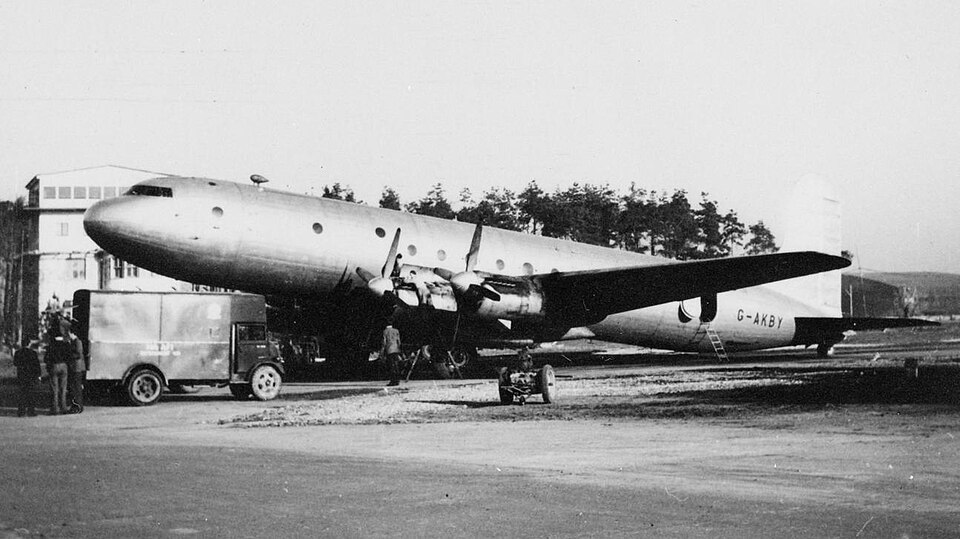
On 24 June 1948, the Soviet Union severed every railway, road, and canal link between West Germany and the western sectors of Berlin. It was a city stranded 100 miles inside Soviet-controlled territory, divided among four occupying powers since the Potsdam Agreement of 1945, and now Moscow intended to starve the western half into submission unless the Allies withdrew the newly introduced Deutsche Mark. Berlin's prewar population of 4.3 million had already been battered down to 2.8 million by war; now its western residents faced a winter with no coal, no food, and no way in by land.
The Western Allies had one narrow legal foothold: a 1945 agreement granting three 20-mile-wide air corridors between West Germany and Berlin. On 26 June 1948, American and British aircraft began flying in on those corridors, launching what the Germans would call the Berliner Luftbrücke — the Berlin Air Bridge. It was an improvised answer to a deliberate siege, an attempt to keep over two million people alive using nothing but propeller planes and pilots' nerve.
The scale required became almost unimaginable. American and British air forces flew more than 200,000 landings into Berlin, delivering roughly 13,000 tons of food, fuel, and other necessities every single day. Workhorse aircraft like the C-47 and C-54 Skymaster, alongside British Handley Page Haltons and Short Sunderland flying boats, formed a relentless conveyor belt across the sky. At the operation's peak, a plane landed in West Berlin every thirty seconds.
Crews from beyond Britain and America joined the effort — Canadian, Australian, New Zealand, and South African airmen flew alongside the RAF, while French aircraft supplied their own garrison. Together, American C-47s and C-54s alone logged over 92 million miles, nearly the distance from Earth to the Sun, ferrying supplies across a corridor the Soviets could have shot down at any moment but never did.
Amid the grinding logistics came an unexpected softness: Operation Little Vittles, in which pilots dropped candy by parachute to children waiting below. These aircraft earned the nickname 'raisin bombers,' and the gesture won enormous goodwill among Berliners who watched their occupiers-turned-protectors toss sweets from the sky.
More from History

The Morning Bingham Climbed to Machu Picchu
On a cold July morning in 1911, an American historian scrambled up a jungle-choked ridge above the Urubamba River — and by afternoon, a forgotten Inca citadel would belong to the world.

The Last Half-Hour of the Hindenburg
It was already half a day late, and the public had been told to keep away — but at seven o'clock that evening, the Hindenburg finally turned toward its mooring mast for the last time.

The Last Hours of Pompeii: August 24, 79 AD
By noon it was just another hot day beside the Bay of Naples. By evening, an entire mountain had rewritten the fate of thousands.

The Longest Walk: Mandela's Last Steps to Freedom
After 27 years behind bars, a 71-year-old man had to relearn how to walk out of a prison gate — into a waiting world of cameras, crowds, and a country holding its breath.

The Document Lincoln Signed on the First Day of 1863
On a single January morning, a president's pen would change the legal status of more than three million people — if the ink held and his hand did not shake.

The Day of the Dream: August 28, 1963
Two hundred and fifty thousand people converged on the National Mall that morning — by nightfall, one voice from the steps of the Lincoln Memorial would echo for generations.